

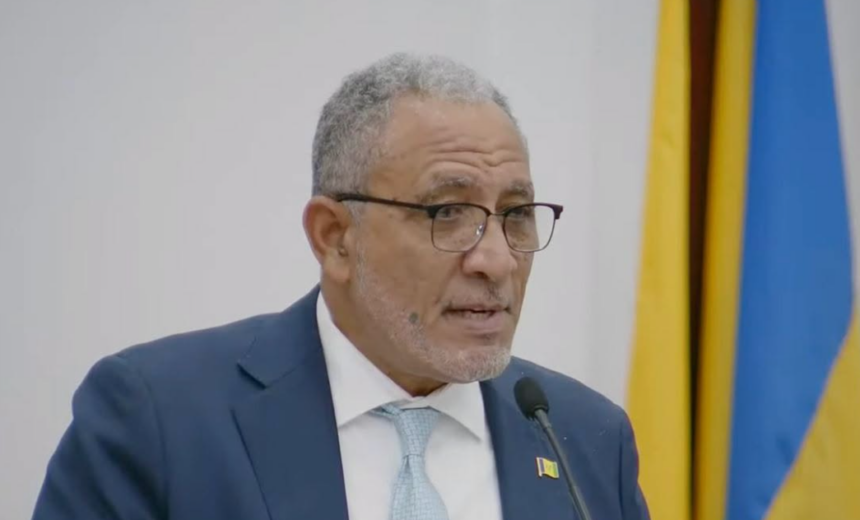
St. Vincent and the Grenadines must make a firm, national commitment to move aggressively away from fossil fuels toward renewable energy to protect the economy from recurring international market shocks, the Prime Minister announced in the House of Assembly.
Addressing Parliament on domestic energy costs, Prime Minister Godwin Friday emphasized that fuel price volatility, driven by the ongoing war in the Gulf, continues to strain state revenues, local businesses, and households.
The Prime Minister provided an update on electricity costs, informing Parliament that the fuel surcharge on October electricity bills from utility provider VINLEC rose by 7 cents to 86.71 cents per kilowatt-hour (kWh).
To cushion domestic consumers against market volatility, state intervention has kept electricity rates significantly below market costs:
Record Monthly Subsidy: Government support for electricity reached $798,591 for the month, its highest monthly level to date.
Unsubsidized Rate: Without state absorption, the fuel surcharge would have reached 92 cents per kWh.
Cumulative Relief: Since the introduction of cost-of-living cushioning measures in May 2026, state subsidies to VINLEC have totaled $3.9 million to prevent the full brunt of international oil price increases from reaching consumers.
In addition to electricity subsidies, the government maintains a 50% reduction in the excise tax across gasoline, diesel, and low-sulfur diesel to help keep pump prices suppressed.
Explaining the imperative for structural energy reform, the Prime Minister stressed that fossil fuel costs exert an inflationary pressure across the entire economy because fuel serves as the foundational input for all domestic production and commercial enterprise.
While calling on citizens to practice immediate energy conservation—such as walking where possible and reducing household electricity consumption—the Prime Minister declared that behavioral conservation alone is insufficient.
Transitioning away from imported oil and gas to renewable energy is essential to:
Shield the Nation from Future Shocks: Insulating the domestic economy from international oil price swings caused by geopolitical conflicts.
Stabilize Long-Term Energy Costs: Keeping power generation costs predictable and steady for consumers and businesses.
Protect the Environment: Fulfilling ecological responsibility by reducing carbon emissions.
Acknowledging that achieving energy independence requires genuine commitment rather than mere dialogue, the Prime Minister reiterated the government’s policy determination to execute the clean energy transition.
Concrete framework details and transition plans are set to be outlined in forthcoming official policy statements to Parliament.
