

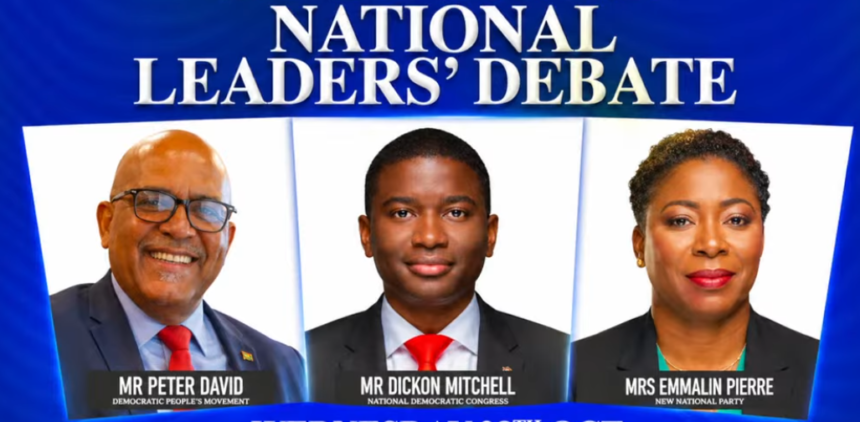
With just seven days remaining before Grenada’s national election on Nov. 6, 2026, the country’s top political leaders faced off in a historic televised debate at the Grenada Trade Center.
The event, titled Grenada’s Choice 2026: The National Leaders Debate, was organized by the Media Workers Association of Grenada (MWAG), the Grenada Broadcasting Network (GBN), and The Bubb Report, in partnership with the Grenada Conference of Churches. The debate brought together the three main political contenders on a single platform:
Prime Minister Dickon Mitchell, Political Leader of the governing National Democratic Congress (NDC);
Peter David, Founder and Political Leader of the Democratic People’s Movement (DPM) and MP for the Town of St. George;
Emmalin Pierre, Political Leader of the opposition New National Party (NNP).
Over two hours, the debaters traded sharp arguments across key national policy issues, including cost-of-living subsidies, healthcare infrastructure, housing delivery, foreign affairs, Citizenship by Investment (CBI), and offshore energy exploration.
Addressing high consumer prices and soaring electricity rates, Prime Minister Dickon Mitchell defended his administration’s fiscal interventions. Mitchell highlighted the government’s expanded electricity subsidy—which was raised from $10 to $50 for households consuming up to 200 kilowatt-hours—alongside designated VAT-free shopping days, expanded zero-rated items, and an increase in the statutory minimum wage from $700 to $1,200 per month.
DPM Leader Peter David criticized reliance on tax subsidies, characterizing them as temporary “bandages” rather than permanent solutions. David argued that sustainable relief requires boosting domestic food production to curb Grenada’s heavy food import bill, re-establishing the Marketing and National Importing Board (MNIB), and providing solar panels for residential homes.
NNP Leader Emmalin Pierre countered that immediate “bandages” are urgently needed for struggling families. She proposed removing specific levies—such as the sugar tax and water levy—reducing personal income taxes, and introducing targeted solar energy initiatives.
Healthcare emerged as one of the evening’s most contentious debates, focusing on Project Polaris—the government’s planned multi-year medical complex.
Pierre criticized the administration for prioritizing a multi-million-dollar hospital complex while local clinics suffer from basic supply and medication shortages. She pledged that an NNP government would prioritize primary healthcare within 30 minutes of every parish and accelerate National Health Insurance (NHI).
Mitchell rejected the framing, asserting that modern healthcare must address complex diseases such as cancer, cardiac conditions, and kidney failure through state-of-the-art facilities. He clarified that the hospital will occupy 15 acres of an 84-acre state-owned site, with the remainder dedicated to private medical tourism. Mitchell added that baseline studies for NHI have been commissioned to align with the hospital’s opening.
David called for a national reset and broader public consultation on Project Polaris, citing uncertainty over its construction timeline and financing, while emphasizing the need for immediate community polyclinics and mobile medical units.
On housing, David outlined the DPM’s proposal to establish a state fund providing first-time home buyers with grants of $35,000 for individuals and $50,000 for couples to cover bank mortgage deposits.
Pierre advocated for a “rent-to-own” initiative and criticized the government for delays in distributing over 600 Chinese-donated housing units, such as those in St. Mark’s.
Mitchell defended his administration’s record, stating that the NDC government has built over 1,000 new homes, repaired 2,450 residences, and constructed 1,360 sanitation facilities at a total cost of $79 million. He explained that selling Chinese-donated apartment units at subsidized rates ($45,000 for single units, $75,000 for doubles) under Homeowners Associations provides a far more financially sustainable model than unmaintained rental properties.
Addressing widespread labor shortages in construction, trade, and technical sectors, David called for a fundamental reorientation of the national education system toward vocational trades to retain local talent.
Pierre pointed out that despite thousands receiving Caribbean Vocational Qualifications (CVQs), major local construction projects still rely heavily on foreign workers. She accused the administration of stalling technical centers of excellence.
Mitchell announced structural education reforms to integrate Technical and Vocational Education and Training (TVET) directly into primary schools, alongside new centers of excellence for marine studies, hospitality, and construction. He confirmed that the Maruba Farm School in St. Andrew will reopen in January with an initial intake of 60 secondary students.
Regarding the Eastern Caribbean’s Citizenship by Investment (CBI) programs and European Union pressure to phase them out by June 1, 2028, Mitchell clarified that CBI accounts for approximately 12% of government revenue. He highlighted regional regulatory reforms—including establishing the Eastern Caribbean CBI Regulatory Authority in Grenada and implementing biometric screening with U.S. cooperation—while confirming ongoing negotiations with the EU for extensions or compensatory fiscal support.
David and Pierre both stressed the need to reinvest CBI revenues into long-term productive sectors like agriculture, digital technology, and tourism rather than recurrent expenditure.
On foreign policy, Mitchell reaffirmed that his administration operates on the core principle of “putting the people of Grenada first” when balancing traditional security ties with the United States and diplomatic partnerships with Cuba and Venezuela.
Responding to questions regarding the recent termination of Grenada’s agreement with Global Petroleum Group (GPG), Mitchell stated that the cancellation followed a lack of commercial yield. He explained that the government will establish an updated regulatory and licensing framework to invite international companies to bid on offshore blocks and assume drilling capital risks.
Pierre criticized the administration for spending $11 million on an oil and gas committee while failing to appoint an energy minister, warning that contract cancellations risk costly international litigation. David urged caution, noting that offshore hydrocarbon ventures carry financial and environmental risks that require careful long-term assessment.
In their closing remarks, all three leaders made their final appeals to electors ahead of the Nov. 6 poll:
Prime Minister Dickon Mitchell (NDC) asked voters for a second mandate to build upon ongoing reforms under the campaign theme “You, Me, Us: Ready for More”.
Peter David (DPM) called for constitutional reform and constituency accountability councils to move past partisan division under the banner “Move Forward Together”.
Emmalin Pierre (NNP) promised a “Better Grenada Plan” prioritizing cost-of-living relief, economic unity, and institutional integrity.
