
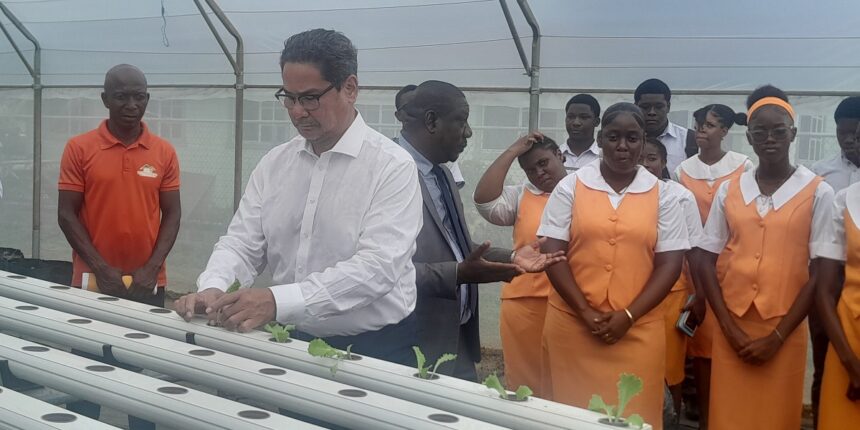
Students pursuing technical and vocational education in St. Vincent and the Grenadines now have greater access to modern agricultural technology following the handover of a complete greenhouse and Nutrient Film Technique (NFT) hydroponic system to the St. Vincent and the Grenadines Community College.
The facility, located at the College’s Technical and Vocational Education and Training Division, was officially handed over on Wednesday, November 4, as part of an initiative supported by the Food and Agriculture Organization of the United Nations (FAO) in partnership with the Government of St. Vincent and the Grenadines.
The investment is being implemented under FAO’s Technical Cooperation Programme project, TCP/SVG/4001 – “Building Effective Public-Private Partnerships for Production and Marketing of Sustainable Agricultural Products.”
The new greenhouse and hydroponic system is expected to serve as a practical learning facility, allowing students to move beyond the classroom and gain hands-on experience in protected agriculture and modern crop-production technologies.
It also represents a potentially important investment in the future of agriculture, particularly at a time when the country is seeking to encourage greater youth participation, improve productivity and strengthen the commercial viability and resilience of local food production.
NFT hydroponics allows crops to be produced without conventional soil cultivation. Instead, plant roots receive water and nutrients through a controlled circulating system, allowing producers to manage growing conditions more precisely.
For students, the technology provides exposure to an increasingly important approach to agricultural production and an opportunity to develop practical skills that can be transferred into employment, entrepreneurship and commercial farming.
The handover comes during an FAO technical mission to St. Vincent and the Grenadines from November 2 to 6, involving specialists in greenhouse production and agricultural value-chain development.
The visiting team includes Greenhouse Specialist Jervis Rowe, along with value-chain specialists Dr. Omardath Maharaj, Juan Cheaz and Jefferson Jaikissoon.
But the week’s activities extend well beyond the handover.
FAO specialists are working with the Ministry of Agriculture and local stakeholders on several areas intended to strengthen the country’s agricultural value chains.
These include technical training in greenhouse operation, nutrient and water management, system sanitation and maintenance, as well as enterprise development, partnerships, contract farming and cost-of-production analysis.
The project is also examining how farmers can become more competitive by understanding their actual production costs, break-even points and appropriate selling prices, an area considered critical to transforming farming from primarily a production activity into a sustainable business.
Hot pepper farmers participating in the programme are also being visited during the mission, with the technical team assessing crop establishment, irrigation and fertigation, pest and disease challenges, input use, production constraints and marketing arrangements.
Work is continuing in the coconut sector as well, including propagation, nursery management, farmer identification and plans for field establishment.
Farmers in Bequia are also expected to benefit from training in protected agriculture, contract farming, partnerships for market-oriented production and farm competitiveness.
The Community College investment, however, puts education and young people directly into that broader agricultural transformation.
Rather than students learning about new agricultural technologies only in theory, the greenhouse and NFT system provide an environment in which they can see, operate and understand the technology firsthand.
It also strengthens the connection between technical education, agriculture and entrepreneurship, potentially giving young Vincentians another pathway into an agricultural sector that is becoming increasingly dependent on technology, business skills and efficient use of resources.
The handover brought together representatives of FAO, the Ministry responsible for Agriculture, the St. Vincent and the Grenadines Community College and other project partners.
The initiative forms part of a broader effort by FAO and the Government to build agricultural value chains that are more productive, competitive, sustainable and market-oriented, while developing the technical skills necessary to support that transition.
With the greenhouse and hydroponic system now available to the Community College, the investment is expected to continue paying dividends beyond Wednesday’s ribbon-cutting, through the students who will train there, the skills they acquire and, ultimately, the farms and agricultural enterprises they may establish or support.