

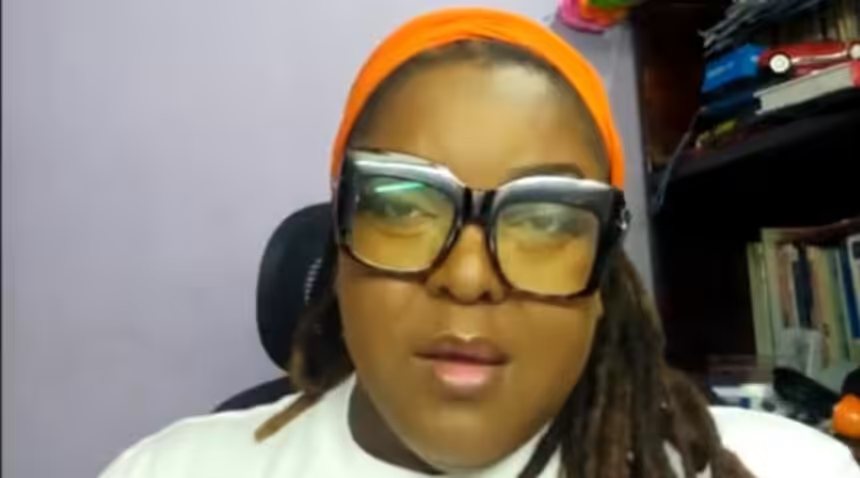
To the public and radio commentators celebrating the legal collapse of a protracted criminal prosecution, Vincentian educator Adriana King was supposedly a free woman. But when King logged onto social media on Friday morning and saw her name broadcast across a live radio stream beneath the triumphant caption “Adriana King ‘freed’,” she did not feel relief or closure.
Calling live into Hot 97.1 SVG’s morning programme, King directly challenged the celebration, offering an unsparing account of why the state’s procedural retreat does not equate to freedom. For King, the end of the court case brings neither an affirmative exoneration nor an end to the psychological, financial, and professional trauma inflicted on her family since August 2021.
“It’s strange that people are using that word—that it’s done, it’s over,” King told hosts Luke and Chris during her live telephone intervention. “I saw your caption when I logged on to Facebook, and that’s why I jumped on the live, because I was like: ‘Adriana King freed.’ I don’t feel that. I don’t feel freedom. I don’t feel a sense that things are over. I guess when you have been in survival mode, in combat mode for so long, it probably would take me a while before I could register that things are changing, because I honestly don’t feel as if a change is here.”
Her intervention transformed a routine morning broadcast into a searching examination of state prosecutorial overreach, the limits of procedural dismissals, and the enduring human toll exacted on public sector workers who challenged government policy.
At the heart of King’s refusal to celebrate is the critical legal distinction between an aborted prosecution and a definitive verdict of innocence. The case against King had initially been stayed on May 28, 2024, by Magistrate John Ballah, who permanently halted the proceedings. However, the state appealed that dismissal, and the Court of Appeal recently overturned the magistrate’s order, granting prosecutors the procedural right to proceed to trial.
Yet, immediately upon securing that appellate ruling, the Office of the Director of Public Prosecutions (DPP) informed the court that it possessed no interest in actually prosecuting King. Prosecutors claimed they had pursued the appeal solely to settle a “point of law” and establish judicial precedent. The matter is now slated to be returned to the Magistrate’s Court for the formal entry of a nolle prosequi—the state’s formal discontinuance of criminal charges.
For King, this procedural mechanism operates as an evasion of accountability rather than justice, leaving an indelible cloud of suspicion over her name.
“There are still people who speak as if I actually did something,” King stated, reiterating concerns she had raised with local press following the appellate ruling. “When a matter is nolle prosequi, as they say, you don’t have that. It’s not like if I’m innocent, not to say I fought the case—it’s like you did me a favor.”
King emphasized that rather than a quiet discontinuance, she wanted a full, open trial where state witnesses would be forced to testify under oath. Specifically, she wanted the prosecution’s primary witness—then-Assistant Superintendent of Police and current Commissioner of Police Trevor “Buju” Bailey—to face cross-examination.
“I would have preferred we have a trial,” King explained. “Buju takes the stand, he explains what he saw—even though he and I were at the same place on that day, which is in front of the prison’s gate while the Prime Minister was entering Parliament—and let him say exactly what he has in the witness statement, so that he could be examined by my counsel, who could then establish: ‘No, this did not happen.’ Everybody on this live knows that what I’ve been accused of didn’t happen. It didn’t. But there’s still people who are… and plus, of course, you’re thinking now at some point I might want to migrate, to be somewhere else, to start over. There is this trailing behind me, and it’s left to people to assume whether or not I did or I didn’t.”
The criminal case arose from the mass civil unrest of August 2021, when hundreds of citizens and public sector employees demonstrated in Kingstown against proposed legislation mandating COVID-19 vaccinations for public workers—a policy later passed into law. Amid the street protests, King was arrested and accused of attempting to block then-Prime Minister Dr. Ralph Gonsalves from entering the Parliament building.
From the beginning, the premise of the charge was met with public derision. On air, the radio hosts openly mocked the logistics of the state’s allegation, questioning how a single female teacher could physically obstruct a prime minister moving with an armed security detail and an entire police escort. “What kind of vitamins you been taking girl? You alone stop a whole barracks?” host Luke quipped during the call, highlighting the physical impossibility at the center of the prosecution.
King recounted how the state repeatedly modified and weakened the formal charges across several years in an effort to keep the case alive:
Initial Charge: Formally accused of directly blocking Prime Minister Ralph Gonsalves from entering Parliament.
First Revision: Altered to alleging that King performed “something to block him” from entering the legislative chamber.
Second Revision: Watered down further to asserting that King did “something that could have led to him being blocked” from Parliament.
King stressed that prosecutors had “absolutely nothing to present to the magistrate” other than Bailey’s lone witness statement, noting that despite that statement, the state felt compelled to constantly reword the offense. Listeners and callers noted that the female Director of Public Prosecutions who oversaw the prolonged action had since resigned from office, underscoring broader community demands for institutional accountability.
While the legal proceedings stalled in procedural maneuvers, the state imposed immediate administrative penalties outside the courtroom. Following her arrest, King was placed on official interdiction from the national teaching service.
Under interdiction, King was removed from her classroom and her salary was slashed to half-pay. The loss of income triggered years of severe household austerity, made particularly painful by her responsibilities as a mother providing specialized care.
“I was on half-pay. Let me put it this way: I literally, for about a year and some, wore a single slipper—literally, I mean everywhere—until that just went down to nothing, and then I got another one,” King recounted. “Because for me, it was always making sure that my daughter had what she needed. She’s on the autism spectrum, so she needs other things that neurotypical children might not need. And so it was always to sacrifice to get her that, make sure she has what she needed. It was an anguish.”
The conditions of interdiction also stripped King of fundamental freedom of movement. Under government regulations, she was barred from traveling outside St. Vincent and the Grenadines without formal permission from the very authorities prosecuting her.
“I couldn’t travel,” King pointed out. “They didn’t take my documents, but part of interdiction is that you are not allowed to travel. You have to ask the same people who have you on interdiction for permission to travel.”
Although broadcast commentators noted that King received her full salary and outstanding arrears around April 2026 under a new political administration, financial restitution did not erase the psychological toll of half a decade of enforced marginalization.
When asked whether she plans to return to the public school system now that the prosecution has been abandoned, King stated unequivocally that she has no desire to re-enter the traditional classroom, rejecting the premise of going backward. While she continues to educate students through private online tutoring, she views stepping back into her former teaching post as a continuation of her punishment.
“To be honest, I would rather not go back to the classroom,” King stated. “And just for that word—that phrase ‘go back’—I’ve been saying to people: I think I have been through enough. I have sacrificed enough. I have been tormented enough. And there are people now who are enjoying a better life, a better job, a better everything because of what I had to go through and others. And so I think it would be really unfair to send me backwards, if you catch where I’m coming from. I’m using a literal interpretation of the word ‘go back.’ My career then, five or six years ago—had all of this not happened, I’m certain I would have been in a far better position today. So to go back, to me, would be further punishment, further abuse.”
Rather than succumbing to stagnation during her years on interdiction, King invested heavily in professional development and curriculum development:
Textbook Authorship: King contributed directly to national pedagogy by writing an English textbook for Vincentian schools.
Human Resource Management: She earned a professional certification in Human Resource Management from the University of the West Indies.
Health and Safety Studies: She is currently pursuing certification in Occupational Health and Safety.
Despite the years of administrative torment and public suspicion, King insisted that her pursuit of justice is not driven by personal malice or vengeance against former officials or prosecutors. Instead, she framed her case as an essential matter of civic principle and democratic hygiene for St. Vincent and the Grenadines.
“I don’t have any bitterness,” King explained. “I just hope that people could understand these sort of things are not right. You’re not supposed to be prosecuting somebody innocently, and people defend that and say, ‘You know, that’s okay.’ You shouldn’t ever accept these things. I don’t feel any bitterness; I just believe that we as Vincentians, we need to hold those in authority accountable for the things that they’ve done. It’s not a matter of being bitter, but if you pick someone, then you should be expected to say sorry, and at least to show that you’re sorry.”
King confirmed that she plans to consult with legal counsel to evaluate her options for civil redress and compensation for the damages she sustained.
When morning host Luke urged her to take comfort in the fact that the legal battle is formally over and that she can now move forward, King acknowledged that the emotional aftermath will take time to process. “I think when it really hits me, I will sit down and have a good bawl,” she said. Until that day arrives, King remains determined to challenge the easy assumption that dropping a wrongful charge is the same as being set free.
