

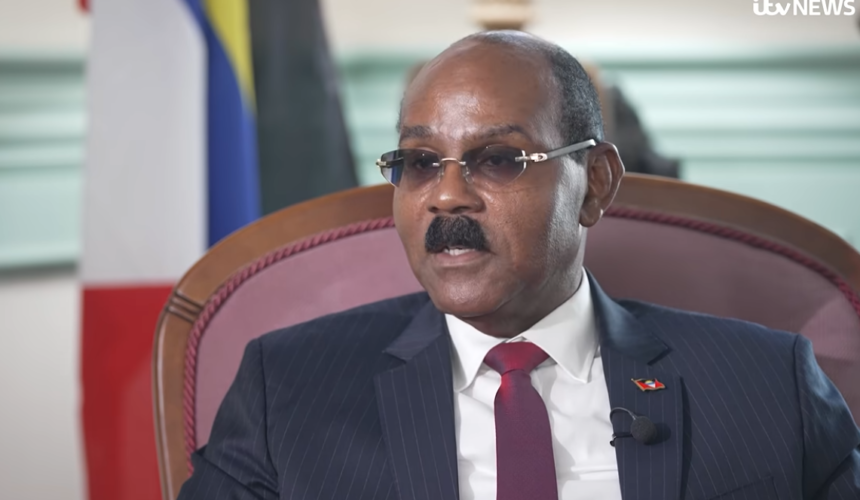
In a definitive challenge to British foreign policy ahead of the Commonwealth summit, Antigua and Barbuda’s Prime Minister Gaston Browne has articulated an uncompromising case for transatlantic slavery reparations, warning that the United Kingdom’s reluctance to provide financial restitution threatens to normalize historical atrocities and embolden modern state brutality worldwide.
Speaking in an extended diplomatic interview with ITV News, the veteran Caribbean leader dismantled conventional defenses used by former imperial powers to evade colonial restitution. Rather than framing reparations as a punitive levy or an exercise in historical grievance, Browne presented reparatory justice as a cornerstone of international law, an economic debt rooted in centuries of uncompensated labor, and a vital modern deterrent against escalating international aggression.
His intervention sharpens the political lines between Caribbean leaders demanding systemic redress and a British political establishment divided over how to confront its imperial past. While welcoming British Prime Minister Andy Burnham’s willingness to engage in structured talks regarding a formal state apology, Browne made clear that diplomatic remorse alone cannot resolve the lasting economic damages inflicted by chattel slavery.
At the core of Prime Minister Browne’s argument is what he characterizes as the global deterrence doctrine. Rejecting the view that transatlantic slavery is merely a closed historical chapter, Browne contends that exempting former colonial powers from financial restitution creates a dangerous global precedent that signals to modern autocrats that state-sponsored atrocities carry no lasting penalties.
Browne pointed directly to the current fracturing of international norms and the rise of unprovoked state aggression, citing the war in Ukraine as evidence of a more brutal global environment. In Browne’s assessment, when powerful states commit historic crimes and escape restitution simply through the passage of time, future regimes are taught that generational turnover provides an inevitable shield against legal and financial accountability.
“If there is not some form of compensation and even liability for future generations, present generations will commit these atrocities thinking that all that is necessary to resolve the issue is for a new generation to come into being. That in itself will not be a deterrent; if anything, that will encourage future human atrocities.”
To underscore the historical reality behind the legal claim, Browne placed chattel slavery within the architecture of international human rights, emphasizing that the United Nations formally recognizes the transatlantic slave trade as the most heinous crime committed against humanity. Browne detailed the extreme brutality of the system: four hundred years during which millions of African men, women, and children were classified as legal chattels, subjected to torture including being broken on the wheel, thrown overboard during the Middle Passage, and denied compensation while building European imperial wealth.
To ground this legal appeal, Browne invoked an evolutionary perspective, arguing that humanity’s common scientific origin demands mutual empathy and reconciliation:
A Shared Biological Lineage: Scientific evidence indicates that the entire human family traces its ancestry to a common mitochondrial lineage in Africa approximately 250,000 years ago, demonstrating that racial subjugation was an artificial construct imposed upon a single human family.
Universal Standards of Justice: Because all nations belong to the same human family, colonial atrocities cannot be dismissed as standard historical practice exempt from universal standards of restitution.
Preventing Future Repetition: Enforcing meaningful liability for historic crimes serves as a practical deterrent, warning modern military powers that the economic exploitation of conquered populations incurs permanent, legally enforceable debts.
A central pillar of British political resistance has been the argument that contemporary UK taxpayers cannot be held responsible for wrongs perpetrated centuries ago by prior generations. Browne met this defense head-on, identifying a profound moral and legal contradiction in the British stance: modern societies enthusiastically embrace inherited colonial wealth while disavowing the unliquidated liabilities created by the system that produced it.
Browne detailed how centuries of unpaid African labor in the Caribbean served as the primary capital base for British industrial development. The massive wealth extracted from Caribbean sugar plantations was systematically repatriated to Britain and North America, financing civic infrastructure, commercial banking systems, global trading empires, and higher education institutions that continue to generate prosperity today.
The Principle of Asymmetric Inheritance: Modern states cannot legitimately claim the accumulated institutional and financial capital of empire while disclaiming the legal and moral liabilities incurred to produce that capital. Inheriting the benefits of colonial extraction binds the inheritor to its corresponding debts.
The Prime Minister emphasized that Caribbean nations were left at independence with severely underdeveloped domestic infrastructure, structural poverty, and fragile fiscal systems directly resulting from centuries of colonial extraction. The ongoing economic hurdles faced by Caribbean small-island developing states, he observed, represent the direct structural legacy of uncompensated wealth extraction.
For Browne, the financial and moral reality is straightforward: Britain cannot enjoy the compound returns of chattel slavery while treating the descendants of its victims as strangers to the imperial balance sheet. Those who enjoy the assets of empire inevitably carry the obligation to address its unresolved burdens.
Mindful of domestic political realities in London—where critics cite Britain’s £3 trillion national debt, strained public health services, and crumbling domestic infrastructure—Browne presented a pragmatic, non-punitive financing model designed to avoid imposing new tax burdens on British citizens.
Rather than demanding immediate, multi-billion-pound cash payments from the British Treasury, the Prime Minister proposed a structured, long-term reallocation of existing British overseas spending. Specifically, Browne called on the UK government to redirect a portion of its existing Official Development Assistance (ODA) budget into dedicated Caribbean developmental investments.
The following comparative breakdown contrasts traditional reparations demands with Browne’s negotiated development framework:
| Dimension | Conventional Reparations Model | Browne’s ODA Realignment Blueprint |
|---|---|---|
| Fiscal Mechanism | Direct, newly appropriated cash transfers from the UK Treasury | Partial reallocation of existing foreign aid and ODA budgets already authorized by Parliament |
| Domestic Impact | Requires additional British borrowing or domestic tax increases amid public austerity | Generates zero net increase to the British national debt or domestic spending limits |
| Capital Allocation | Unrestricted budgetary cash payouts | Targeted capital investment in Caribbean regional infrastructure, climate adaptation, and education |
| Sovereign Debt | Unconnected to sovereign debt burdens | Integrates systematic debt restructuring and relief for vulnerable small-island economies |
| Diplomatic Framing | Insistence on adversarial litigation and formal damages | Flexible diplomatic mechanisms focused on long-term developmental transformation |
Browne reiterated that Caribbean nations are not seeking handouts or charity. Instead, the proposal establishes an institutional framework to address the structural underdevelopment inherited from the colonial era through predictable, targeted developmental financing.
“We are not coming cap in hand begging, and we are not going to make any unreasonable demands,” Browne affirmed. “You have an ODA budget, and a portion of it can be allocated towards developmental support for Caribbean countries. You don’t have to call it reparations, but there has to be a systematic program of funding to deal with the issues of underdevelopment that Britain has left us over the decades.”
Browne’s statements underscore a widening fissure within British politics over how to respond to Commonwealth calls for historic justice. The Prime Minister drew a sharp contrast between Prime Minister Andy Burnham’s constructive diplomatic posture and the outright rejection voiced by Conservative opposition leader Kemi Badenoch.
Browne commended Burnham for exhibiting diplomatic courage by signaling openness to working toward a formal British state apology during bilateral talks at the Commonwealth heads of government summit. Describing Burnham’s stance as a “breath of fresh air,” Browne recognized the domestic political constraints facing Downing Street and credited the Prime Minister with engaging in serious dialogue where prior administrations maintained rigid opposition.
However, Browne emphasized that formal expressions of regret must serve as the foundation of an inclusive, structured, and time-bound process rather than an end in themselves:
Constructive Engagement: Reassurance that Caribbean leaders will conduct summit negotiations with maturity, dignity, and grace, fostering dialogue rather than hostility.
Structured, Time-Bound Dialogue: Insistence that bilateral talks adhere to concrete timetables to ensure discussions lead to actionable development agreements rather than perpetual delays.
Concrete Goodwill: A direct invitation for Downing Street to demonstrate good faith by announcing an initial Caribbean development assistance package during the Commonwealth gathering.
In sharp contrast, Browne delivered an uncompromising rebuke of Conservative opposition leader Kemi Badenoch, who publicly criticized Burnham’s openness to an apology by arguing that “the time for apologizing is over” and asserting that apologies merely open the door to financial compensation. Badenoch maintained that historical sorrow was sufficient and that modern Britain should move on.
Browne dismissed Badenoch’s position as fundamentally misguided and completely out of step with the magnitude of the atrocities committed under British colonial rule:
“I think she’s misguided, and no wonder she is the leader of the opposition and not the prime minister. Some of the most heinous crimes were ever committed against humanity, and they don’t see the need for an apology and for restitution. If I had a relative that committed those crimes, I would feel ashamed and condemn that behavior. I don’t see how anyone can feel proud about atrocities where millions of human lives were destroyed.”
Browne concluded that durable diplomatic reconciliation between Britain and the Caribbean cannot be achieved through historical denial or unilateral declarations that the past is resolved. By connecting historical accountability directly to modern developmental finance, Antigua and Barbuda’s Prime Minister has positioned reparatory justice at the center of the Commonwealth agenda, requiring modern Britain to reckon with both the source of its prosperity and the unfinished business of its empire.
