
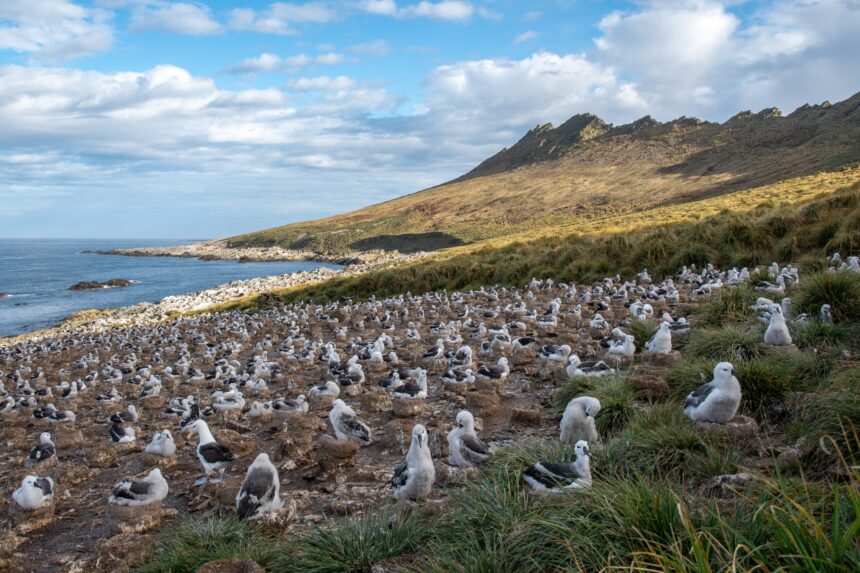
The Question of the Malvinas Islands is a national cause for the Argentine people. The defence of this cause requires that we act with the determination demanded of us by the force of our Constitution and the sacred significance of this quest. Today, that responsibility calls on us to confront a threat posed by two companies and a planned programme of operations. The British company Rockhopper Exploration and the Israeli company Navitas Petroleum intend to extract oil from the North Malvinas Basin through the so-called “Sea Lion” project, under illegal and illegitimate licences issued under the de facto authority exercised by the United Kingdom over our Islands.
Argentina has repeatedly protested against these unlawful activities. In recent months, the announcements made by the companies, their contracts and the drilling schedule have brought closer the start of a programme envisaging 35 years of production and 23 wells. Beneath the seabed of our country’s Continental Shelf lie reserves which, once extracted, will be lost for ever. Preserving them means defending the assets of all Argentines.
On 3 September, President Javier Milei announced, in a nationwide address, a comprehensive strategy to defend our rights and respond to this threat. His instruction was to deploy all available diplomatic and legal tools with the firmness that this cause demands. Accordingly, we are pursuing the goal of regaining the full exercise of our sovereignty over the Malvinas, South Georgias and South Sandwich Islands and the surrounding maritime areas.
The request submitted to the International Tribunal for the Law of the Sea is one more cog in the legal and diplomatic machinery that we have already set in motion, with a specific and immediate objective: to secure provisional measures to halt hydrocarbon exploitation under the Sea Lion project before it begins.
Argentina is grateful for the broad international support it has received. That support is the reasonable and expected response to the United Kingdom’s repeated unilateral actions, which aggravate the dispute as it systematically refuses to engage in dialogue. The international community calls for negotiations and peaceful solutions, not the infringement of sovereign rights or the illegitimate exploitation of natural resources.
This has been expressed by the United Nations General Assembly and its Special Committee on Decolonization (known as the C-24), the OAS, Mercosur, CELAC, LAIA, and the Group of 77 and China, among others. The Ibero-American Summit, held in Madrid on 4 and 5 November, renewed its call for negotiations and for refraining from adopting unilateral measures. Given the expansion of these illegal and illegitimate activities and the risk of irreversible harm, we decided to complement these diplomatic efforts with legal proceedings in order to safeguard our resources.
The Ministry of Foreign Affairs has taken steps to initiate these proceedings before the International Tribunal for the Law of the Sea as part of a strategy that we are also pursuing at the bilateral and multilateral levels. Preparing the case brought against the United Kingdom required months of coordinated work. At this stage, the Argentine Government’s legal team responsible for carrying out this task comprised Ambassador Mario Oyarzábal, Legal Adviser to the Ministry of Foreign Affairs; María Ibarzabal Murphy, Legal and Technical Secretary to the Office of the President; Deputy Treasury Attorney General Santiago Castro Videla, representing the Office of the Treasury Attorney General; Juan Ignacio Stampalija, Legal Secretary of the Ministry of Economy; and legal experts Marcelo Kohen, Nico Schrijver and Agustín Giustiniani.
Acting in time to defend our interests
On 28 September, we initiated arbitration against the United Kingdom. Both countries are parties to the United Nations Convention on the Law of the Sea and have accepted its mechanisms for the settlement of disputes. Annex VII sets out the procedure for constituting a tribunal comprising five independent arbitrators, which will examine the case and issue a decision that will be binding on both parties.
We chose this course of action in order to require the United Kingdom to fulfil its obligations in respect of the natural resources in the disputed maritime areas and to refrain from making unilateral modifications.
What will happen if activities continue while the tribunal is being constituted? The Convention allows either party to request provisional measures from the International Tribunal for the Law of the Sea, based in Hamburg, that is, urgent protection to prevent irreparable harm during that period.
We took that step on 13 October, after the United Kingdom refused to adopt the measures we had requested. Once constituted and in a position to act, the arbitral tribunal will be able to confirm, modify or revoke any measures that have been ordered.
The United Kingdom must be held accountable for its actions
At the hearings held on 10 and 11 November, we explained which rights are at risk, why they can be protected through these proceedings, and what irreparable harm could occur before the arbitrators are able to intervene. The United Kingdom challenged the tribunal’s jurisdiction, arguing that the case would require a determination of territorial sovereignty.
It is important for all Argentines to understand this distinction. The issue before the tribunal is what obligations the Convention on the Law of the Sea imposes on both States in the disputed maritime areas. A decision on the merits of the sovereignty dispute falls outside the scope of these proceedings. In order to resolve that dispute, United Nations General Assembly Resolutions 2065 (XX), 3160 (XXVIII), 31/49 and 37/9 reiterate the call on Argentina and the United Kingdom to negotiate a peaceful solution through diplomatic channels.
Is it necessary to resolve the sovereignty dispute first in order to prevent one of the parties from irreversibly altering the resources at issue? Our position is that the Convention allows those resources to be protected while the dispute remains pending. It recognizes rights over the seabed and subsoil, requires States to act in good faith and settle their differences through peaceful means, and requires them to protect the environment. Furthermore, United Nations General Assembly resolution 31/49 calls on both countries to refrain from introducing unilateral modifications while the decolonization process remains ongoing. The United Kingdom disregards this call and refuses to negotiate over sovereignty. At the same time, it is pursuing the unlawful and illegitimate exploitation of our resources as though the dispute had already been settled in its favour.
The British Government invoked the applicability of the right to self-determination to the current inhabitants of the Islands. Our delegation refuted this argument on the grounds that the Malvinas Islands remain on the United Nations list of non-self-governing territories, that the UN General Assembly has determined that decolonization must be achieved through the settlement of the sovereignty dispute between the two States, and that the self-organized referendum held in 2013 brought about no change to the situation.
The United Kingdom also argued that there was time to wait. It identified 21 March 2027 as the earliest date for new drilling operations and March 2028 for the commencement of hydrocarbon extraction. In its view, the arbitrators could take action before those operations began. We responded that experience from other cases shows that constituting an arbitral tribunal and ensuring that it is in a position to act can take several months.
A well, once drilled, leaves a permanent footprint on the subsoil, even if hydrocarbon extraction is not yet due to begin. Provisional measures are intended to prevent a fait accompli before the arbitral tribunal is in a position to act. The aim is to preserve what a subsequent decision will no longer be able to restore to its original state.
The risk also extends to the marine environment. The contingency plan of one of the companies itself considers that a spill originating from a well could reach Argentine waters outside the disputed area within 30 days. Argentina would have to deal with the consequences and coordinate the response to an activity it had not authorized. For this reason, we demanded information and cooperation in order to fulfil our obligations to protect and preserve the marine environment.
The United Kingdom also argued that the companies would suffer financial losses and that the inhabitants of the Malvinas Islands would lose future income. The companies assumed these risks in full knowledge of Argentina’s protests and the existence of the dispute. The public services and current living conditions of the inhabitants do not depend on production under the unlawful project. We have asked the judges to weigh those economic interests, insofar as they are relevant, against the risk of irreparable harm to Argentina’s rights.
Argentina has already taken action
On those grounds, we requested four provisional measures. The first would require the United Kingdom to take all necessary measures to prevent any further drilling for exploitation and any installation of production infrastructure in the North Malvinas Basin in connection with the so-called “Sea Lion” project, whether by the United Kingdom itself or by any individual or legal person under its jurisdiction or control.
We also requested that the United Kingdom refrain from using the information obtained in the exploration of natural resources of the disputed maritime areas to the detriment of the rights of the Argentine Republic. We further asked that it stop obstructing Argentina’s efforts to fulfil its obligations to protect and preserve the marine environment of those areas and refrain from taking any other measure that might aggravate the dispute, in particular the granting of new unlawful and illegitimate authorizations for the exploitation of resources of the disputed continental shelf.
The Tribunal has tentatively set 28 November as the date for announcing its decision on the request for provisional measures. We hope for a favourable ruling, confident in our arguments and with full respect for the independence of the judges.
In that ruling, the Tribunal will decide on the request for urgent protection at this stage. The international arbitration is already under way, and Argentina will continue to pursue every legal and diplomatic avenue available to it, with the same firmness and determination, whatever circumstances may arise.
In the meantime, we will continue issuing warnings to companies and governments, pursuing sanctions proceedings, and bringing criminal proceedings against the companies and their executives. Congress must therefore give priority to the National Sovereignty Defence Bill and move swiftly to debate and pass it. Passing the Bill will strengthen the tools available to the State to act with the determination we have shown in defending the rights of all Argentines.
Respect for our legislation and Argentina’s legitimate authorities also underpins our invitation to invest in mainland Argentina, where the increasing value of the country’s strategic assets is creating opportunities with clear rules and predictability.
For the first time in the history of the Question of the Malvinas Islands, Argentina has faced the United Kingdom directly before an international tribunal, with determination and professionalism. We will not stand idly by while others seek to appropriate our natural resources. Our firmness is not incompatible with peace: it is precisely our respect for the law and for dialogue that distinguishes us from those who seek to impose their will through faits accomplis. That is the instruction given by the Argentine President, and that is our commitment to our country.
As Foreign Minister, I wish to express my deepest appreciation to the legal team that represented Argentina at the hearings in Hamburg on 10 and 11 November. Those days were marked by total dedication, tireless work and an extraordinary commitment to our country. We are peacefully honouring the legacy of the Malvinas cause using the tools of international law. This team did so with courage, excellence and unwavering legal rigour, showing that Argentina can rise to the greatest challenges and that, when it comes to defending what is ours, we spare no effort.
We will pursue this defence through every avenue available under the law. The Argentine people have the law on their side and a Government determined to uphold it.
By history and by law, the Malvinas belong to Argentina.