

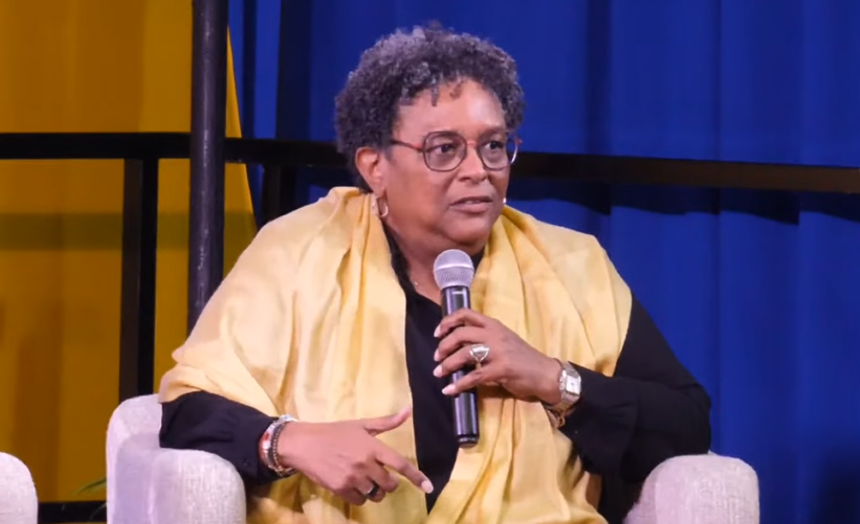
Barbados Prime Minister Mia Mottley delivered a passionate call for regional unity, personal accountability, and a fundamental shift in mindset to navigate what she described as unprecedented global turmoil and structural inequality.
Speaking at the National Library Service’s third lecture on “Leadership, Governance and the Caribbean Experience”—held during celebrations marking 60 years of Barbadian independence and five years as a republic—Prime Minister Mottley joined featured speaker Dr. Ralph Gonsalves to evaluate the region’s progress and outline the hurdles confronting small island developing states.
Reflecting on Caribbean political leadership, Prime Minister Mottley praised Dr. Gonsalves for combining academic scholarship with deep human compassion, emphasizing that leadership in the region must translate ideas into meaningful actions that improve daily lives. Mottley noted her own unique vantage point in Barbadian public life, having engaged with every prime minister in the island’s independent history across political lines. She articulated the core philosophy of her government as stopping poor people from being poor, fighting injustice, and expanding access to opportunity for those historically denied it. True societal transformation, she stressed, cannot occur through polite conversation alone; it demands scale and a tangible shift in human behavior.
Turning to global realities, the Barbadian leader warned that small island states face three overarching existential crises over the next decade to fifteen years. First, she highlighted a grave threat to national sovereignty and independence driven by the continuous breakdown of the international rules-based order, leaving small nations vulnerable without military backing. Second, she underscored the escalating climate and biodiversity crisis, reminding the audience that environmental destruction operates without geopolitical bias, hitting Caribbean shores with the same intensity as recent devastating floods in Georgia and Tennessee. Third, Mottley identified Artificial Intelligence as a potent “force multiplier” for small and middle-income states, while warning that without global guardrails, unmanaged technology threatens to pull humanity backward.
Addressing internal domestic challenges, Prime Minister Mottley contrasted the substantial public funds invested by Caribbean governments in free education, healthcare, and subsidized medications with the premature loss of human potential. She observed that state investments are frequently undermined by preventable tragedies, including road accidents, gun violence, and early-onset chronic non-communicable diseases such as type 2 diabetes among young adults.
Government policies alone, Mottley argued, cannot resolve these systemic issues. She urged citizens to reclaim personal responsibility for lifestyle choices, parenting, and moral grounding, cautioning that Western consumerism and hyper-individualism have eroded the Caribbean’s traditional commitment to the collective good. Drawing on recent analyses of international civil breakdown, she cautioned that a nation can only advance as far as its citizens are willing to commit through collective behavior and shared values.
Prime Minister Mottley launched a scathing critique of international double standards, arguing that global governance continues to view nations through a discriminatory prism of first-class and second-class citizenship. She pointed out that when the COVID-19 pandemic struck, wealthy G7 nations immediately resorted to quantitative easing and export restrictions—tactics they had long lectured developing countries to avoid. This hypocrisy, she asserted, has severely compromised the moral authority of the international order. Drawing parallels to global conflicts, rising populism, and economic divides, Mottley warned the audience that unless Caribbean citizens actively defend their interests, they risk walking willingly into modern forms of subjugation.
To counter external vulnerabilities, Prime Minister Mottley advocated for aggressive South-South cooperation, particularly by forging direct economic and cultural bridges with Global Africa. She highlighted ongoing partnerships, including the placement of over thirty Ethiopian doctors in Barbados, educational exchanges with Sierra Leone, and the establishment of the Afreximbank regional office in Bridgetown. Mottley questioned why the region continues to look exclusively to North Atlantic nations for capital and development finance, pointing to CARICOM’s $84 billion in private savings alongside Africa’s $4 trillion in savings—including $600 billion in pension funds—as untapped resources for joint capital markets.
Achieving true self-reliance, Mottley emphasized, requires dismantling colonial travel and trade routes, establishing direct flights and maritime links, and ensuring widespread bilingualism to connect with Latin American neighbors. Regionally, she called for CARICOM to deepen its legal personality at the United Nations, taking inspiration from how Europe consolidated its diplomatic voice through the Treaty of Lisbon.
Closing her remarks on domestic governance, Prime Minister Mottley rejected what she called the “politics of vilification” and personal destruction, advocating instead for a broad political tent that brings citizens together to confront external pressures. In response to concerns regarding election turnout, Mottley clarified that official voter registries across the region remain inflated by citizens living abroad, obscuring genuine civic participation among resident populations. Ultimately, she reminded the audience that the anniversary of independence is not merely a moment for celebration, but a vital call for gratitude, rigorous reflection, and renewed commitment to safeguarding Caribbean civilization.
