

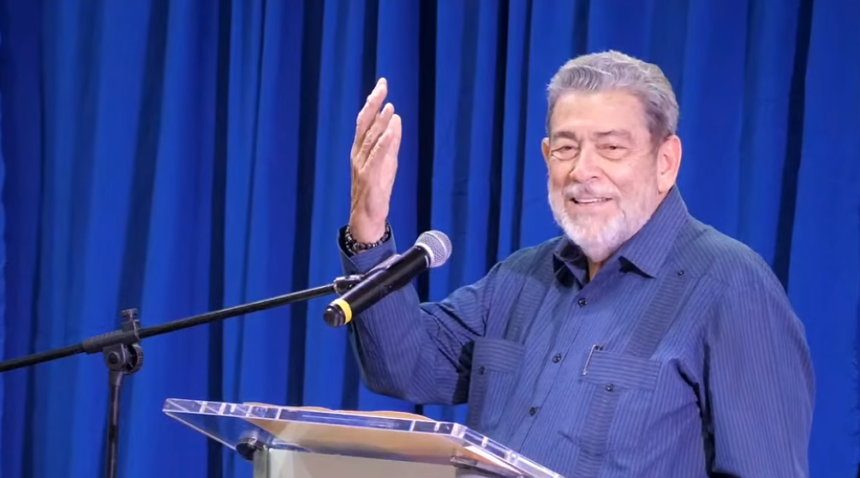
In a wide-ranging address reflecting on decades of Caribbean statecraft, former Prime Minister of St. Vincent and the Grenadines Dr. Ralph Gonsalves called on regional leaders to break decisively from inherited colonial economic models, embrace “small island exceptionalism,” and forge a unified front against accelerating global volatility. Delivering the third lecture in the National Library Service’s Series on Independence and Governance at the Lloyd Erskine Sandiford Centre, Dr. Gonsalves addressed a packed hall alongside Barbadian Prime Minister Mia Amore Mottley, framing the current era as a decisive test of Caribbean leadership, sovereignty, and social cohesion.
Set against the backdrop of Barbados celebrating 60 years of independence and five years as a republic, the 80-year-old veteran political leader delivered a lecture titled Leadership, Governance and the Caribbean Experience. Gonsalves argued that true Caribbean independence was never merely about taking administrative control of territory, but about accepting the ongoing responsibility to shape a self-determined destiny. He underscored that while 13 independent CARICOM member states have achieved high or very high levels on the United Nations Human Development Index despite historical disadvantages, sustaining those gains requires continuous structural transformation, disciplined governance, and unwavering commitment to reparatory justice.
Reflecting on his deep personal and political connections to Barbados, Dr. Gonsalves shared anecdotes illustrating the long-standing intellectual exchange across the Eastern Caribbean. He recalled meeting Prime Minister Mottley in 1979 when she was a 13-year-old student at a secondary school lecture in Barbados, where she peppered him with sharp questions and demanded his contact details. Years later, in October 1994, Gonsalves invited the then 29-year-old Mottley to deliver the feature address at the founding convention of the Unity Labour Party (ULP) in St. Vincent. Highlighting recent progress in regional integration, Gonsalves commended the full freedom of movement established between Barbados, St. Vincent and the Grenadines, Belize, and Dominica since late 2023, observing that citizens are actively contributing across borders without the economic instability critics had feared.
Rooting his vision of leadership in historical memory, Dr. Gonsalves recounted the fierce resistance of the indigenous Kalinago and Garifuna peoples of St. Vincent and the Grenadines, led by National Hero Right Excellent Joseph Chatoyer during a 30-year guerrilla war against British colonizers from 1764 to 1795. He connected this legacy of defiance to the historical migration of runaway enslaved Africans from Barbados to St. Vincent, as well as the tragic forced exile of 5,000 Garifuna to the island of Baliceaux and ultimately Central America. Rejecting contemporary claims by UK politicians such as Kemi Badenoch that European colonization benefited the region through institutional legacies like the common law and cricket, Gonsalves insisted that no administrative apparatus could compensate for native genocide and racialized chattel enslavement, reinforcing the imperative of European reparatory justice for enduring economic harm.
Drawing on political theory and West Indian intellectual tradition, Gonsalves invoked Karl Marx’s famous dictum from The 18th Brumaire of Louis Napoleon that men and women make their own history, but not under circumstances chosen by themselves. Expanding on insights from C.L.R. James and George Lamming, he observed that outstanding leaders are both products and agents of structural historical forces. Referencing C.L.R. James’s classic Beyond a Boundary and the legendary West Indies cricket captaincy of Sir Frank Worrell during the 1960–61 Australian tour, Gonsalves asserted that the supreme art of leadership lies not merely in inspiring followers or imposing authority, but in drawing out from people the inherent nobility, capability, and quality they do not yet realize they possess. He warned against the illusion of absolute personal power held by some leaders, arguing that leaders who believe they can shape events single-handedly exhibit a fundamental powerlessness that ultimately breeds institutional failure.
Addressing the region’s economic imperatives, Dr. Gonsalves outlined the necessary paradigm shift from an amended colonial economy—historically dependent on cheap labor, raw commodity export, and metropolitan dependence—to a sustainable, modern, competitive, and multi-sided post-colonial economy. This transformation, he explained, requires less concentrated ownership of production, market-priced skilled labor to stem brain drain in nursing and engineering, enhanced technological integration including artificial intelligence, robust environmental management, and an active state working in harmonious partnership with private and cooperative sectors.
Addressing the structural constraints of small population sizes and geographic limitations, Gonsalves drew on the economic literature of William Demas (Economics of Development in Small Countries), E.F. Schumacher (Small Is Beautiful), and his son Camilo Gonsalves (Globalized, Climatized, Stigmatized) to articulate the concept of “small island exceptionalism.” He cautioned international financial institutions against attempting to scale down continental economic models to fit small island developing states. Instead, he stressed that Caribbean nations face unique vulnerabilities to climate change, natural disasters, and global market shocks through no fault of their own, often forcing governments into an unacceptable dilemma of choosing “debt over death” to build essential infrastructure.
In light of these existential threats, Dr. Gonsalves voiced strong support for Prime Minister Mottley’s Bridgetown Initiative 3.0, which advocates for fundamental reform of the global financial architecture and multilateral development banking. Citing former British Prime Minister Gordon Brown’s recent analysis in The Future Starts with Us, Gonsalves warned that the international system is transitioning from unipolar stability to volatile multipolarity, marked by protectionism, tariff wars, and a breakdown in rules-based order.
Navigating relations with major global powers, particularly under a renewed American foreign policy environment emphasizing the Monroe Doctrine and “Pax Americana,” Gonsalves proposed a pragmatic, three-tiered diplomatic strategy for small Caribbean nations. First, Caribbean states should pursue active cooperation on matters of clear mutual interest, such as security and trade. Second, on matters of principled disagreement—such as the United States embargo against Cuba—nations should maintain constructive dialogue while upholding sovereign principles. Third, for complex existential disputes, nations should seek a settled, mutually agreed condition of dissatisfaction that preserves broader friendship without capitulating to coercion.
Looking beyond the Western Hemisphere, Dr. Gonsalves urged Caribbean governments to deepen diplomatic, commercial, and cultural ties with Global Africa. Pointing out that less than one percent of African pension fund capital is currently invested within Africa or the Caribbean, he endorsed joint regional efforts—such as the Afreximbank Caribbean office in Barbados and unified capital market initiatives—to unlock non-North Atlantic financing for regional development projects.
Closing his presentation, Dr. Gonsalves warned against the rise of “atomized individualism” driven by digital isolation and social media, calling instead for a renewed spirit of social solidarity and community engagement, particularly among university graduates. He dedicated his address to the youth of the Caribbean, reciting Barbadian poet H.A. Vaughan’s To the Unknown Leader and charging the next generation to build upon past achievements with “the flaming faith of these first years.”
