
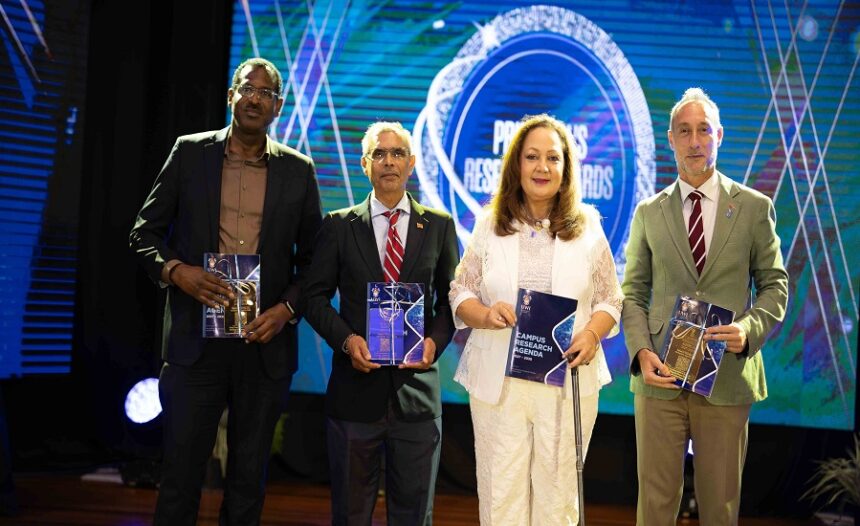
Research that could help Caribbean kidney patients access precision therapies, treat antimicrobial resistance, transform invasive Sargassum into biodegradable products, give communities earlier warning of floods and develop safer alternatives for use in plastics was among the work recognised at The University of the West Indies (The UWI), St. Augustine Campus 2026 Principal’s Research Awards on November 25 at the Daaga Auditorium.
Held under the theme “Research for a Resilient Future: Caribbean Solutions, Global Impact,” the fourth annual awards placed a public spotlight on research being undertaken at St. Augustine to address some of the region’s most urgent challenges, such as crime, disease, food insecurity, climate vulnerability, social inequality, emerging technology and sustainable development.
Extending that research beyond the stage, a Research & Innovation Display Wall allowed guests to engage directly with research posters showcasing the work behind the awards, offering a closer look at the questions being investigated, the solutions being developed and the potential impact of the research.
The Campus also formally released its Research Agenda for 2027–2030, more than two years in development and shaped through consultation with the public and private sectors and international development agencies. It sets out research priorities across the Campus’s faculties, including interdisciplinary and multidisciplinary work aimed at responding to complex development challenges.
The highlight of the evening was the Principal’s Award for Best Researcher, the ceremony’s premier research honour which was won by Dr Randy Seepersad, Senior Lecturer in Criminology in the Department of Behavioural Sciences.
Professor Rose-Marie Belle Antoine, Pro Vice-Chancellor and Campus Principal, said the work being recognised demonstrated why research is fundamental to the region’s ability to navigate an increasingly uncertain world. “The research we do at The UWI is not an academic luxury; it is, and has always been, a development necessity,” Professor Antoine said.
Professor Antoine explained that the awards were created not only to recognise outstanding researchers, but to make their contributions more visible to the wider society, strengthen the Campus’s research and innovation culture and find meaningful solutions to society’s problems.
Dr Seepersad’s research tackles some of the region’s most difficult social challenges, including gangs and firearms, youth violence, policing, prisons and corrections, intimate partner violence and crime prevention. A defining feature of his scholarship is the production of original Caribbean evidence through national surveys, inmate studies and multi-country research. His findings have been cited or used in Trinidad and Tobago parliamentary deliberations, UK Home Office country guidance, United Nations Office on Drugs and Crime analysis and Canadian refugee-country information.
Caribbean researchers need not merely apply knowledge developed elsewhere. As Professor Antoine elaborated: “We must generate our own evidence, ask our own questions and develop solutions reflecting our own circumstances and lived realities.”
That approach was visible across the award-winning projects. One team, led by Dr Rajini Haraksingh, is addressing a major gap in global medical research through its work on chronic kidney disease in Trinidad and Tobago. The work identified high-risk APOL1 genetic variants in a Caribbean cohort and has helped establish readiness for possible local participation in international Phase 2 clinical trials of a targeted therapy.
Another award-winning project is tackling a problem visible on beaches throughout the Caribbean. Led by Dr Akeem Mohammed, researchers are extracting sodium alginate from Sargassum for potential use in biodegradable packaging and water-treatment materials, turning a costly environmental problem into a possible raw material for a Caribbean bio-based industry. The project has attracted US$829,464 in external funding and in-kind support, advancing the potential to turn a recurring Caribbean environmental burden into a source of green products, jobs and exports while also helping to address another major regional challenge: plastic pollution.
Research recognised through the Hurricane and Earthquake Alleviation Research (HEAR) Award demonstrated a similarly direct connection between university knowledge and community safety. Dr Gabrielle Thongs and Mr Dale James developed an Integrated Caribbean Flood Resilience and Multi-Hazard Early Warning System, piloted in Roxborough, Tobago. The project combined flood-monitoring and remotely controlled visual equipment with a mobile application that allows users to monitor river conditions, alongside the use of Vetiver grass to stabilise riverbanks.
A special mention in the same category went to web solutions specialist, Mr Himraj Bir for creation of StormPlan TT, a free offline-first disaster-preparedness platform. The application consolidates information from 18 official and regional sources, calculates household emergency supplies, conducts a home vulnerability check, maps 404 official shelters with routes that can remain available without mobile data or power, tracks storms and facilitates community welfare checks following disasters.
Importantly, the HEAR Award and the Principal’s Special Innovation Award are open to participants beyond The UWI community, recognising that solutions to the region’s challenges are also being developed within communities, industry and entrepreneurial spaces. By opening these categories to the wider public, the awards extend the University’s research and innovation platform beyond the Campus and encourage broader participation in developing practical solutions to Caribbean problems.
Dr Nigel Kevin Jalsa, Dr Lorale J. Lalgee and Mr Ricardo Roopnarine received a joint Principal’s Special Innovation Award for research into a cyclodextrin-based environmentally friendly plasticizer. Their carbohydrate-derived alternative is being developed to perform a function comparable with conventional plasticizers without the migration associated with some existing products. The research has received a provisional US patent, and the team is seeking commercialisation partners.
Third-year Physics and Computer Science student Brandon Deonarine was also recognised for CoursePilot, an independently developed academic planning platform that integrates degree auditing, prerequisite analysis, course planning and timetable assistance while processing academic transcripts without uploading or storing them online.
Dr Milena Mechkarska’s work examines bioactive compounds from natural sources, including antimicrobial peptides with activity against multidrug-resistant pathogens. Her research on medicinal plants traditionally used as “bush medicine” in Trinidad and Tobago has also demonstrated promising anticancer potential and resulted in an intellectual property disclosure with commercialisation prospects.
Research beyond science and technology was also strongly represented. Dr Bephyer Parey and the SALISES Disability Studies Research Cluster were recognised for multidisciplinary research into disability, wellbeing and inclusion. Their work has examined discrimination complaints involving persons with disabilities, wellbeing among persons with lower-limb amputations and their relatives, and produced policy recommendations aimed at strengthening rights protections and rehabilitation services.
Dr Gabrielle Hosein’s research spans masculinities, gender-based violence, adolescent sexualities and post-indenture feminist scholarship. A six-country study on child marriage and early unions has informed regional advocacy and international policy guidance, while other work has used spoken word and theatre to engage Caribbean secondary-school students in gender-based violence education.
The Break the Silence Project, represented by Dr Deborah Mc Fee, was recognised for research and advocacy addressing child sexual abuse and gender-based violence, while Professor Jeannine Remy was honoured for research documenting the histories, knowledge and lived experiences of Trinidad and Tobago’s steelpan communities.