

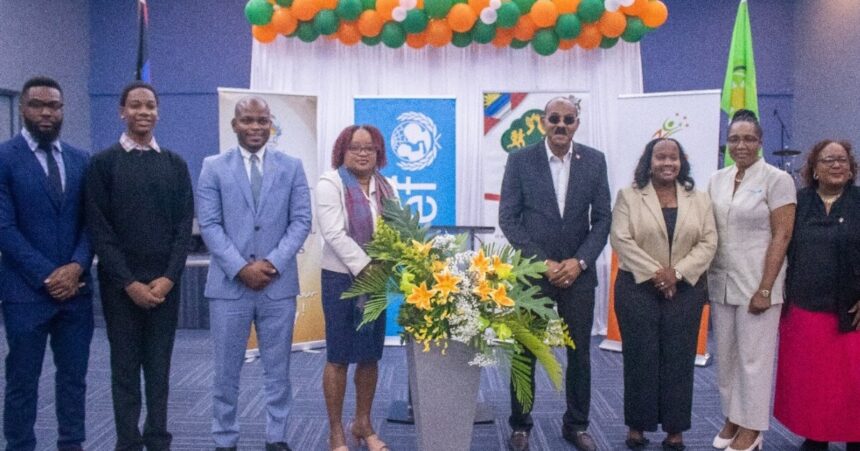
The Government of Antigua and Barbuda, in partnership with UNICEF, the University of the West Indies (UWI), the Organisation of Eastern Caribbean States (OECS) Commission and Zenith Centre, today launched the Young Caribbean Minds (YCM) Chatline—the OECS’ first free, anonymous, text-based mental health and child protection support service for children and young people.
The launch follows the largest youth consultation on mental health legislation ever undertaken in the Eastern Caribbean, with more than 1,000 children and young people helping to shape both the future of mental health care in Antigua and Barbuda and the development of the Young Caribbean Minds Chatline.
Launched alongside the Chatline, the Youth Voices: Mental Health Care Bill Survey Report captures the perspectives of young people aged 10 to 19 through surveys, focus groups and a national consultative process. It marks the first documented youth consultation to inform mental health legislation in the Caribbean and will help shape Antigua and Barbuda’s proposed Mental Health Care Bill 2026, demonstrating how children’s voices can meaningfully influence national policy.
The report found that stigma remains the greatest barrier preventing young people from seeking mental health support, with 34.2 per cent of respondents saying they fear being judged if they ask for help. More than half called for stronger protections within the legislation, while nearly 90 per cent supported the Bill’s proposed rights-based provisions. Privacy emerged as the single most important factor in building trust in mental health services, with online chat support ranking as the second most preferred way for young people to access help.
These findings directly informed the development of the Young Caribbean Minds Chatline.
Designed to remove many of the barriers identified by young people themselves, the Chatline provides free, real-time psychosocial support through UWI-trained volunteers under the supervision of qualified psychologists. Young people can access support anonymously, without providing personal information, while an integrated child protection referral system ensures that children at risk can be connected to appropriate safeguarding services when needed.
Prime Minister the Honourable Gaston Browne described mental health as a fundamental right and reflected on his long-standing advocacy for improved mental health services across Antigua and Barbuda and the wider region.
“I have been an advocate of mental health care for everyone as a fundamental right,” he said. “I’ve advocated here in Antigua and Barbuda, within the region, the OECS and the United Nations, and I’m very happy to be participating in this programme, which has mental health at its epicentre.”
The Prime Minister also spoke candidly about his personal connection to the issue, underscoring the importance of breaking the stigma surrounding mental health.
“Unfortunately, the issue of mental health has been stigmatized globally,” he said. “The reason why I’m so committed to this issue is personal. Many of you may not be aware that I grew up in a single-parent home with a mentally ill mother… many times there was a crisis that could not work, which made it very difficult for me and my siblings.”
For UNICEF, the launch represents an important milestone in ensuring that children and young people have access to safe, confidential and youth-friendly mental health support.
“Today we reaffirm our commitment to every young person in the Caribbean: your voice matters, your feelings matter, and help is available,” said Maryam Abdu, UNICEF Representative a.i. for the UNICEF Eastern Caribbean Area Office. “The Young Caribbean Minds Chatline provides a free, confidential and accessible space so no child has to struggle alone.”
She said the initiative demonstrates the region’s commitment to listening to young people and responding with practical solutions.
“Our region has shown the courage to listen—now we are responding,” Abdu said. “By expanding this Chatline across Eastern Caribbean member states and offering bilingual support, we are ensuring that support is truly inclusive and reaches the young people who need it most.”
Describing the broader vision behind the initiative, she added: “Young Caribbean Minds is more than a service—it is a promise. Built with young people’s voices and guided by local partnerships, this initiative strengthens resilience, protects children and gives families and communities the tools to help every child thrive.”
Dr Camille Samuel, Registrar at the University of the West Indies Five Islands Campus, highlighted the University’s role in preparing the next generation of volunteer mental health supporters.
“Seeing our Five Islands students step forward as volunteer chat supporters fills me with pride,” she said. “Their year-long training will build a community of empathetic, skilled peers who can change lives.”
The Young Caribbean Minds Chatline builds on a successful five-month pilot, during which more than 1,000 support sessions were delivered and 88 per cent of users indicated they would use the service again. The initiative has also received international recognition, including being identified as a best practice at the Global Conference on Child and Adolescent Mental Health in South Africa and being named among the Top Three finalists in the UNICEF Global INSPIRE Awards from more than 300 submissions worldwide.
Today’s launch brought together Prime Minister Browne; Minister of Health, Wellness, the Environment and Civil Service Affairs, the Honourable Michael Joseph; Minister of Social Transformation, the Honourable Kiz Johnson; senior government officials; development partners; civil society organisations; and youth representatives. Members of the National Student Council and the National Youth Parliament Association of Antigua and Barbuda also delivered a youth response, welcoming the Government’s commitment to mental health and calling for continued youth participation in shaping policies that affect their lives.
The Young Caribbean Minds Chatline was endorsed by Ministers of Health at the OECS Health Policy Forum in April 2025 and is being developed as a regional service for all nine OECS Member States. Following today’s soft launch in Antigua and Barbuda, volunteer training and system strengthening will continue ahead of a phased national and regional rollout. The initiative will also be discussed at the Second OECS Council of Ministers on Youth and Sports, to be held in Antigua and Barbuda on 12–13 August 2026.