

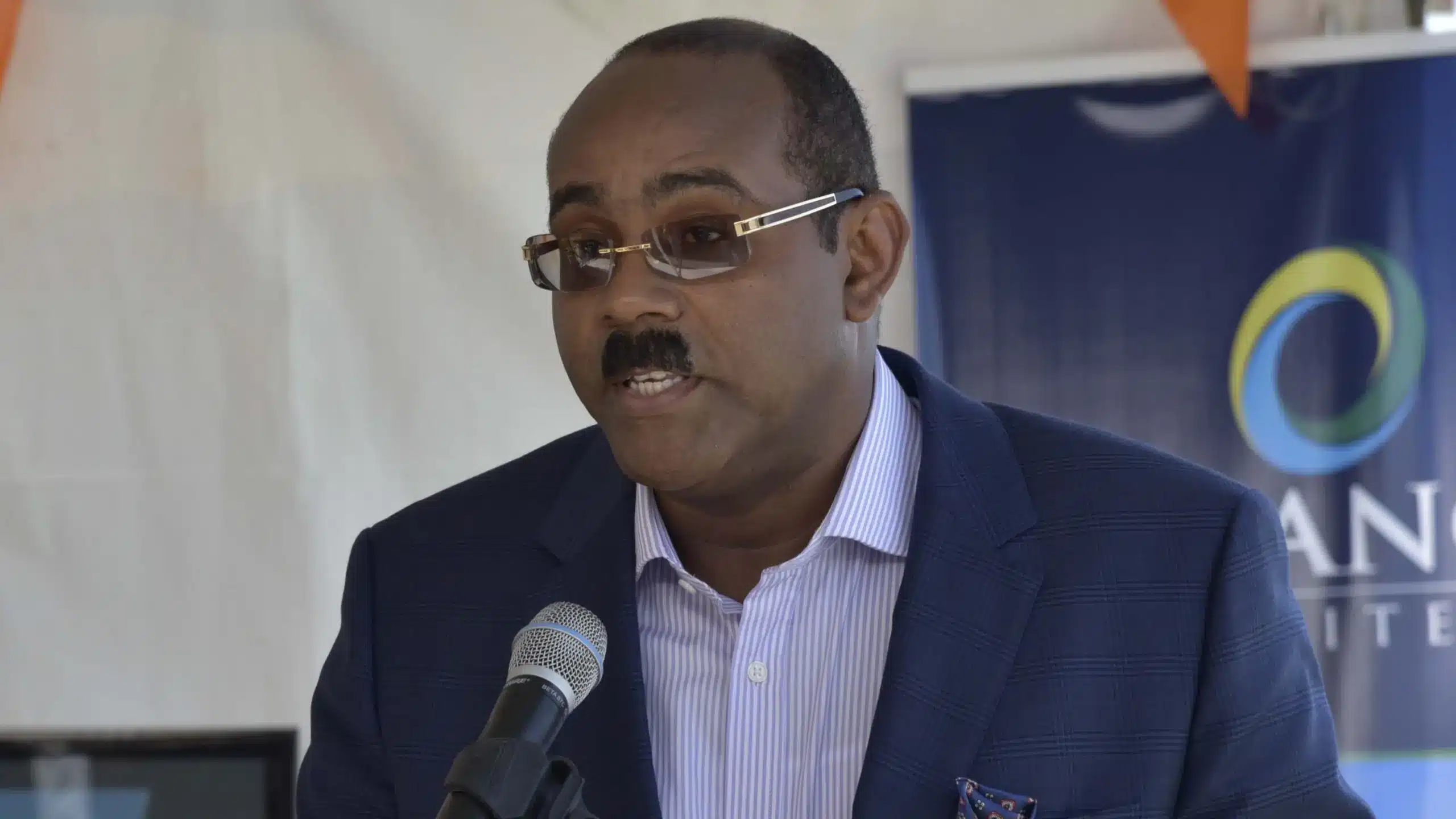
Gaston Browne Rebukes Kamla Over Caricom Solidarity
At a recent Christmas event, Trinidad and Tobago’s Prime Minister, Kamla Persad-Bissessar, laid out a starkly transactional foreign policy doctrine. She suggested that public criticism of the United States should be curtailed to protect citizens’ access to US visas and ensure the nation’s security.
Tying criticism directly to consequences, she pointed to newly announced US travel restrictions affecting Antigua and Barbuda and Dominica as a cautionary tale.
“Which Trini wants their visa cut? So behave yourself. Understand where our help comes from. Understand who can protect and defend Trinidad and Tobago. Right now, there is only one country in the world that can do it.”
This perspective is striking for its directness. It frames international relations not as a dialogue between sovereign equals, but as a deferential arrangement where silence is exchanged for tangible benefits like travel access and security protection.
The reaction from the region was swift and sharp. In a highly unusual public move, Antigua and Barbuda Prime Minister Gaston Browne delivered a “stinging rebuke” to his counterpart via a Facebook post. Such direct, public criticism between leaders of the Caribbean Community (CARICOM) is rare, as these matters are typically handled through more discreet diplomatic channels.
Browne accused the leader of undermining regional solidarity and challenged the very foundation of her argument.
“I challenge that leader to back her statement with facts.”
This public airing of grievances signals more than just a simple disagreement; it points to a significant breach of diplomatic protocol and trust between two regional allies, playing out for all the world to see.
The core of the dispute hinges on a critical factual claim: Persad-Bissessar’s assertion that Antigua and Barbuda faced US visa restrictions because they “badmouthed” the US. Prime Minister Browne didn’t just disagree—he flatly rejected the allegation, accusing the leader of spreading “falsehoods” and publicly demanding she substantiate the claim.
This isn’t just a factual dispute; it’s a direct challenge that threatens to invalidate the entire “Silence for Visas” doctrine laid out in Point 1. If the foundational example used to justify a policy of silence is false, the entire argument for a deferential foreign policy collapse, adding a layer of potential misinformation to an already tense diplomatic spat.
The regional misstep immediately created a political vulnerability at home, igniting a firestorm of domestic criticism. Former Prime Minister Stuart Young launched a fierce critique, accusing Persad-Bissessar of “recklessly torching regional and bilateral relationships” and demonstrating a dangerous misunderstanding of statecraft.
“Diplomacy is an art form that, when properly understood and practised, allows countries to defend their interests without humiliating allies or sacrificing long-term sovereignty.”
Young grounded his criticism in local politics, adding, “That art is clearly lost on the UNC government, which continues to worsen Trinidad and Tobago’s position daily.” The backlash was further amplified by former UN ambassador Rodney Charles, who argued that the government’s posture was not only isolating the nation but was also strategically naive.
He questioned the lack of tangible rewards for T&T’s cooperation with the US, contrasting it with Argentina receiving “US$40 billion for doing much less.” In a sophisticated geopolitical jab, Charles highlighted the irony of the US under Trump pressuring the International Criminal Court for immunity, suggesting T&T should seek similar protections as a “co-conspirator” in US policy.
Beyond the war of words between two leaders, this incident is being interpreted as a symptom of a much deeper malaise within CARICOM. Prime Minister Browne connected the episode directly to the structural weaknesses hampering the regional body’s effectiveness. His critique suggests a growing frustration with the organization’s inability to act cohesively and decisively.
“The inertia and insularity within Caricom continue to undermine the effectiveness of our integration movement.”
Yet, Browne’s critique was not one of pure despair. He tempered his warning by clarifying his position as a constructive critic, adding, “Yet, as a hardcore integrationist and an eternal optimist, I remain hopeful for a stronger and more effective Caricom.”
This public feud, therefore, does more than just damage bilateral relations; it shines a harsh light on the underlying tensions and institutional frailties that challenge the very promise of Caribbean integration.