

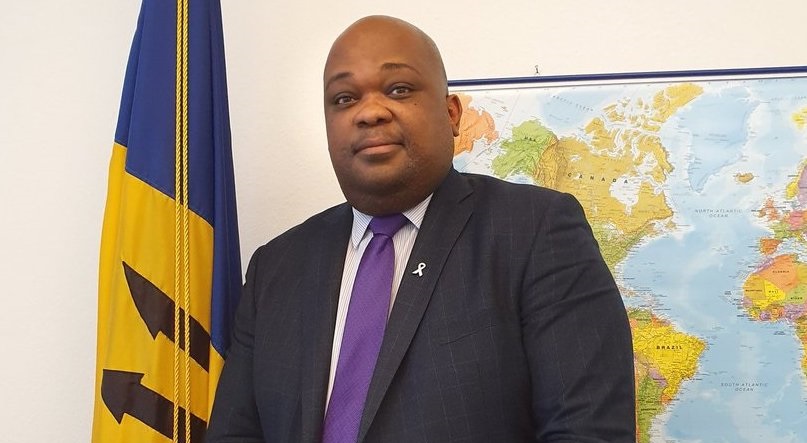
The Minister of Education Transformation of Barbados, the Hon. Chad Blackman, JP, MP has issued a strong call for a comprehensive review of student assessment systems across the Caribbean, urging regional assessment body, the Caribbean Examinations Council (CXC) to reform and modernise how student achievement is assessed in a rapidly evolving global landscape.
Speaking at the CXC Ministerial Forum 2026 in Kingston, Jamaica, the Minister highlighted that while education systems across the Caribbean are undergoing significant transformation, regional assessment models have not kept pace.
The Minister pointed specifically to the need for reform within the Caribbean Examinations Council (CXC), noting that the current system relies heavily on traditional examinations and does not sufficiently capture the full range of students’ capabilities, talents, and competencies.
The Minister stated. “We are moving from a hard-core examination-focused education system, to one that is really based on ensuring that our students can do different things in different manners.” He further reminded his colleagues that “The pipeline is still one where they are still forced to go through a traditional exam. There is going to be a significant bottleneck and there is going to be serious frustration…CXC now has to work (with us) to ensure that the region is not impaired by holding onto a methodology of assessment that does not capture the aspirations, not just of the Government, but of the young people in the education system itself.”
The Minister emphasized the need for a reformed assessment framework that:
- Reflects diverse learning styles and literacies
- Captures competencies from early childhood through to secondary education
- Integrates project-based, skills-based, and applied learning methodologies
- Aligns with the demands of a knowledge-based global economy
He stressed that Caribbean students must be equipped not only to compete globally, but to create solutions to global challenges, leveraging their education to produce tangible outcomes.
This call was immediately supported by CXC’s Registrar Wayne Wesley, who welcomed Barbados’ call, which was also echoed by CARICOM’s Assistant Secretary General, Alison Drayton, Human and Social Development, CARICOM Secretariat, who indicated that this is critical as the region moves ahead with much needed transformation.
The Minister reminded regional colleagues that Caribbean youth have consistently called for more meaningful ways to demonstrate their talents and abilities.
He underscored the importance of ensuring that assessment systems evolve in tandem with education reform efforts already underway across CARICOM member states.
The Minister called on regional governments, education stakeholders, and CXC to work collaboratively to address the fundamental structural elements within the current system as a matter of urgency.
Addressing the role of technology in education, the Minister cautioned against misconceptions:
“Technology cannot replace teachers. Technology cannot replace learning. It is there to augment and amplify.” He reiterated that technology must be used a tool and not seen as a widespread solution to our challenges.”
He reinforced the importance of continuous teacher training and retooling, ensuring educators are equipped to deliver modern, dynamic instruction aligned with new modes of learning.
Speaking specifically to Barbados’ transformation, the Minister also highlighted ongoing reforms within Barbados’ Ministry of Education Transformation, noting that significant efforts are underway to refocus the Ministry’s organisational structure, to:
- Improve efficiency in delivery of services
- Enhance responsiveness to stakeholders
- Better support students, teachers, parents, and the wider public
The Minister concluded by reaffirming Barbados’ commitment to working with regional partners to ensure that Caribbean education systems remain relevant, equitable, and globally competitive.