
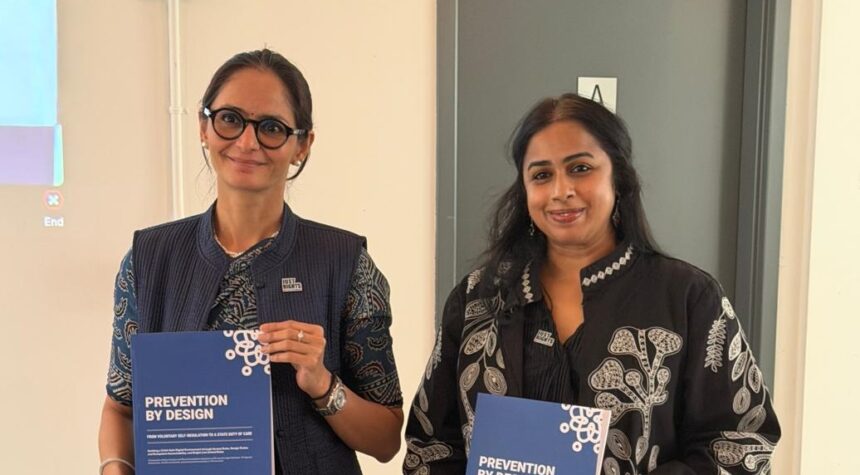
Governments should move from voluntary industry safeguards towards binding legal duties to protect children online, according to a new global policy report launched on the sidelines of the United Nations General Assembly. Titled “Prevention by Design: From Voluntary Self-Regulation to a State Duty of Care,” the report was launched at an event on “Responsible AI & Safe Digital Spaces for Children” organised by Athena Infonomics and Just Rights for Children.
The report is published by (CLAB) Centre for Legal Action and Behaviour Change, one of India’s leading research and policy institutes and a partner of the Just Rights for Children network. It draws on legal and policy developments across 40 countries, 10 regional and multilateral frameworks, and 13 United Nations instruments, as well as school smartphone policies across 110 countries.
The analysis points to growing government action on children’s access to social media. Australia, China, Indonesia and Malaysia already enforce binding age rules, while four other countries have passed legislation, 11 bills are before parliaments, and 22 governments are actively considering regulatory measures. Proposed minimum ages are increasingly clustering around 15 and 16.
At the centre of the framework is “Prevention by Design”, bringing age limits, privacy, algorithms, online exploitation and platform accountability into a single regulatory approach. It proposes a statutory age floor of 15, supervised parental consent between 15 and 16, and enhanced protections for all users below 18.
The framework also calls for greater platform responsibility, including restrictions on targeted and behavioural advertising to minors and design features such as infinite scroll, autoplay, streaks and reward loops. It proposes stronger privacy and safety settings by default, privacy-preserving age assurance, data minimisation and a ban on centralised databases of children’s identities.
For enforcement, it proposes independent online-safety regulators, mandatory platform reporting, revenue-linked penalties, graduated sanctions and child-accessible remedies. Child participation, digital literacy, parental guidance and independent review are also included.
A separate recommendation calls for national legislation restricting smartphone use throughout the school day in primary and lower-secondary schools, including breaks, with publicly funded storage and exceptions for medical needs, disability-related assistive technology and teacher-directed educational use. More than half of the 110 countries examined have some form of national or subnational school smartphone restriction, according to the analysis.
The framework also calls for stronger international cooperation to address online harms that cross borders.
Speaking at the launch of the report “Prevention by Design,” Bhuwan Ribhu, Founder, Just Rights for Children, said,
“The digital world has expanded the scale of harm, while systems for preventing it have not kept pace. The world needs mandatory reporting and an international legal framework to address online harms that cross borders. Social media platforms cannot be allowed to place children in contracts or arrangements that undermine their rights and safety. A child below 18 cannot legally enter into a contract, and any such agreement is void ab initio”.
He further added that this report applies the principles of child protection and the rule of law to technology itself. At the scale of digital platforms, we cannot wait for millions of harms to occur before acting—we must design systems that prevent harm, strengthen accountability, empower communities and local protection mechanisms, and use technology to identify risks early and connect children to protection.
The framework acknowledges that evidence on some digital risks and regulatory interventions is still developing, and calls for regular statutory review, independent evaluation and continued evidence gathering.
The findings are being presented to policymakers and child-rights advocates in New York during the UN General Assembly week.