

Commercial banks across the Eastern Caribbean are currently holding billions in excess liquidity, creating a major barrier to economic growth as local businesses and entrepreneurs continue to struggle to secure loans.
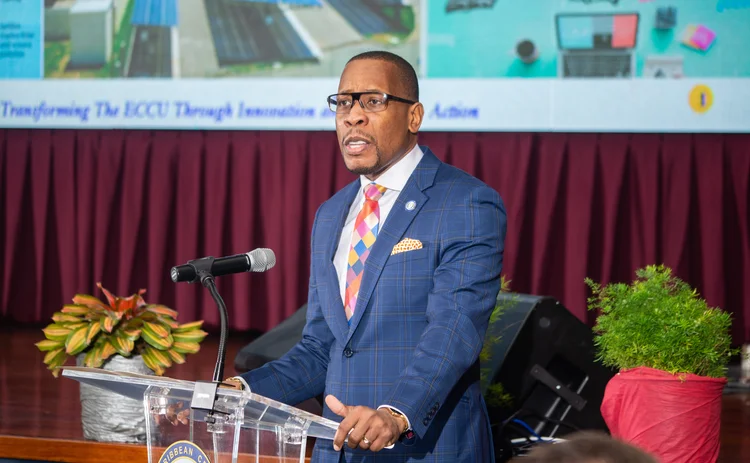
Speaking at the launch of the Eastern Caribbean Central Bank’s (ECCB) 2026–2031 strategic plan, Central Bank Governor Dr. Timothy N.J. Antoine highlighted a significant structural weakness in the region’s financial system.
According to Antoine, financial institutions are holding more than $28 billion in deposits, yet only have about $16 billion in active loans. This massive disparity demonstrates that while funds are readily available, they are not being effectively channeled into productive investments, a reality that disproportionately affects small and medium-sized enterprises (SMEs) struggling to meet strict lending requirements.
To combat this imbalance, the ECCB is rolling out its new “Big Push” strategy, which aims to unlock credit, improve access to finance, and modernize the region’s financial infrastructure. Central to this initiative is the expansion of the ECCB’s partial credit guarantee programme.
By providing guarantees of up to 75 to 80 percent on qualifying loans, the ECCB hopes to significantly lower the risk exposure for banks and encourage them to lend to underserved sectors. This programme has already facilitated over 300 loans valued at approximately $30 million for farmers, creatives, fishers, and small businesses, and will now be scaled up to reach a wider cross-section of the economy.
Beyond improving credit access, the ECCB’s strategic plan includes technological and structural upgrades. The Central Bank plans to implement a regional credit bureau to help lenders assess borrower risks more accurately, which could lower borrowing costs.
Governor Antoine also announced plans to modernize payment systems, including a fast payment system for cheaper, quicker transactions within the currency union, as well as a pilot program for the CARICOM payment and settlement system to handle real-time, low-cost cross-border payments in local currencies.
Despite these ambitious plans, Governor Antoine noted that the banks are only part of the equation. He emphasized that there remains a critical shortage of “bankable” projects, urging the private and public sectors to collaborate in generating viable business opportunities that can successfully qualify for the available financing.
