
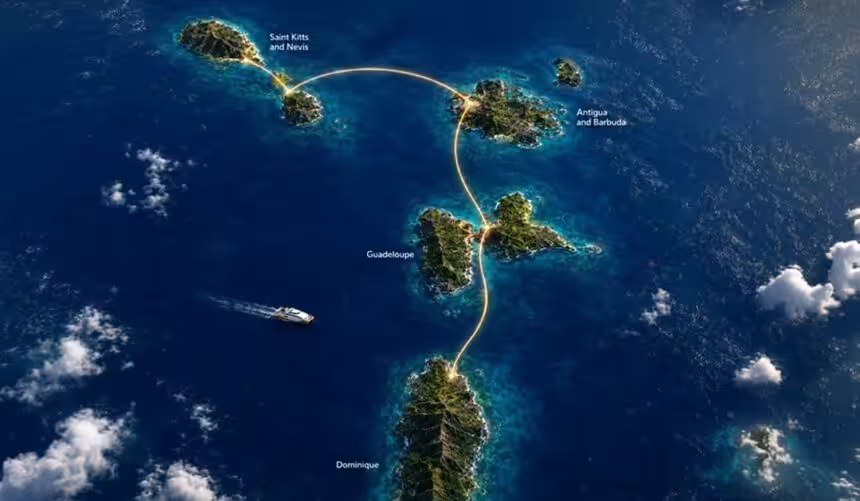
Regional efforts to bridge island transport divides across the Eastern Caribbean have reached a decisive operational milestone. The KARULINK project, an inter-island territorial cooperation initiative designed to enhance maritime transit and multimodal connectivity between Guadeloupe, Antigua and Barbuda, Dominica, and Saint Kitts and Nevis, has officially launched its feasibility studies alongside an intensive campaign of ground-level stakeholder engagement.
Initiated under the auspices of the European INTERREG Caribbean 2021–2027 programme and co-financed through the European Regional Development Fund (ERDF / FED-FEDER), the initiative addresses long-standing transit fragmentation across the archipelago. Operating under the banner of “linking islands,” KARULINK connects island territories through coordinated maritime links and centralized digital transit tools, aiming to establish a smoother, more sustainable mobility network that deepens regional economic integration.
The operational acceleration follows the formal convening of the project’s inaugural Steering Committee (COPIL) in Guadeloupe in June 2026. Under the leadership of project coordinator Groupe STEP—a Guadeloupe-based mobility advisory firm—the international partnership has moved swiftly from initial planning into active regional implementation.
Scheduled to run until December 31, 2027, the multi-year initiative focuses on delivering structural solutions to Caribbean transit challenges. Rather than treating sea crossings in isolation, KARULINK positions maritime routes as integral links within a wider multimodal journey, connecting ports with local overland transit systems and municipal centers across all four participating territories.
| Project Dimension | Strategic & Operational Details |
|---|---|
| Framework Programme | European INTERREG Caribbean 2021–2027 |
| Funding Mechanism | European Regional Development Fund (ERDF / FED-FEDER) |
| Participating Territories | Guadeloupe, Antigua and Barbuda, Dominica, Saint Kitts and Nevis |
| Lead Partner & Coordinator | Groupe STEP (Guadeloupe) |
| Operational Term | Active through December 31, 2027 |
| Core Technical Focus | Mobility needs assessment & centralized multimodal digital platform |
The foundational technical priority of the newly launched feasibility studies centers on accurately evaluating commuter and traveler transit needs while engineering the architecture for a centralized multimodal information platform—identified by project leaders as the primary catalyst for seamless and low-carbon regional travel.
To guarantee that the forthcoming digital platform responds directly to daily travel realities, the consortium has mobilized extensive field consultations and technical exchanges across Guadeloupe and regional industry networks.
Stakeholder engagement accelerated sharply throughout October 2026, pairing public consultations with specialized clean-technology showcases:
- Youth and Commuter Engagement at the Université des Antilles (October 12, 2026): Project leaders met directly with university students in Guadeloupe to preview the functional features of the upcoming centralized multimodal platform. The session provided a forum to analyze student commuting habits and daily transit bottlenecks, gathering practical data to align future digital services with user needs while raising awareness around ecological transition issues.
- Showcasing Clean Mobility at EKO Innovation (October 14, 2026): Featured at EKO Innovation—the flagship future-solutions conference organized by the Synergîles innovation cluster—KARULINK presented its strategic vision for connected, low-carbon mobility. Dialogues with economic stakeholders, institutional representatives, and project developers highlighted the initiative’s direct contribution to regional attractiveness and economic integration.
- International Industry Dialogue at IFTM Top Resa: These regional field actions expanded upon strategic exchanges and insights shared during the international tourism and industry trade fair IFTM Top Resa, held from September 15 to 17, 2026.
Ongoing collaboration with regional academic and innovation bodies, including the Université des Antilles and Synergîles, continues to provide analytical grounding as technical specifications for the mobility platform take shape.
KARULINK’s delivery model rests upon a structured alliance between public authorities and private-sector chambers of commerce across French and English-speaking Caribbean territories.
The governance coalition brings together key institutional and municipal actors across the four partner territories:
- Groupe STEP (Guadeloupe): Serves as Lead Partner and overall project coordinator, steering technical execution and operational alignment.
- Antigua & Barbuda Chamber of Commerce (ABCC): Represents commercial and logistical interests within Antigua and Barbuda.
- Dominica Association of Industry and Commerce (DAIC): Mobilizes private-sector commercial links and transit advocacy in the Commonwealth of Dominica.
- St. Kitts and Nevis Chamber of Industry and Commerce (SKNCIC): Coordinates commercial stakeholder input and local maritime connectivity priorities for Saint Kitts and Nevis.
- Communauté d’Agglomération La Riviera du Levant (CARL): Represents south-eastern and coastal Guadeloupean communities, including Le Gosier, Sainte-Anne, Saint-François, and La Désirade.
- Municipality of Bouillante: Provides municipal governance and western coastal territorial perspectives from Guadeloupe.
This cooperative framework ensures that the technical guidelines established under the European funding programme align directly with local economic priorities and municipal transport realities across each island.
The consortium will mark its next major milestone on December 10, 2026, when delegates convene in Saint Kitts for the project’s second Steering Committee meeting.
The Saint Kitts summit will bring together the full network of institutional, municipal, and commercial partners to evaluate the initial findings of the feasibility studies. The committee will assess travel demand data, review platform technical requirements, and define the strategic technical guidelines that will steer operational implementation through 2027.
As the initiative progresses toward its December 2027 conclusion, the technical blueprints established in Saint Kitts will lay the groundwork for a more cohesive, sustainable, and interconnected maritime transport network across the Eastern Caribbean.