

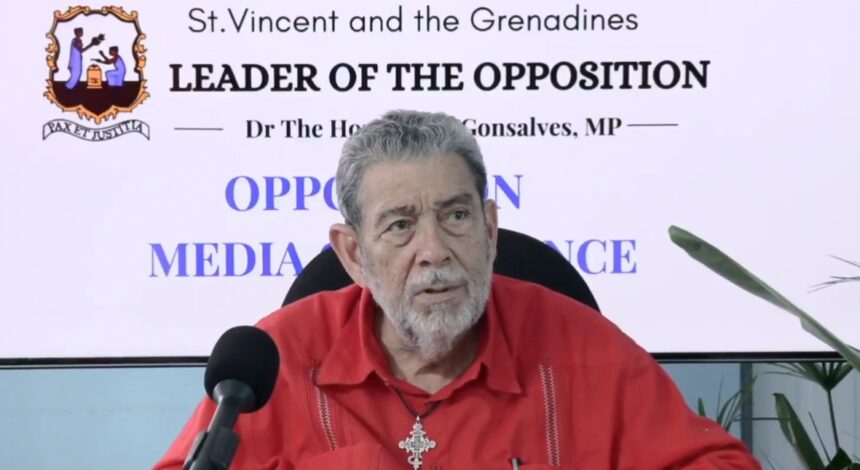
Former PM Ralph Gonsalves on Monday offered a detailed critique of CARICOM’s reaction to the charges against President Nicolás Maduro and the U.S. intervention, characterizing it as a principled but incomplete response.
Gonsalves noted that the Bureau of CARICOM—consisting of St. Kitts and Nevis (current chair), Jamaica (outgoing), and St. Lucia (incoming)—issued a statement on January 3rd. He described the initial response as a “holding operation” following an early morning Zoom meeting at 5:00 AM attended by heads of state from St. Kitts and Nevis, Guyana, Barbados, and Suriname, along with the foreign minister of Trinidad and Tobago.
He acknowledged that CARICOM’s substantive statement was firmly rooted in the fundamental principles of international law and multilateralism. Specifically, the region reiterated: A commitment to the UN Charter, including sovereignty and territorial integrity, A call for peaceful dialogue through diplomatic channels, A focus on ensuring Venezuela’s stability and the prosperity of its people and the monitoring of economic impacts, specifically regarding air travel and the safety of regional citizens.
While Gonsalves shared the principles expressed in the statement, he criticized it for stopping short of making a judgment on whether the U.S. actions constituted a violation of international law. He expressed a wish that a clearer assessment had been made rather than just an enunciation of principles. He also pointed out that the statement was entirely silent regarding the potential trial in New York City.
Gonsalves revealed that it is an “open secret” that different countries within CARICOM hold divergent positions on the matter. He attributed the Bureau’s hesitation to apply principles to the factual situation to the varying national interests of member states. Despite these differences, he stressed the importance of CARICOM leaders not “cannibalizing one another” and maintaining unity where possible, as the organization is a community of sovereign states rather than a federal government.
Looking forward, Gonsalves suggested that CARICOM should move beyond “episodic gatherings” and offer itself as an interlocutor. He argued that because CARICOM nations are the “smallest and weakest” partners, they may be viewed as more disinterested and therefore better suited to facilitate a “mature conversation” between the United States and Venezuela to ensure regional security and peace