

Senior officials and finance ministers from across the Caribbean have gathered in Kingstown, St. Vincent and the Grenadines, to attend a high-profile regional workshop focused on modernizing public financial management (PFM). The event, titled “Adapting Public Financial Management for AI: Harnessing Digital by Design,” aims to chart a path forward for integrating artificial intelligence (AI) and advanced digital solutions into public governance across small island developing states (SIDS).
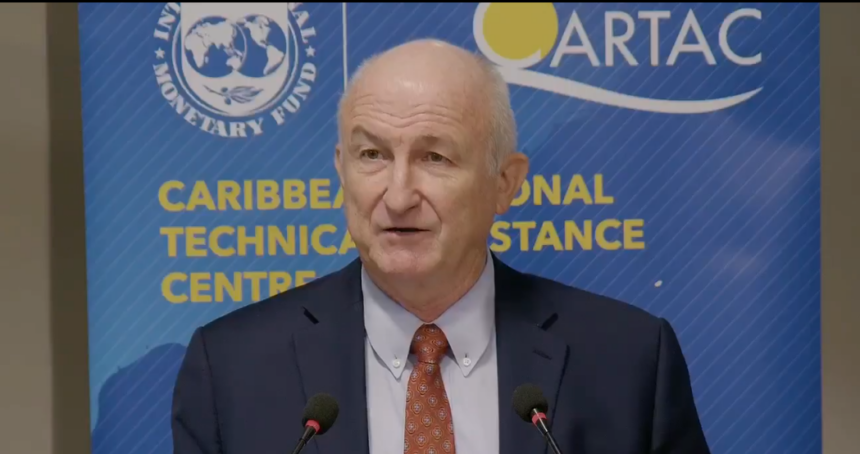
Co-hosted by the Government of St. Vincent and the Grenadines and the Caribbean Regional Technical Assistance Center (CARTAC), the workshop has brought together representatives from 19 of CARTAC’s 23 member countries, marking an exceptional turnout that underscores the urgency of digital transformation in the region.
In his remote opening remarks, Sandeep Saxena, Deputy Division Chief of PFM in the IMF’s Fiscal Affairs Department, urged countries to embrace a “digital by design” approach. Saxena explained that this methodology requires governments to start with the actual problems to be solved—such as mapping information flows, identifying where decisions are delayed, where controls are weak, where data is fragmented, or where staff time can be used more efficiently.
Saxena cautioned that technology should not be used merely to automate existing, inefficient procedures. “Technology is not a substitute for sound institutions, clear processes, good data, and strong governance,” Saxena noted, stressing that the true opportunity lies in re-engineering business processes to achieve greater accountability and resilience.
Dr. the Honorable Godwin Friday, Prime Minister and Minister of Finance of St. Vincent and the Grenadines, echoed these sentiments during his address. He warned against getting misguided by the hype surrounding artificial intelligence. “We must not invent problems simply so that AI could solve them,” the Prime Minister remarked, emphasizing that AI must instead be utilized with a clear purpose to solve existing operational challenges.
Friday highlighted the critical distinction between simple digitization—which merely replicates manual paper forms in a digital environment—and true digital transformation, where functional processes are completely re-engineered to be digital by design. He also stressed that while AI serves as an enabler for public offices, it is not a substitute for human accountability, professional judgment, or institutional ethics.
For climate-vulnerable small island developing states, digital transformation is inseparable from physical and digital resilience. Prime Minister Friday recalled the severe disruptions caused by the eruption of the La Soufrière volcano five years ago and the devastation of Hurricane Beryl in 2024 to illustrate how quickly natural disasters can halt ordinary government operations.
To counter these threats, Friday called for cyber resilience, robust backups, and secure safeguards to be built into public systems from the start. Saxena supported this perspective, noting that cyber resilience is a vital feature of any modern PFM system in a region highly exposed to natural disasters and operational disruptions.
The workshop’s opening ceremony also celebrated the 25th anniversary of CARTAC, highlighting its long-term impact on regional cooperation and technical expertise. High Commissioner of Canada to Barbados and the Eastern Caribbean, Mrs. Brenda Wills, reaffirmed Canada’s enduring commitment to the region. Canada has contributed over $100 million to CARTAC since 2001, including $15 million for the current Phase 6 program.
Wills emphasized that the success of digital modernization should be measured by the results achieved for citizens, noting that the benefits must be broadly shared with women, youth, and underserved communities.
CARTAC Director Matthew Burn expressed deep gratitude to the Government of St. Vincent and the Grenadines for co-hosting the event, which helps alleviate the center’s current financial constraints and allows it to do more for its regional members. Burn urged delegates to build strong peer networks across jurisdictions during the week, noting that artificial intelligence is a shared regional challenge that can be managed more effectively through collective collaboration.
The week-long workshop is supported by a coalition of development partners, including Canada, the United Kingdom’s Foreign, Commonwealth and Development Office (FCDO), the European Union, the Kingdom of the Netherlands, the Caribbean Development Bank (CDB), and the Eastern Caribbean Central Bank (ECCB).
