

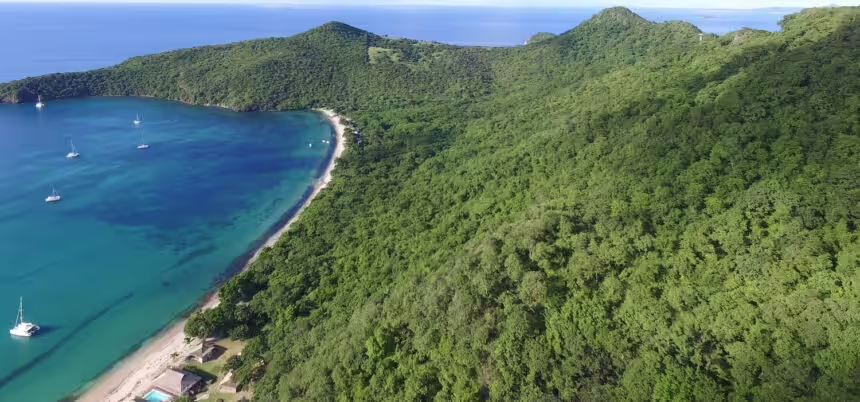
Chatham Bay on Union Island have become the epicenter of a fierce political and economic debate. The sale of approximately 100 acres of prime beachfront land to private developer AHRA LLC has ignited a national controversy, pitting the government’s vision of conservation and fiscal responsibility against a blistering critique by former Prime Minister and Opposition Leader Dr. Ralph Gonsalves.
While the current New Democratic Party (NDP) administration frames the deal as an innovative conservation and debt-relief triumph, critics argue the transaction represents a deeply flawed liquidation of a national “crown jewel” that leaves major questions unanswered.
The Friday administration has defended the transaction—which secured nearly EC$53 million—as a landmark achievement for a nation carrying a heavy fiscal burden. Facing an inherited public debt of approximately 113% of Gross Domestic Product (GDP), Prime Minister Hon. Dr. Godwin Friday stated that the proceeds will support critical national priorities, including debt reduction, funding for the Ministry of Fisheries, land and sea conservation, climate resilience, and initiatives to improve government efficiency.
To justify the sale, the government highlights two main pillars:
Restricted Preservation: The land is being sold under binding covenants that restrict its development potential, placing biodiversity protection and the preservation of local wildlife—such as the endangered Union Island Gecko—at the center of its future. Friday argued that Chatham Bay is an exceptional national asset, but rejected the notion that its highest value must necessarily come from intensive hotel or resort development.
The Repurchase Safeguard: The agreement includes a unique two-year option allowing the government to buy back the land at the exact same price at which it was sold.
To support this innovative model, the Prime Minister pointed to regional precedents like Belize’s 2021 “Blue Bond” debt-for-nature refinancing, which reduced Belize’s national debt by 12% of its GDP while generating millions for marine conservation. Additionally, around the time of the transaction, the government moved to return lands in southern Union Island to local residents—property that the previous administration had acquired for foreign resort development.
Opposition Leader Dr. Ralph Gonsalves, head of the Unity Labour Party (ULP), has launched a devastating counter-offensive, dismantling the government’s narrative and calling their celebration of the sale “laughable” and “absolute misbehavior.” A central point of contention is the NDP’s claim that the sale represents a “substantial capital gain” for the public because the previous ULP government originally reacquired the Chatham Bay property for “less than EC$700,000.”
Gonsalves thoroughly rejected this characterization, explaining the actual legal history of the site:
The Forfeiture Settlement: The parcel originally belonged to American investors who purchased it under the James Mitchell NDP administration for less than US$200,000—a price Gonsalves claims was kept artificially low to evade stamp duty. Because the investors breached their alien landholding license by failing to conduct any development for approximately 15 years, Gonsalves’ administration successfully sued for forfeiture under 1922 legislation.
The Court Penalty: After defeating the investors in both the High Court and the Court of Appeal, the government agreed to a “take-it-or-leave-it” settlement two days before a scheduled Privy Council hearing. The state returned the exact purchase price listed on their deed, plus 5% interest calculated to January 2006, when the lawsuit was filed. This legal settlement—prepared by then-Senior Counsel Camilo Gonsalves and argued by Senior Counsel Anthony Astaphan—resulted in the EC$700,000 figure. The resulting sum was a court-secured penalty for a defaulted license, not an open-market valuation.
Gonsalves revealed that the defaulting investors were so aware of the land’s true worth that they had offered to settle the lawsuit in 2006 for US$20 million (EC$54 million)—the exact same figure the current NDP government has accepted twenty years later. Furthermore, Gonsalves disclosed that over fifteen years ago, the chief surveyor valued Chatham Bay at approximately US$42 million (over EC$110 million).
Given subsequent infrastructure and property developments on Union Island, Gonsalves argues the land’s market value is substantially higher today, meaning the government sold the estate for less than half of its historical valued price.
To highlight the poor financial management of the transaction, Gonsalves contrasted it with the ULP’s transaction at Mount Wynne, where the previous government sold just over 30 acres of land for over EC$40 million. By comparison, Chatham Bay represents 100 acres of prime beachfront land—more than triple the size of the Mount Wynne parcel—sold for just EC$54 million. This represents a per-acre sale price that is less than half of what the ULP secured at Mount Wynne.
As public debate intensifies, the conflicting claims of the government and the opposition leave several critical questions open in the public square:
How was the EC$53–54 million sale price justified in light of historical valuations? If the chief surveyor valued the property at over EC$110 million fifteen years ago, why did the government agree to a price that is less than half of that historic figure, accepting the exact dollar amount that defaulting investors offered to pay twenty years ago?
Why must conservation require private ownership? If environmental preservation of the Union Island Gecko and the natural biodiversity is the primary goal, why did the government sell the land to a private corporation (AHRA LLC) instead of establishing a publicly owned, state-managed national park?
What are the specific, legally binding covenants protecting the land? What exact development restrictions are written into the agreement, what penalties exist for breaches, and how will the public be assured that the private developer complies with these environmental restrictions?
Is the two-year buy-back option financially realistic? With national public debt sitting at approximately 113% of GDP, under what realistic fiscal scenario would the government be able to find the EC$53 million required to repurchase the land if they chose to exercise the option?
Who is behind AHRA LLC? Who are the principal investors of the private entity purchasing this national asset, and what is their track record in environmental conservation?
How will the proceeds actually be distributed? Although the government promised the funds would support debt reduction, the Ministry of Fisheries, land and sea conservation, climate resilience, and government efficiency, what are the specific allocations and oversight mechanisms to prevent these funds from being absorbed into general administrative expenses?
The debate has also exposed a deep philosophical divide regarding state control and environmental preservation:
The NDP View: Prime Minister Friday maintains that responsible governance means recognizing that not every beach or forest must be intensively developed to have value. He argues that environmental protection and responsible economic management can go hand-in-hand.
The ULP View: Gonsalves dismissed the conservation justification as “pure foolishness trying to hoodwink people,” arguing that if the state genuinely wanted a conservation park, it could establish one under state ownership without selling national territory to a private corporation. Gonsalves revealed that during his tenure, he rejected an offer from a Vincentian citizen who owned a home in Mustique who wanted to buy the 100 acres to keep as a national park, because he believed prime land must be leveraged for resort development to create jobs, employ Vincentians, and boost the economy of Union Island and the Southern Grenadines. Gonsalves’ administration never had any intention of selling the crown jewel for conservation, choosing instead to hold the land until serious investors with real resources came forward.
