

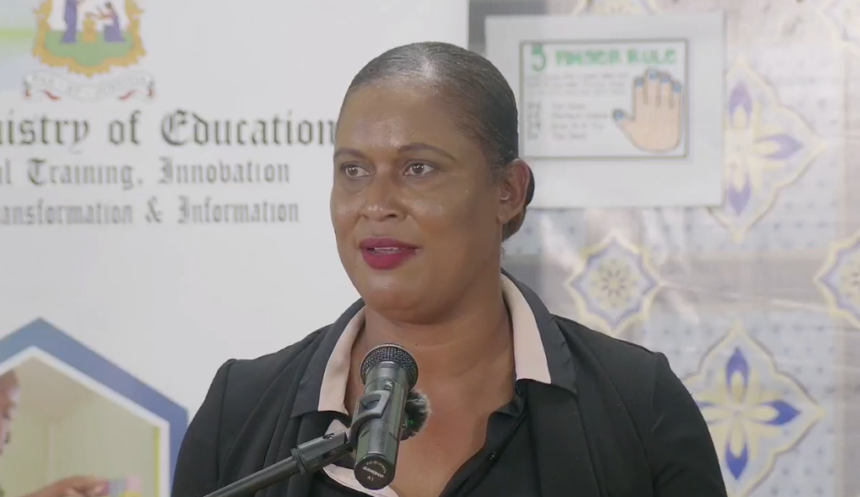
St Vincent Government officials, education leaders, and residents of Sandy Bay and surrounding communities gathered recently for a critical town hall consultation to deliberate on the location, curriculum, and community role of the new Sandy Bay Secondary School.
School Improvement Project Manager Dimitri Samuel provided historical context, reminding attendees that designs had originally been drafted to rebuild the secondary school at its old site. However, the explosive eruption of the La Soufrière volcano forced a major shift. The government adapted, seeking a larger, more modern facility at a better location, with the explicit goal of returning the school directly to the Sandy Bay community.
Currently, the Sandy Bay Secondary School operates at a temporary location with an average population of 200 students. While the initial post-volcano design catered to 400 students to accommodate future growth, Samuel explained that the government is evaluating a phased approach.
The facility may initially be built to accommodate 200 to 300 students, with built-in provisions for seamless expansion. This strategy aims to manage design and construction costs responsibly while providing a top-tier learning environment.
To guide the community’s recommendations, Samuel outlined several crucial criteria for evaluating potential sites:
- Accessibility: The site must be easily accessible for students, parents, and community members, including individuals with disabilities. It must also accommodate construction vehicles to minimize project costs.
- Proper Size: The building footprint requires a minimum of 17,000 to 20,000 square feet, supporting an overall facility size of approximately 47,000 square feet.
- Circulation and Recreation: The ideal site should feature enough flat land to accommodate a netball court and a playing field.
- Environmental Safety: Crucially, the location must be safe from natural hazards, particularly flooding and landslides.
- Student Security and Proximity: To ensure students can participate in after-school programs—such as scouts, guides, and sports—and return home safely, the site should be close to residential areas and well-lit. Samuel noted that students leaving classes as late as 6:30 PM should not have to traverse isolated or dark roads.
The consultation sparked a lively debate among local residents and educators regarding several proposed locations:
- Old Orange Hill Village: Some community members championed this location, noting that it has ample space to accommodate a playing field, hard courts, and a large school building. Proponents argued that constructing the school here would naturally expand the village, attracting residents from nearby areas like Overland. However, others—including a local youth speaker—expressed strong reservations, describing Orange Hill as a “lonely area” on evenings. They voiced safety concerns about children walking through isolated spaces after dark.
- London Playing Field: Another popular suggestion was the London playing field area, which already features a playing field and hard court. Supporters acknowledged that while space above the field is limited, the government could explore the feasibility of relocating some nearby residents to make room for the school.
- The Old School Site and Radio Station Repurposing: A proposal was made to return to the original school site, perhaps utilizing the space as an annex or integrating it with the underutilized local learning resource center and radio station. While Samuel pointed out that a split annex would present severe logistical hurdles and double staffing requirements, he praised the idea of repurposing the radio station downstairs. This space could be converted into a state-of-the-art audio and video studio, perfectly complementing the school’s highly active music program.
- Tourama (Orange Hill): Deemed “medium ground” by North Windward Representative Shevern John, Tourama offers extensive government-owned land. Minister John noted that Tourama could easily support a comprehensive school model, including a playing field, agricultural plots, and specialized vocational workshops.
A central theme of the consultation was elevating the school’s academic offerings. The acting principal of the Sandy Bay Secondary School spoke passionately about the severe limitations of their current temporary site, which lacks dedicated science labs. Consequently, students are restricted to Integrated Science, Human and Social Biology, and Agricultural Science, preventing high-achieving students from pursuing pure sciences like chemistry, physics, and biology.
Minister Philip Jackson responded with a bold vision: the new school will be designed as a “center of excellence for science education,” complete with modern science and agricultural laboratories.
To overcome staffing challenges, Minister Jackson revealed a pioneering national strategy to deploy “Master Teachers.” Leveraging digital technology, the Ministry plans to coordinate curricula so that top-tier specialist teachers in one part of the country can deliver specialized syllabus sections to students across St. Vincent and the Grenadines.
The consultation also focused on broadening Technical and Vocational Education and Training (TVET). Beyond traditional options like woodwork and metalwork, speakers called for training in high-demand, practical fields.
The acting principal emphasized that many students are eager to learn modern services like barbering, hair braiding, nail care, and cosmetology. Additionally, residents highlighted the importance of preserving local cultural heritage by offering classes in traditional Garifuna and Kalinago crafts, such as basket weaving and bag and mat making.
Mrs. Hepsey Roberts, Principal of the Sandy Bay Government School, reminded the forum of the importance of disaster resilience. As the head of the only school in St. Vincent selected for a specialized disaster resilience project, she warned against cramming the secondary school into tight spaces, emphasizing that adequate evacuation routes and safe assembly zones are vital to protect student lives during emergencies.
