


Confronting the $3.5 Billion Debt Inheritance
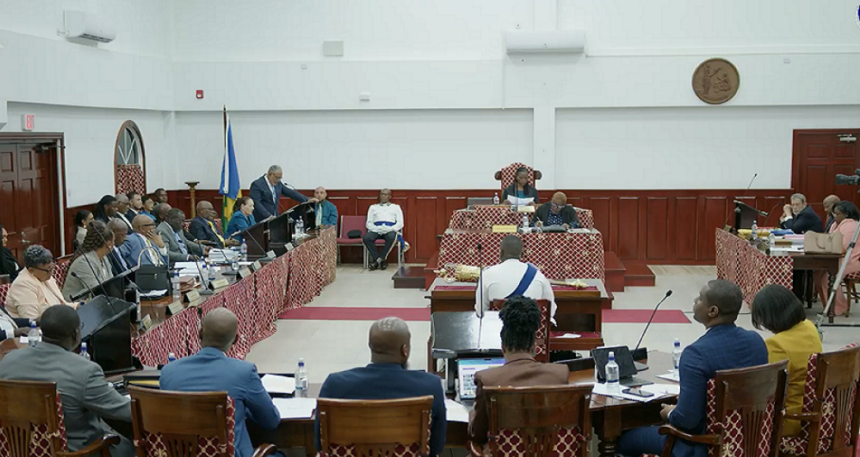
On February 9, 2026, Prime Minister Dr. Godwin Friday delivered a budget address that carried the gravity of a historic 14-1 electoral mandate. For the first time in over two decades, the New Democratic Party (NDP) has taken the helm of the nation’s finances, signaling a definitive end to the previous administration’s long tenure.
Dr. Friday’s address was intended to fulfill a “sacred responsibility” to a citizenry that voted decisively for change. After twenty years in opposition, the NDP faces a monumental task: transitioning the country from a state of emergency “rescue” toward long-term economic resilience while untangling the fiscal knots tied by its predecessors.
The “rescue” began with a sobering disclosure of a dismal fiscal landscape. Most critically, the administration revealed a “hook in the gill” of the national economy: a public debt that has ballooned to levels far exceeding regional benchmarks. Investigative scrutiny of the books uncovered a troubling trend of “fiscal recklessness” in the previous administration’s final days, including contracts hastily concluded and “struck at speed” just days before the polls. This inheritance, characterized by the NDP as the byproduct of a “Lost Decade” (2016–2025), leaves the current government with a narrow path toward stabilization.
Fiscal Snapshot: The 2025 Inheritance
| Indicator | Value | Implications |
| Total Public Debt | EC$3.5 Billion | Represents a historic high and a systemic sustainability risk. |
| Debt-to-GDP Ratio | 110.3% | Well above the ECCU benchmark of 60% by 2035. |
| Debt Service Ratio | 39% | 39 cents of every revenue dollar is consumed by debt interest and principal. |
| Current Account Deficit | EC$69.8 Million | Revenue is insufficient to meet basic, day-to-day costs of government. |
To navigate this crisis, the Friday administration is invoking the “prudent conservatism” of the Mitchell-Eustace era (1984–2001), a period defined by consistent surpluses and 5% annual growth. By moving away from heavy state-interventionist models, the new administration justifies a return to a strict Fiscal Responsibility Framework.
The philosophy is simple: spend only what is earned and incentivize the private sector to lead. However, as the Prime Minister noted, the true cost of this inheritance is not merely found in red ink on a ledger, but in the lived reality of a population where the “growth” of previous years failed to reach the kitchen table.
The “Silent Crisis” – Poverty
The “One Nation Together” agenda is predicated on a blunt acknowledgment of a “silent crisis” of poverty. Drawing on the 2018 Survey of Living Conditions and the 2023 Census, the 2026 budget admits that nearly one in three Vincentians is living in poverty or remains a single paycheck away from it. This admission is a prerequisite for the administration’s policy shift, as they argue that previous “glossy statistics” obscured a widening chasm in the national social fabric.
This crisis is defined by a “Growth Paradox”: while national GDP moderated at a seemingly healthy 4.4% in 2025, the cost of food and non-alcoholic beverages surged by a staggering 38% between 2019 and 2025. This 38% food inflation vs. 4.4% growth metric illustrates why the average citizen feels poorer despite macroeconomic gains.
The geographic divide is equally stark. The “Forgotten North,” specifically the Red and Orange Zones impacted by the 2021 La Soufrière eruption, remains economically depressed. In these rural communities, the “indigence line” now exceeds $10 per day—the bare minimum for survival.
The profile of vulnerability is multifaceted:
Gendered Vulnerability: A significant portion of the poor live in female-headed households, where women face limited access to land and higher caregiving burdens, making them disproportionately susceptible to external shocks.
The “Grey Zone” of Employment: Informal employment accounts for 41.8% of the workforce (roughly 20,150 workers). These individuals lack contracts, pensions, or social security, leaving them with no safety net when disasters strike.
Rural Stagnation: Poverty is spatially concentrated in the north, where access to healthcare and quality education is lower, leading to higher school dropout rates.
The administration’s “Policy Ladder” offers immediate tactical relief: doubling Public Assistance to $500 per month for 4,614 beneficiaries and a “Youth Guarantee Pledge” promising every young person a job, training, or an internship. Yet, lifting the North requires more than aid; it requires a total reconstruction of the nation’s physical and economic foundation to ensure that geographic location no longer determines one’s prospects.
The Four Pillars of Growth
The 2026 budget outlines a strategic move away from the “Lost Decade” of stagnation toward a multi-pillared economic transformation. The administration’s goal is to “grow its way out of the crisis” by focusing on four structural pillars.
Agriculture: Productivity and Structural Reform Repositioning agriculture as an export-led engine requires addressing “acute labor shortages” that have left the sector reeling. To combat this, and to address “idle” government spending, the administration is launching a pilot to second government-paid agricultural workers to private farms.
A significant $2.7 million is dedicated to Arrowroot Revitalization, including a new processing plant to revive the northern economy. A central aggregator will also be established as a buyer of last resort to prevent produce from rotting in fields.
Tourism: Optimizing the “Super-Cycle” Stay-over arrivals surpassed 100,000 for the first time in 2024, yet the administration warns of a policy failure in the yachting sector, which is losing market share to regional neighbors.
Tourism Performance Metrics (2023-2025)
| Metric | 2023 (Jan-Sept) | 2024 (Jan-Sept) | 2025 (Jan-Sept) |
| Stay-over Arrivals | 57,967 | 71,100 | 81,025 |
| Growth Rate (YoY) | – | 22.7% | 14.0% |
| US Market Arrivals* | 22,898 | 28,733 | 39,187 |
*The significant jump in 2025 US arrivals was supported by new flight capacity from five carriers: JetBlue, Delta, LIAT 2020, WinAir, and Sunrise Airlines.
To fix the yachting drain, a new duty-free concession regime for yacht parts and services aims to recapture maintenance and provisioning business currently lost to other islands.
The Blue Economy: The creation of the “Ministry of Fisheries, Marine and Land Conservation” signals a move to treat the ocean as a primary growth frontier. Strategic moves include establishing “wild nurseries” off Adams Bay and Isle a Quatre to protect conch and lobster stocks, alongside a $10.9 million allocation for coastal livelihoods.
The New Economy: The information/BPO sector has grown by 110% over the last decade. The administration plans to accelerate this through a “National Innovation Hub” and a “Creative Industries Act,” providing $20,000 in duty-free concessions for creative equipment.
These four pillars are designed to diversify the economy. However, as the Prime Minister noted, these pillars cannot stand without the “external lungs” of the economy: resilient physical infrastructure.
Infrastructure & Utilities Analysis
For 2026, the administration has allocated EC357.5 million to capital investment, with a firm rejection of the “build-break-rebuild” cycle. Prime Minister Friday emphasized that climate resilience is no longer a slogan but a “fiscal necessity,” especially following Hurricane Beryl, which cost the nation US48.3 million in damages.
In a move of “responsible stewardship,” the government is capping the geothermal project. Investigative details reveal that the project has become a public safety risk, as the wells are currently emitting steam and gases.
Consequently, expenditure will be restricted to risk mitigation and environmental safety. Instead, the strategy shifts toward “Targeted Clean Energy Integration” at high-consumption sites like the Argyle International Airport (AIA) and the Arnos Vale Hospital to deliver immediate savings.
Water Security: A $23 million investment is being funneled into the Overland Water Supply System. This project marks a strategic shift from fragile surface water to resilient groundwater sources, utilizing solar-powered pumps to ensure the northeast has a reliable supply.
Transport Chokepoints: The AIA runway, which has suffered from chronic surface damage and flight disruptions due to “delayed maintenance” under the previous regime, is undergoing a comprehensive technical study for permanent repair. Additionally, the government is moving to break the “asphalt monopoly” by commissioning a feasibility study for a state-owned asphalt plant.
Project HOPE and Resilient Housing
The 2023 Census revealed a 27.5% increase in households since 2001, but an aging housing stock. Through “Project HOPE,” $35 million is allocated for housing rehabilitation, prioritizing steel-frame housing for speed and durability. A “National Housing Recovery and Resilience Fund” will be established within the National Development Bank to offer low-interest “build-back-better” loans.
Building resilient structures is vital, but the state must also protect its people through reformed national security and public health systems.
Public Welfare Review
The administration operates on the premise that health and safety are “preconditions for stability.” The 2026 budget seeks to restore “operational confidence” by addressing structural distortions in the public service.
National Security Reform
The security agenda focuses on internal repair. The administration is implementing a “Pay for Performance” policy to address the morale of 112 acting police corporals who have served without substantive pay for years. Furthermore, the decommissioning of the Kingstown Prison by mid-2026 and the consolidation of operations at Belle Isle represent a shift toward humane correctional management.
The Healthcare Overhaul
The $117.5 million healthcare budget focuses on self-reliance and mitigating a “silent epidemic” of non-communicable diseases (diabetes and hypertension).
Arnos Vale Flagship Hospital: This facility will consolidate maternity, pediatric, and major hospital services, ensuring women and children are not “left behind” in the deteriorating facilities in Kingstown.
Medical Staffing Localization: A three-year plan will phase out reliance on foreign medical officers by recruiting local doctors to address language barriers and reduce costs.
Decentralized Diagnostics: Expanding community laboratory access from 8% to 18% to increase patient convenience.
The Education Quality Deficit
The administration would be confronting a “math crisis” where national pass rates fluctuate between 29% and 41%. This “quality deficit” is directly linked to the national “Execution Gap”—a paradox where high unemployment exists alongside acute skills shortages in the construction and technical trades.
The policy response involves deploying specialist math teachers for Grades K–6. In the vocational sector, “Prior Learning Assessment” (PLA) will allow skilled but uncertified tradesmen to gain formal certification, turning informal skills into formal productivity.
Sustainable welfare, however, requires a radical new approach to sovereign financing, as explored in the final financial strategy.
Financial Strategy
To fund resilience without “mortgaging the future,” the administration is introducing a strategic pivot in sovereign financing. The centerpiece is the launch of a Citizenship by Investment (CBI) program by mid-2026. While the administration frames this as a tool for “sovereign capital mobilization,” it does so amidst a “revenue-at-all-costs” regional environment and emerging international norms that make such a pivot a high-stakes endeavor.
The CBI Integrity Framework
To build trust and distinguish itself from regional competitors, the administration is adopting an “Integrity First” model:
St. Vincent and the Grenadines Investment Fund (SVGIF): This is a legislatively established and ring-fenced vehicle designed to prevent the “political discretion” of the past. 100% of non-debt capital will be directed toward verifiable, long-term productive expenditure.
Continuous Due Diligence (CIDD): Protocols including residency requirements and multi-layered background screening are intended to maintain the nation’s international reputation.
The National Development Bank (NDB)
The NDB is the “strategic financial instrument” designed to shift the nation from a consumption-driven to an investment-driven economy. By using partial credit guarantees, the NDB aims to de-risk lending for MSMEs and the Blue Economy—sectors often ignored by commercial banks.
Revenue Measures
The budget proposes “Rationalising Tax Expenditures” to address the $624.1 million in revenue foregone through import concessions between 2022 and 2025. A uniform 20% reduction in these concessions is expected to generate $30.4 million annually. Furthermore, a nationwide property revaluation—the first since 2013—will broaden the tax base to reflect current market values.
In his closing remarks, Prime Minister Friday asserted that fiscal discipline is the only path to securing national sovereignty. By re-establishing the guardrails of responsibility, the administration aims to turn the “rescue operation” of 2026 into a “resilient reality,” building “One Nation Together” through substance, diligence, and shared ownership.