
When I was a child at the Belair government school in St. Vincent, a travelling magician once visited and made a bird appear out of thin air. I raced home, breathless, to tell my late grandmother. She listened, laughed and then asked one question: “Which hand were you looking at?”
I didn’t understand the question so I went back for the second show, and this time I watched the other hand and saw exactly how the trick was done. When I told her, she asked a second question, one that took me much longer to answer: “Why did he do it?”
The “how” ruined magic shows for me from that day forward. The “why” I didn’t really answer until much later in life only after having to read Niccolo Machiavelli “ The Prince” one of the many must read books on my family book shelf’s. But those two questions have stayed with me, because they are, in miniature, the entire discipline of asking hard questions about power. Misdirection only works on the hand you’re not watching. And it only works at all if you never ask what the trick was for.
I think of my grandmother “why” question every time a government tells us that a land sale is “for conservation.”
The trick in question
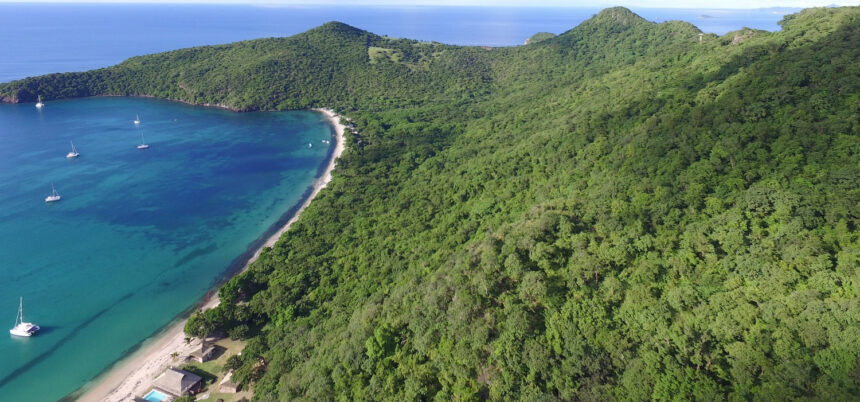
In August 2026, the government of St. Vincent and the Grenadines sold roughly 100 acres of prime beachfront land at Chatham Bay, Union Island, for approximately EC$54 million about US$20 million. The ruling New Democratic Party defended the sale as an arrangement to protect the area’s biodiversity, pointing to covenants written into the sale agreement and to the presence of the endangered Union Island Gecko, a species found nowhere else on Earth.
Sound noble. Except the government’s own account of the deal tells a different story about what it was actually for. Prime Minister Godwin Friday disclosed the sale to Parliament not as an environmental milestone, but as a fiscal one crediting the roughly EC$52.7 million capital injection with narrowing the country’s mid-year budget deficit by more than half compared to the year before.
That is not the language of conservation. That is the language of a government that needed cash and reached for the nearest national asset it could sell.
Former Prime Minister Ralph Gonsalves, now opposition leader, made the same point more bluntly, calling the conservation justification “pure foolishness trying to hoodwink people.” His argument cuts to the heart of it: if the state genuinely wanted to protect the biodiversity of Chatham Bay, it did not need to sell the land to a private company to do it, it could have declared the area a conservation park under its own control. Instead, a public asset became a private one, at a price that, per acre, came in at less than half of what the government had secured for a comparable parcel elsewhere in the country.
This brings me back to my grandmother’s second question. If conservation isn’t really the reason, what is?
What’s in the other hand?
Here are four possibilities worth asking a government to rule out, not just assert isn’t happening.
1. A straightforward cash grab, conservation-branded. This is the one the government’s own numbers support. A EC$52.7 million injection that gets cited in Parliament as the reason a deficit shrank by over 50% is, on its face, a debt-relief transaction. “Conservation” here isn’t the purpose it’s the packaging. It’s the kind of language that makes a sale of national asset sound like stewardship rather than a fire sale.
2. Land as collateral. Once crown land becomes a private company’s titled asset, it becomes bankable. A “protected” designation can lower the land’s value for resort development while doing nothing to stop it being pledged against a loan. Worth asking publicly: who are the shareholders of the holding company, and has the land been used, or is it intended to be used, to secure financing anywhere?
3. Carbon and biodiversity offset monetization. Conservation covenants are exactly the paperwork international carbon and biodiversity credit registries look for. Land bought cheap and registered as “protected” can generate a steady income stream selling offsets to corporations abroad often worth more over time than any resort development, and requiring far less local employment or public benefit. Worth checking: has the buyer applied to register the land with any voluntary carbon or biodiversity credit scheme?
4. Eco-tourism exclusivity. “Conservation” status is also a marketing tool. It lets a private owner restrict public access to what was once a public beach, then sell the resulting scarcity as a “pristine, protected” experience at a premium to visitors who will never know it was crown land twelve months ago.
None of these four is mutually exclusive. A single transaction can lower government debt today, sit as bankable collateral tomorrow, and become a carbon-credit or eco-resort asset the year after. That’s not a coincidence it’s the whole appeal of “conservation” as a label. It is one of the few justifications broad enough to survive being applied to all three at once, and vague enough that almost no one asks which hand to watch.
My grandmother never went to college or university. But she knew that a trick isn’t explained by what you’re told to look at, it’s explained by what the magician needed the audience not to see. Twenty million dollars is a lot of birds and lizards. It’s worth asking, plainly, what else that money is protecting.