
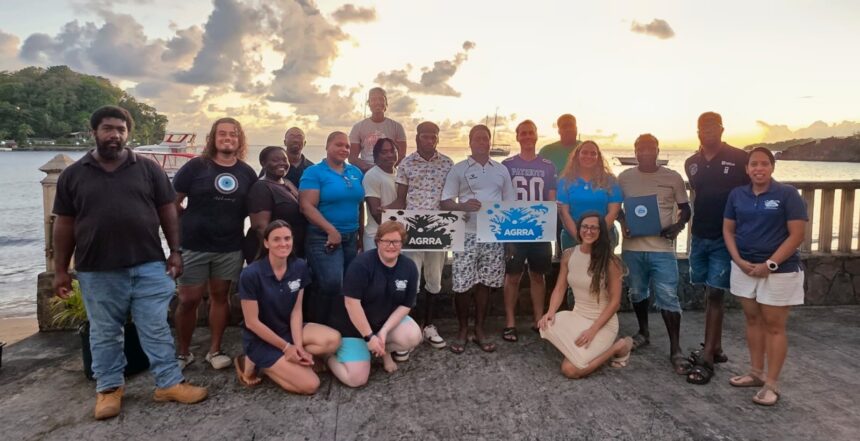
The Ministry of Fisheries, Marine and Land Conservation and Climate Resilience spearheaded an Atlantic and Gulf Rapid Reef Assessment (AGRRA) training to strengthen local capacity to monitor and assess coral reef health using standardised methods.
“Our reefs protect our coastlines, feed our communities and support our tourism sector. Having a trained national team that monitors them using the same methods as the rest of the Caribbean means our management decisions can rest on solid, comparable data,” said Mrs Delight Ollivierre-Davis, coordinator of the project activity from the Ministry of Fisheries, Marine and Land Conservation and Climate Resilience.
The five-day course ran from 19 to 23 October 2026 at Paradise Beach Hotel in Villa, St. Vincent, bringing together 18 participants. Daily sessions from 9 am to 5 pm combined classroom theory with practical fieldwork, including seven training dives. Participants gained hands-on skills to observe, measure, and analyse reef conditions, and the data they collect will support marine management and decision-making in St. Vincent and the Grenadines.
Participants came from the Ministry of Fisheries, Marine and Land Conservation and Climate Resilience; We Are Mayreau’s Reef Life team; CLEAR Caribbean; Richmond Vale Academy; National Parks, Rivers and Beaches Authority; Tobago Cays Marine Park; Serenity Dive; and Environmental Protection in the Caribbean (EPIC).
AGRRA and the Ocean Research and Education Foundation (ORE) delivered the training, with facilitators Giselle Brady, Michelle Taylor, and Claudia Guerrero. It combined classroom sessions with supervised in-water exercises covering two of AGRRA’s survey protocols: Benthos and Fish. Participants learned to identify corals, algae, invertebrates, and key reef fish; record reef conditions, including coral bleaching and disease; and enter and check data in the regional AGRRA database.
Participants who completed every component earned a Professional Development Certification as AGRRA Coral Reef Monitoring Surveyors under their respective protocol, while others received partial certification in the aspects of the training they completed (theory or practical). All graduates joined the AGRRA Caribbean Network, which has trained more than 2,000 people from 25 countries.
Dive Antilles supported all seven training dives, providing boat access to dive sites, equipment, and safety assistance.
The Ministry of Fisheries, Marine and Land Conservation and Climate Resilience facilitated the training, funded through its Ridge to Reef project, “Conserving Biodiversity and Reducing Land Degradation using a Ridge to Reef Approach” (“Ridge to Reef”). The United Nations Development Programme (UNDP) implements the project with funding from the Global Environment Facility (GEF), with the Ministry of Agriculture, Forestry and Rural Transformation as the implementing project lead. CLEAR Caribbean funded the in-water training and dive operations through a Caribbean Biodiversity Fund project supported by the German Federal Ministry for the Environment, Climate Action, Nature Conservation and Nuclear Safety (BMUKN) through the International Climate Initiative (IKI) and KfW.
Why it matters
Caribbean reefs are under growing pressure. The Global Coral Reef Monitoring Network’s 2025 report found that hard coral cover in the region fell by 48% between 1980 and 2024, while disease, heat stress and overfishing continue to take a toll. Standardised, long-term monitoring helps managers detect decline, recognise recovery and assess whether protection is working.
“Good reef management starts with knowing what is actually happening underwater. This group now has the skills to collect reliable data year after year, and that long-term record is what will help us better understand the impact that conservation and restoration work is having,” said Dr Owen Day, Executive Director of CLEAR Caribbean.
The training supports ongoing national efforts to improve coral reef monitoring and protect marine biodiversity in St. Vincent and the Grenadines. Because AGRRA methods are used across the region, data collected locally can be compared with reefs throughout the Caribbean.
“In the Grenadines, the reef is part of daily life. Training our Reef Life team alongside fisheries officers and regional partners means people from our own communities are directly involved in protecting our environment for the next generation,” said Marion Isaacs, Executive Director of We Are Mayreau.
Next steps
Participants will form a national AGRRA monitoring team and carry out reef assessments across St. Vincent and the Grenadines. The team will receive continued support from the broader AGRRA team, including guidance to help sustain and strengthen the capacity developed through the training.