
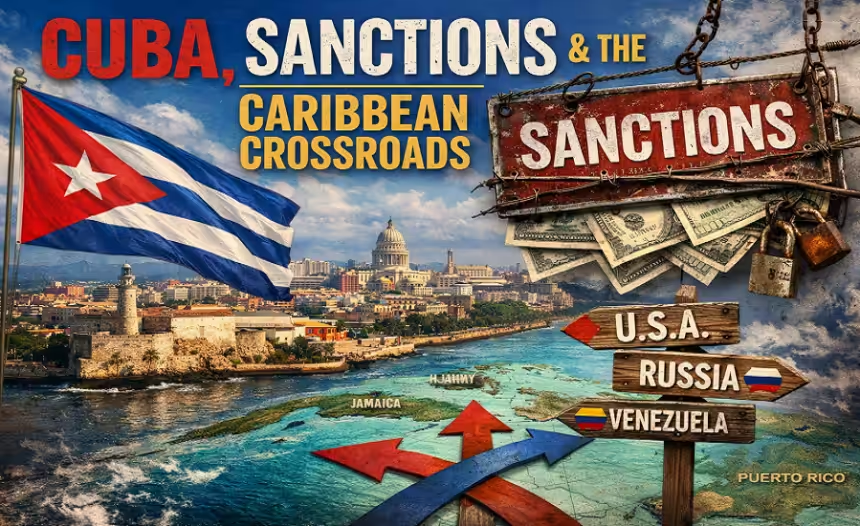
Few issues test Caribbean diplomacy more consistently than Cuba. For decades, regional governments have defended Havana’s sovereignty in international forums while simultaneously managing deep economic, financial and security ties with the United States. As such, when senior U.S. lawmakers call for a sweeping review of licenses that authorize American business with the Cuban state, the ripple effects are not confined to Capitol Hill, but rather, they move through the Caribbean Basin and into Latin America’s wider strategic calculus.
Representatives Mario Díaz-Balart, Carlos Giménez and María Elvira Salazar have urged the U.S. Treasury and Commerce Departments to scrutinize and, where necessary, revoke licenses that allow transactions benefiting Cuban state-controlled entities. Their argument is straightforward, as if U.S. law, such as the LIBERTAD Act of 1996, prohibits economic support to the Cuban government until democratic reforms occur, then enforcement must be consistent and rigorous. Exceptions should not swallow the rule.

From a Caribbean vantage point, the instinct may be to recoil as CARICOM governments have long opposed unilateral sanctions and have consistently defended Cuba’s sovereignty in multilateral forums, including annual U.N. votes condemning the U.S. embargo. Many Caribbean states also maintain close diplomatic and technical cooperation with Havana as Cuban medical brigades have served across the region and Cuban scholarships have educated generations of Caribbean professionals.
Cuba’s economy remains heavily state-directed, with dominant sectors tied to ministries and military-affiliated conglomerates and when U.S. licenses allow commercial flows that advantage those entities, it can distort competition in tourism, logistics, professional services and import channels across the Caribbean. Strengthened sanctions, applied consistently, reduce the possibility that state-subsidized structures receive indirect advantages through selective U.S. authorization. Smaller Caribbean economies, built largely on private enterprise and open market frameworks, stand to benefit from a clearer and more equitable competitive environment.
Moreover, Caribbean banks operate within the U.S. dollar system and are acutely sensitive to regulatory risk. Uncertainty surrounding what is permitted under evolving Cuba licenses can produce de-risking behavior and costly compliance burdens. A comprehensive review, particularly if accompanied by updated guidance, could provide the predictability financial institutions require. In a region already grappling with correspondent banking pressures, regulatory clarity is a form of stability.
While CARICOM has consistently championed democratic principles and rule of law, even while opposing unilateral sanctions, a firmer and more coherent U.S. enforcement posture underscores that economic engagement in the hemisphere is linked to institutional accountability. For Latin America more broadly, it sends a signal that access to the world’s largest economy remains connected to governance standards. That linkage, applied transparently, strengthens regional expectations around political reform and human rights.
Probably the most interesting impact on the region surrounds Cuba’s relationships with Venezuela and Nicaragua, both under U.S. sanctions, which places it within a broader geopolitical matrix. Clear and consistent enforcement by Washington reduces policy volatility and signals a defined strategic approach and for Caribbean and Latin American governments navigating external partnerships, predictability from the United States enhances diplomatic planning and economic forecasting. Policy coherence, even when firm, is often preferable to oscillation.
When commercial flows disproportionately benefit state-controlled conglomerates, independent entrepreneurs struggle to compete. Tightened scrutiny of licenses that advantage regime-linked entities may shift attention toward avenues that more directly empower private Cuban actors, civil society and small enterprise — areas where engagement can have more transformative impact. For a Caribbean region that has invested heavily in small business development and entrepreneurship, this distinction is consequential.
Of course, none of this negates the need for humanitarian channels, medical cooperation or people-to-people exchange, and avenues should definitely remain safeguarded. But there is a difference between targeted humanitarian engagement and broad commercial activity that reinforces centralized control.
For CARICOM and Latin America, the question is not whether to choose between principle and pragmatism. It is whether clearer alignment in U.S. policy can create a more stable regional framework. A disciplined review of Cuba-related licenses, as called for by Representatives Díaz-Balart, Giménez and Salazar, has the potential to do just that.
In a hemisphere where ambiguity often breeds instability, coherence can be constructive. If sanctions are to remain part of U.S. policy, applying them consistently may ultimately serve not only American statutory intent but also regional economic balance and institutional integrity.