

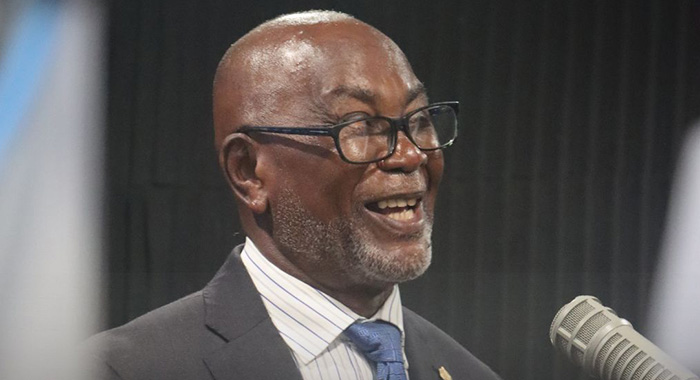
The euphoria of an election victory is a fleeting drug. For Deputy PM St clair Leacock, the transition from opposition to Deputy Prime Minister and Minister of National Security has been a sobering immersion into “rough” financial waters.
Staring into a $3.4 billion fiscal abyss—a debt figure that jumped from an initial $3.1 billion estimate once the “phantom” capital receipts were stripped away—Leacock is a man attempting to bridge the gap between private sector velocity and the grinding gears of a public sector in decay.
With audits for 2023 through 2025 still outstanding, the true depth of the debt may yet sink deeper.
Leacock in a wide ranging interview on Boom FM 106.9 OMG show spoke to several things including crime, debt, police living conditions and Taiwan.
The Deputy PM stated that when a nation faces a crime crisis, the reflexive demand is for “boots and guns.” While Leacock acknowledges the necessity of enforcement, he is pivoted toward “soft power” to reclaim the nation’s social spaces from lawlessness.
The strategy relies on “emotional accountability” rather than just the threat of a cell. This involves mobilizing community influencers—artisans, cultural icons, and the church—to make crime socially unacceptable.
The most poignant manifestation of this is a series of media infomercials which now rotates on NBC radio where a four-year-old children appeal directly to their fathers and uncles to stay out of prison so they can be present to walk them down the aisle one day.
Leader said this is an attempt to trigger a psychological shift, moving the narrative from “the people vs. the government” to a collective stand by the citizenry.
Perhaps the most visceral revelation of the new administration is the discovery that the “system failure” extends to the basic human dignity of those tasked with national security. Leacock’s tours of police stations revealed public health hazards that go far beyond a lack of equipment.
At the Layou station, female officers were found using toilets without seats. In the Central Police Station, the rank and file are sharing their quarters with pigeons and rats.
Leacock on Monday said the “human-first” cost of this neglect is embodied by a musician in the police band at Largo Height, who was found sleeping on the floor on a mattress so degraded “the Salvation Army would not give it to anyone else”—the beds having been reassigned to a training school years ago.
“This is why the government is prioritising basic human needs over grand “bricks and mortar” projects; you cannot build morale in a station unfit for habitation”.
When confronted with the sensitive issue of international relations—specifically the long-debated relationship with Taiwan—Leacock employs a metaphor for the administration’s pragmatic survival. He is effectively walking back 2016 campaign promises to switch to China, choosing instead to focus on the reality of the current “wicket.”
With a 96% debt-to-GDP ratio and a discovered debt of $3.4 billion, the government views foreign partners as essential “hand-ups,” not “hand-outs.” This is a policy of continuity dictated by fiscal reality rather than political ideology. By treating the debt as a windscreen through which they must navigate, rather than a rearview mirror of past promises, the administration seeks stability over disruption. As Leacock sums up:
“I don’t drive my vehicle looking through a rearview mirror… I drive my vehicle looking through the windscreen.”
