
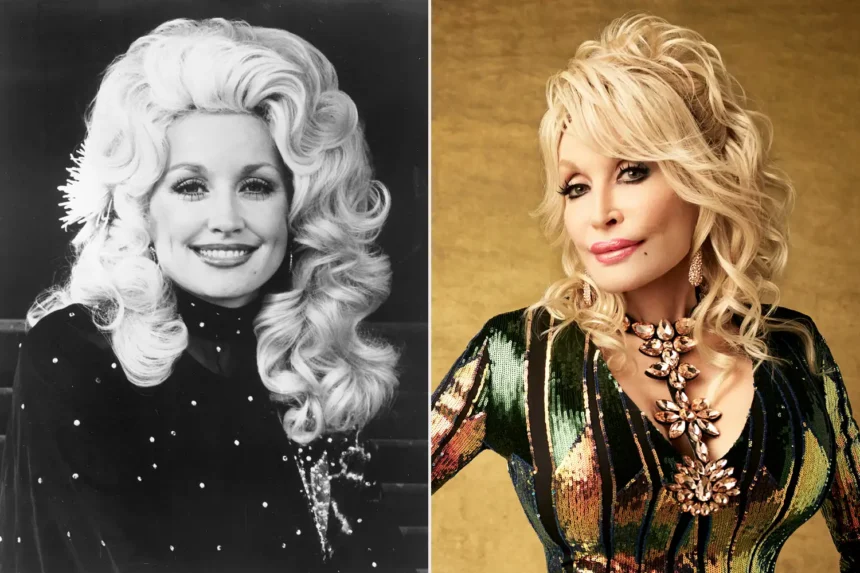
On August 25, 2026, the global cultural landscape shifted with the passing of a woman who served as the definitive bridge between the isolated hollows of the Appalachian diaspora and the pinnacle of international superstardom. Dolly Parton died at the age of 80, leaving an incomparable void in the fabric of American arts.
The announcement was delivered via an Instagram video by her nephew and head of security for over twenty years, Bryan Seaver, the son of Cassie Parton. With profound gravity, Seaver identified her formally as Dolly Rebecca Parton Dean, a title that acknowledged both her professional titanhood and her private devotion.

He described his aunt through the lens of her own father’s agricultural roots: while he farmed the soil, she “farmed songs and happiness.” In a final, evocative request that summarized her desire for grace after decades of public labor, she asked to rest in a “beautiful bed of plush cotton,” trading her heavy, world-famous rhinestones for a hard-earned, final comfort.
Parton’s departure followed a period of indomitable creative output despite a visible decline in her physical strength. Her final public sentiments, shared on August 21, 2026, revealed a woman who had “dreamed herself into a corner” and refused to stop working even as her health wavered. Facing the modern world with characteristic wit, she joked about her status as the “Queen of Social Media AI,” yet she remained grounded in the reality of her own mortality.
As the light dimmed on her extraordinary life, the world’s attention was drawn back to the Great Smoky Mountains, the rugged terrain that first forged her voice and fueled her unyielding ambition.
The authenticity that became Parton’s greatest commodity was rooted in the “homemade” poverty of Pittman Center, Tennessee. As one of twelve children, her upbringing was defined by a scarcity of resources but a surplus of faith and melody.
This environment served as the essential raw material for her art; her songs were not merely observations of the working class but dispatches from the front lines of rural survival. Beginning her musical development at age six in her grandfather’s church, she transitioned to Nashville in 1964—the day after her high school graduation—carrying a suitcase of dreams and a preternatural gift for narrative.
Crucially, Parton’s physical persona was never an accident of vanity, but a profound exercise in rhinestone-encrusted agency. She deliberately subverted her “homemade” reality by adopting a bright, bold aesthetic of tight clothes and long nails, a self-made construct that allowed her to “fix herself up” to meet her own internal standards of success rather than society’s. This strategic glamor acted as both a shield and a trademark. After her debut album, Hello, I’m Dolly (1967), and her pivotal partnership with Porter Wagoner, it became increasingly clear that her singular talent could no longer be contained within a supporting role. Her eventual departure from Wagoner’s shadow was not merely a professional pivot, but a necessary liberation for her creative soul.
In the early 1970s, Parton underwent a metamorphosis into a solo powerhouse, defining herself as the premier songwriter of her generation. This era yielded a string of masterpieces, including the chart-topping “Joshua,” the haunting “Jolene,” and the autobiographical “Coat of Many Colors.” The latter remains a cornerstone of the American songbook, a poignant exploration of dignity in the face of poverty and the transformative power of a mother’s love.
The strategic and emotional apex of this period was the 1974 composition of “I Will Always Love You.” Written as a professional “goodbye” to Wagoner, the song was an exercise in sophisticated diplomacy and raw emotion. While it was a massive success on the country charts, its 1992 reimagining by Whitney Houston elevated it to a global phenomenon. For Parton, this crossover was the ultimate validation. She famously reflected, “That’s when I felt my worth as a songwriter,” realizing that her “little song” possessed a universal, borderless resonance that transcended genre. This financial and creative independence provided the essential platform for her calculated entry into the American cinematic canon.
During the 1980s, Parton’s expansion into film solidified her status as a multi-media mogul, challenging the stereotypical limitations often imposed on the “Country Queen” archetype. Her debut in 9 to 5 (1980) alongside Jane Fonda and Lily Tomlin was a masterstroke of branding, utilizing her comedic timing to deliver a sharp critique of corporate sexism. She followed this with celebrated roles in The Best Little Whorehouse in Texas and the perennial classic Steel Magnolias, proving her depth as both a wit and a dramatic force.
The success of the song “9 to 5” provided Parton with her first No. 1 single on the Billboard Hot 100, marking her definitive crossover into pop music. As she became a global icon, Nashville purists voiced concerns about her shifting focus, yet Parton remained anchored to her roots, insisting that her soul was non-negotiable. This meteoric rise in the public eye was countered by a remarkably stable private life, which she guarded with strategic precision.
The endurance of Parton’s 60-year marriage to Carl Thomas Dean was rooted in her famous “stay gone” philosophy. By maintaining a private sanctuary away from the 24/7 magnification of the celebrity machine, the couple preserved a sense of normalcy that sustained them through decades of intense public scrutiny. Dean, described as her “biggest fan behind the scenes,” avoided the spotlight entirely, providing the unmoving center around which her chaotic world turned.
The death of Carl Dean in March 2025 was a seismic event in Parton’s final years. She honored their lifelong bond with the tribute song “If You Hadn’t Been There,” acknowledging that their love was the foundation upon which her empire was built. The loss of her “quiet anchor” significantly influenced her health, as she admitted to neglecting her own well-being while caring for him during his final months. This period of mourning led directly into her final acts of legacy-building, bridging her personal devotion with her broader devotion to humanity.
Parton’s business acumen was always secondary to her desire to uplift her home region. Dollywood was established not merely as a theme park, but as an economic engine for the Great Smoky Mountains, providing employment and dignity to her neighbors. Her commitment to childhood development culminated in the Imagination Library, a mission of literary evangelism inspired by her father’s inability to read or write. By mailing millions of books to children across the globe, she ensured that her father’s struggle would result in a worldwide legacy of literacy.
Her career was adorned with every conceivable honor, including 11 Grammy Awards, the National Medal of Arts, and a hard-earned induction into the Rock and Roll Hall of Fame in 2022. In July 2025, she achieved a final creative milestone with the premiere of Dolly: A True Original Musical in Nashville. She insisted on overseeing the production personally, determined to ensure her story was told with the rigor and “properly” earned respect she deserved. This dedication to her own narrative remained steadfast even as she faced the inevitable decline of her final year.
The closing chapter of Parton’s life was handled with the same grace and transparency that defined her career. Following the cancellation of her long-anticipated Las Vegas residency in May 2026, she faced her health challenges with a characteristic “check-up” joke, yet she was deeply serious about her intent to “put her dreams in a place where they can continue.” Her final months were a testament to her foresight, as she worked to ensure her philanthropic and musical legacies were secured for future generations of dreamers.
As the best-selling female country artist in history, with over 160 million albums sold, Parton’s impact is beyond calculation. She spent eighty years “farming happiness” and cultivating a world that was kinder, brighter, and more melodic than the one she found. Her transition from a living legend to an immortal icon of American culture was completed as she sought her “bed of plush cotton,” leaving behind the “iron butterfly” spirit that proved a woman from the mountains could indeed conquer the world. Dolly Parton’s song has ended, but its resonance is eternal.