NEMO/BRICS CONDUCTS TRAINING IN EMERGENCY COMMUNICATIONS
On July 22, 2026, 19 persons from the public and private sector successfully graduated from an intense three day course that earned each participant a Technician Class Amateur radio license.
This follows a similar training held three weeks earlier where the majority of these participants were also involved with the operation and use of modern High Frequency (HF) radios. The current training gives the successful participants the ability to operate on the amateur radio frequencies, which has millions of operators world wide, many of whom also provide service in times of national emergencies.
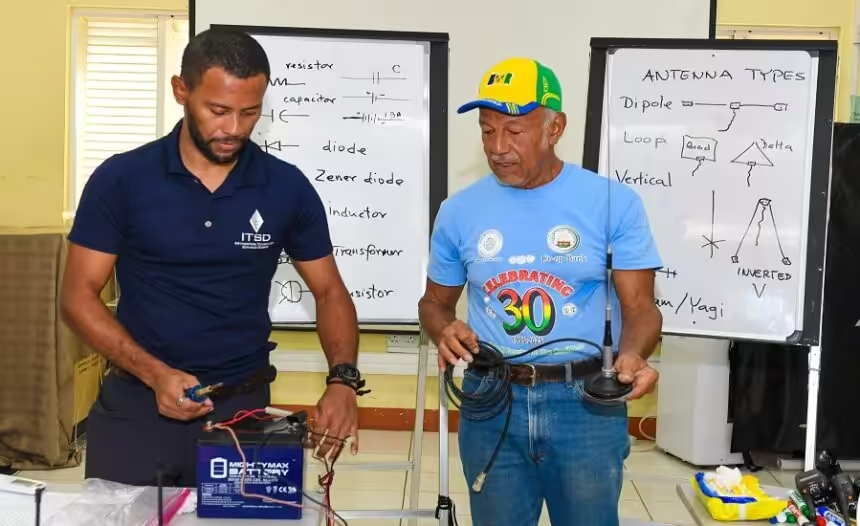
Three day course covered areas including Ohm’s Law, Frequency allocations for radio amateurs, radio etiquette, basic electricity, and antenna theory and construction among other areas.
During the session focusing on antennas, students used a formula taught to make and test a High Frequency (HF) ¼ wave dipole for the 40 Meter amateur radio band and actually tested the antenna making contact with stations located in Biabou (Monte Browne – J88NMB) and Bequia (Sylvester Tannis J88DT). Students were also given the opportunity to use VHF radios during a mini simulation while conducting training in emergency message handling.
On the final day all 19 participants successfully completed a test administered by the NTRC, allowing them to legally operate on frequencies allocated licensed amateur radio operators. Executive Director and Immediate Past President of the Youlou Amateur Radio Association – YARA , Donald De Riggs (J88CD) who conducted the training course noted that this group of students was one of the best groups he ever taught, stating that they asked pertinent questions and most importantly were actively involved with all of the practical activities including making, installing and testing the antenna they made, as well as handling themselves creatively during the mini simulation.
The test was administered by the NTRC with Mr.Cyron Cyrus as invigilator. As an incentive to the new radio operators, NEMO will provide each successful participant with a VHF handheld radio upon receiving their Technician Class amateur radio license.
The successful participants will form part of NEMO’s Telecoms sub Committee, which plays a pivotal role in post disaster and recovery scenarios. NEMO’s communications specialist Jerwayne Laidlow also took the opportunity during the first day of the training to show how radio amateurs fit into the national preparedness, response and relief mechanism. Also addressing the participants on the first day of the course was Nemo’s Director (Ag) Kenson Stoddard who reiterated the importance of the role and service provided by radio amateurs in SVG, wider Caribbean and globally.
This training initiative is part of a joint collaboration with NEMO, CDEMA and BRICS. BRICS is a program funded by the European Union (EU) and is designed to reduce the vulnerability of CARIFORUM states by strengthening institutional systems in preparation for and response to the hazards to which the region is prone. BRICS is the acronym for “Building the Resilience of CARIFORUM States” which was launched in 2019.
According to the Executive Director of CDEMA, Elizabeth Riley, noted among other things that “BRICS has served as a vehicle for regional solidarity, capacity strengthening and locally driven action”