

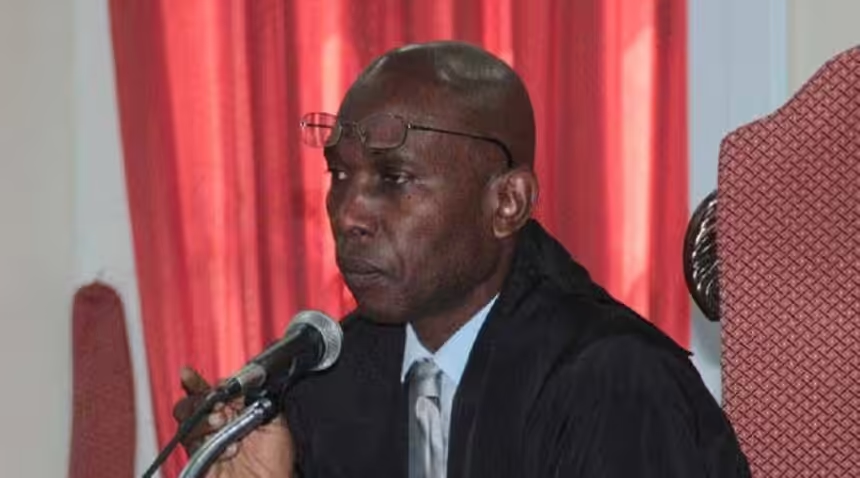
Former Speaker of the House of Assembly Jomo Thomas has issued a stark warning regarding pervasive civic unawareness and what he terms “willful ignorance” across St. Vincent and the Grenadines, cautioning that a widespread lack of basic constitutional knowledge and declining reading habits threaten public discourse and national governance.
Speaking during his regular “Plain Talk” commentary segment on OMG radio, Thomas drew a sharp distinction between classical ignorance—characterized by a simple lack of information or education—and willful ignorance, in which individuals possess access to facts but deliberately choose to ignore them. Thomas argued that much of the societal disagreement in St. Vincent stems not from genuine intellectual debate over facts, but from partisan political loyalties and personal animosity, where individuals refuse to acknowledge truth simply because of political bias.
Highlighting what he identified as a critical deficit in civic consciousness, Thomas pointed out that many Vincentians remain unfamiliar with foundational milestones in their nation’s democratic development. He noted that few citizens are aware that universal adult suffrage was achieved in 1951, granting voting rights to Vincentians aged 21 and older. Furthermore, he observed widespread public confusion regarding the head of state, noting that many citizens mistakenly identify the Prime Minister as head of state rather than King Charles, who is represented locally by the Governor General.
Addressing constitutional roles within government, Thomas referenced his own tenure as Speaker of the House of Assembly, recounting instances where members of the public criticized him on social media and radio for directing the Prime Minister to sit down or cease speaking. Thomas clarified that under parliamentary standing orders, the Speaker serves as the presiding officer and leader of the National Assembly, possessing sole authority to maintain order. He emphasized that public misunderstanding of parliamentary rules led many to misinterpret routine legislative enforcement as disrespect toward the head of government.
Thomas also noted that many citizens, including high school students, are unaware that the Judicial Committee of the Privy Council in London remains the highest court of appeal for St. Vincent and the Grenadines. He explained that due to high legal costs and geographical distance, access to the court has been severely constrained, with only a couple of major Vincentian cases reaching the Privy Council in over two decades—specifically a bias challenge brought by former Prime Minister Sir James Mitchell regarding a commission of inquiry, and recent litigation by public sector workers affected by government vaccine mandates.
Elaborating on the constitutional separation of powers, Thomas cautioned that a lack of civic understanding leaves vital democratic institutions vulnerable to erosion. He cited a past incident where former Antigua and Barbuda Prime Minister Gaston Browne publicly threatened to expel a judge over sentencing decisions, noting that public applause for such executive overreach demonstrated a concerning failure to grasp the tripartite structure of government, which separates the executive, legislative, and judicial branches to protect judicial independence.
To counter pervasive ignorance, Thomas advocated for a renewed national emphasis on literacy and reading, referencing Vincentian-born labor pioneer Elma Francois, who achieved recognition as a national hero in Trinidad and Tobago but remains largely uncelebrated in St. Vincent.
Recalling an encounter with a university graduate who openly boasted about not reading a single book in the seven years following graduation, Thomas warned that modern reliance on smartphones, social media platforms like TikTok, and artificial intelligence tools is progressively diminishing critical thinking, memory retention, and imaginative capacity. While acknowledging the utility of digital technology for quick reference, he concluded that sustained reading of physical books remains an essential foundation for child development, cognitive health, and an informed citizenry.
