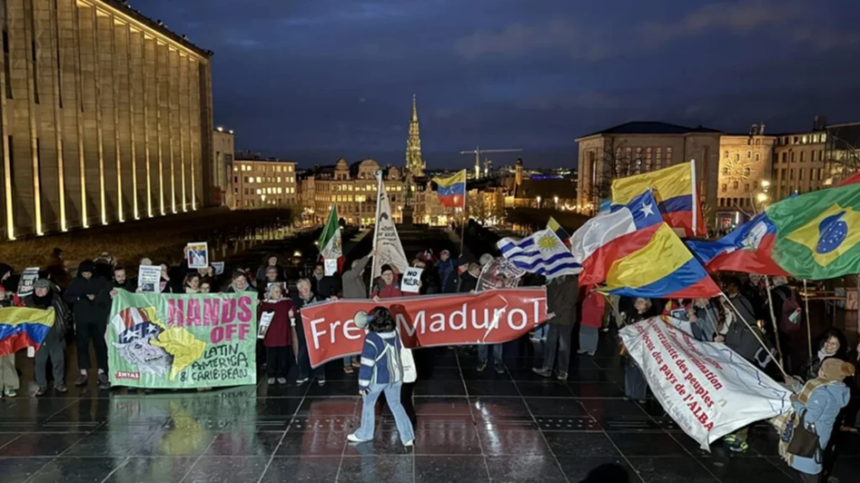
On Tuesday, social movements, political parties and human rights organizations staged the “Bring Them Back” protest in 60 cities around the world, demanding the release of Venezuelan President Nicolas Maduro and First Lady Cilia Flores.
They were kidnapped on Jan. 3, when U.S. military forces carried out a military assault on Venezuelan territory that violated the country’s sovereignty and left at least 100 people dead.
Maduro and Flores were later brought before the U.S. Federal Court for the Southern District of New York, where both pleaded not guilty. The Venezuelan head of state then declared himself a “prisoner of war.”
Americas and the Caribbean: Mass Mobilizations in Solidarity With Venezuela
In the United States, the “Hands Off Venezuela” movement led a protest outside New York’s Metropolitan Detention Center, where President Maduro and his wife are being held. At the same time, images denouncing the situation were projected in front of the United Nations headquarters.
In Colombia, sit-ins and marches were held in Bogota, Medellin, Cali, Barranquilla, Cucuta and Cartagena. Social organizations maintained a significant presence outside the U.S. Embassy in Bogota.
In Brazil, the Landless Rural Workers Movement (MST) planted trees at the Cuban Embassy in Brasilia as a symbolic expression of Latin American peoples’ resistance to the U.S. blockade and aggressions.
“The offensive of capital and imperialism against peoples who fight for their sovereignty does not silence us. On the contrary, it strengthens us in collective resistance,” the MST said.
In Mexico, the Anti-Imperialist Front gathered outside the U.S. Embassy, joined by activists and social sectors who demanded respect for Venezuelan sovereignty and condemned the kidnapping of President Maduro and his wife. The mobilization expressed international solidarity with the Bolivarian nation and called for the immediate release of its leaders.
In Uruguay and El Salvador, social organizations held rallies in public squares and outside embassies in support of the Venezuelan people and to denounce U.S. military action.
In the Caribbean, the Solidarity Movement of Saint Vincent and the Grenadines gathered outside the Venezuelan Institute of Culture and Cooperation in a powerful demonstration of solidarity to raise their voices in the defense of the dignity, sovereignty and justice of the Venezuelan people.
Venezuelan Acting President Delcy Rodríguez Promotes Diplomatic Respect While Supporting Popular Demands for President Maduro’s Freedom
The acting President of Venezuela, Delcy Rodríguez, welcomed the mobilizations of the Venezuelan people demanding the release of President Nicolás Maduro and First Lady Cilia Flores, highlighting that the country maintains institutional calm despite recent challenges.
Rodríguez, appointed by the Supreme Court of Justice (TSJ) as Vice President, reaffirmed that the path to overcoming international tensions lies in respecting the rule of law, both national and international, and in building working agendas despite political differences.
“This attack constitutes a stain on our relations, and we must work diligently and respectfully to overcome our differences,” Rodríguez stated, referring to the recent talks held with the United States government, including with Secretary of State Marco Rubio and Donald Trump.
The president emphasized that Venezuelan diplomacy is oriented toward peace and public administration for social equality. Rodríguez emphasized that institutional order prevailed in Venezuela following recent events, activating mechanisms such as political dialogue, the Commission for the Justice System, and the amnesty law to advance an inclusive national policy.
Venezuela Consolidate a Work Agenda to Strengthen Peace and Sovereignty
The President of the National Assembly of Venezuela, Jorge Rodríguez, reported on a meeting held with the Commission for Democratic Coexistence and Peace, in response to the call for in-depth dialogue made by President Delcy Rodríguez.
The main objective was to consolidate a work agenda that strengthens peace, sovereignty, and the search for common paths toward the nation’s future.
Rodríguez emphasized that it is in the commission’s interest to guarantee mechanisms for political participation that ensure everyone’s right to participate in the country’s political life. The agreed-upon agenda, which will begin next Monday, seeks to achieve “the peace, stability, and well-being that everyone deserves.”
All the country’s political forces involved in the dialogue agree on the need to find prompt solutions to the damage caused by the economic war, stated the legislative president.
He also stressed that the Constitution is the only limit that will be established in the Bolivarian nation and condemned the use of politics to incite invasions against Venezuela.
Acting President Promotes Communal Economy at National Meeting in Caracas
The acting president of the Bolivarian Republic of Venezuela, Delcy Rodríguez, led the National Meeting of Communal Economy this Wednesday, February 4th, at the Poliedro de Caracas. The event brought together approximately 10,000 community members from various regions of the country.
The event served as a platform to showcase products derived from regional production and reinforce the pillars of the self-managed economic model.
The meeting highlights the organizational capacity of Socially Owned Enterprises and Family Units, structured under a framework that prioritizes the territorial and strategic vocation of each region of the country.
Rodríguez emphasized that “a new economic model is born here, the people’s economic model,” while also underscoring that “this great popular mobilization demonstrates the productive capacity of Venezuela’s regions.”
The meeting’s central objectives are to achieve productive independence and exports, strengthen regional identity, showcase experiences, consolidate capacities, and generate strategic alliances. One hundred exhibitors presented their progress in five key areas: primary agri-food (planting, livestock, and fishing); agro-industrial processing (mills, sugar mills, processing plants, and packaging facilities); community services (logistics, transportation, telecommunications, and community banks); appropriate technology (artisanal irrigation, alternative energies, and adapted tools); and direct marketing (fairs, fixed points of sale, CLAP deliveries, and digital sales).
Amnesty Law, Contribution of Revolutionary Forces in Venezuela
Jorge Rodríguez, president of the National Assembly of Venezuela, stated that the General Amnesty Law is part of the initial contribution of revolutionary forces to the start of the national dialogue.
“We aspire to reach sufficient consensus for it to be unanimously approved in parliament,” the deputy wrote on his Telegram account.
The legislator spoke to the press after concluding an extensive day of two meetings that addressed the proposals of acting president Delcy Rodríguez to achieve total peace and stability in the country in the current situation.
The head of the Legislative Branch indicated that true dialogue is that which “allows for the development of proposals for early victories” on social, cultural, economic, and political issues, and a roadmap where everyone has sufficient guarantees of political participation.
She considered that, from the perspective of the Bolivarian forces—united in the Great Patriotic Pole—an initial contribution “is precisely the Amnesty Law” announced by the acting president on January 30th at the opening of the 2026 Judicial Year of the Supreme Court of Justice.
Delcy Rodríguez oversees public radiotherapy and nuclear medicine unit in southeastern Venezuela
The acting president of the Republic, Delcy Rodríguez Gómez, inspected the “Virgen del Valle” Radiotherapy and Nuclear Medicine Unit this Thursday. The unit is part of the “Ruiz y Páez” University Hospital Complex in Ciudad Bolívar, and is part of the 2026 Health and Life Plan.
The project, financed by the Sovereign Wealth Fund under the leadership of President Nicolás Maduro, is the first public oncology center in the southeastern region of the country, eliminating the need for patients to travel to other states for specialized treatment.
Rodríguez highlighted that the Ruiz y Páez Hospital was completely remodeled and equipped, incorporating specialized technology for cancer treatment. “It gives me great satisfaction to deliver this hospital equipped with a linear accelerator, a CT scanner, portable X-ray machines, and the nuclear and radiotherapy unit,” the president stated.
The acting president highlighted the social impact of the infrastructure: “It’s truly a great step forward for the people of Ciudad Bolívar and surrounding communities that cancer patients can now come here for treatment and no longer have to travel to other states.” More than 680 patients have been enrolled to begin free radiotherapy treatments, in contrast to the high costs in the private sector.