

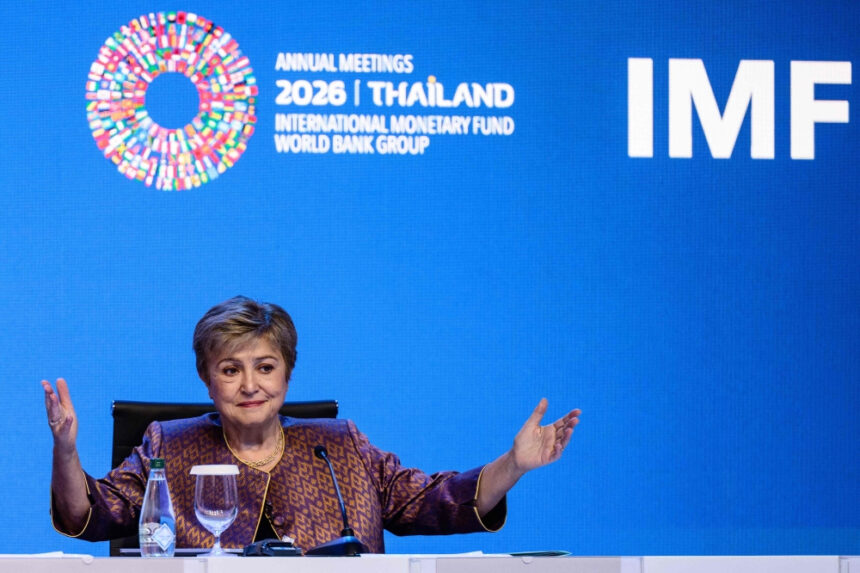
The Annual Meetings of the International Monetary Fund (IMF) and World Bank in Bangkok concluded without providing lower-income countries a clear roadmap to navigate compounding global crises, including escalating regional conflicts, mounting debt burdens, and economic uncertainty driven by artificial intelligence.
As wars in Ukraine and the Middle East persist, lower-income nations face severe economic spillovers from wealthier states, including surging debt-servicing costs, elevated inflation, and the risk of lagging further behind economically. Despite these mounting pressures, international financial institutions offered traditional prescriptions, advising developing states to shrink fiscal deficits and accelerate economic reforms to attract private capital.

Addressing delegates, IMF Managing Director Kristalina Georgieva noted that advanced economies were the worst offenders for budget imbalances. While debt levels in developing countries actually declined in recent years, spiking bond yields in advanced economies drove up borrowing costs across lower-income nations. Average debt-servicing payments for developing nations have more than doubled over the past decade, now consuming 14% of government revenue and crowding out essential spending on education, healthcare, and social infrastructure.
The rapid rise of artificial intelligence emerged as a major focus, yet global financial institutions offered little concrete guidance. Georgieva cautioned delegates against trusting commentators claiming to have easy answers, emphasizing that unresolved questions regarding AI vastly outnumber solutions.
Former Colombian Finance Minister Mauricio Cardenas observed that while the IMF and World Bank have brought in experts, neither institution has offered specific, actionable advice to help developing nations navigate AI-driven shifts. Atlantic Council Vice President Josh Lipsky highlighted that international lenders struggled to provide direction while advanced economies face risks of fiscal crises and political shifts that reduce the priority of development assistance.
Although the World Bank has helped mobilize private capital for AI preparation—tripling levels compared to 2022—it continues to face sharp drops in official development aid and ongoing hurdles in attracting foreign investment.
The meetings reflected broader geopolitical divisions and security disruptions. In a stark display of diplomatic tension, nearly half the delegates at an IMF steering committee meeting walked out when Russia’s finance minister began speaking. Logistics were also disrupted by Middle East conflict, as Houthi attacks on Riyadh airport forced Saudi Finance Minister Mohammed al-Jadaan—head of the steering committee—to travel overland to Qatar before flying to Bangkok.
The host city itself highlighted climate vulnerabilities, as parts of Bangkok remained submerged following September floods that caused nearly $200 million in industrial damage. World Bank Deputy Chief Economist Ayhan Kose reported that while the global economy weathered the energy shock from the Iran war better than anticipated, economic growth in developing nations slowed significantly to 3.6%, down from 4.4%. Kose warned that recurring shocks every three to six months leave developing economies constantly exposed.
Challenging standard policy recommendations, University of York professor Kate Pickett urged policymakers to prioritize inclusive growth over strict structural reforms. Pickett stressed that forcing austerity risks deepening poverty and inequality, warning that existing market resilience primarily serves the rich and privileged while increasing long-term public costs.