

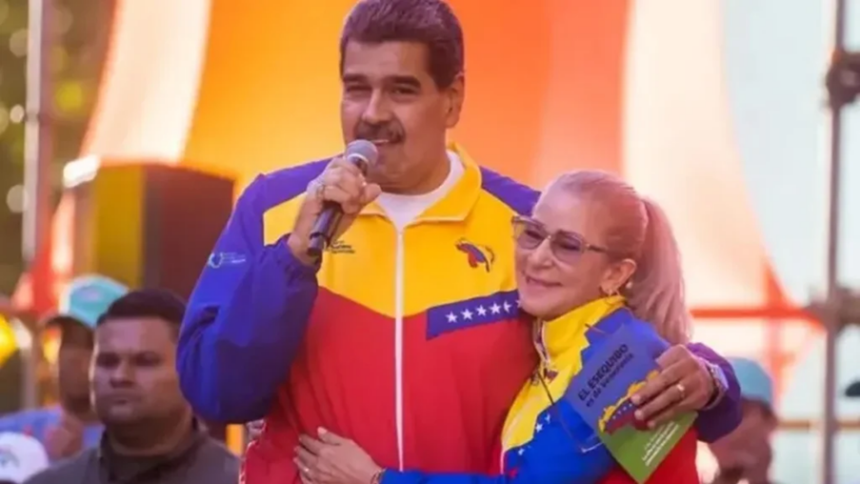
In an unprecedented show of internationalist solidarity, dozens of progressive social movements and political parties issued a joint declaration demanding the immediate release of Venezuelan President Nicolas Maduro and First Lady Cilia Flores.
The signatory organizations described the kidnapping of Maduro and Flores carried out by U.S. forces as a flagrant violation of self-determination and international law.
The document stresses that the attack is not only against President Maduro as an individual, but against the autonomy of Venezuelan workers and popular sovereignty.
For the signatory movements — including groups from Senegal, Ghana, Mali, Colombia, and France — Washington’s action sets a dangerous precedent, which threatens the territorial integrity of all nations that resist imperial control over their resources.
The declaration lays out an 11-point roadmap calling on the international community to organize pickets at U.S. embassies and to reject any attempt at regime change.
Venezuela Rejects New U.S. Measures Targeting Cuba
On Friday, Venezuela expressed its rejection of what it described as new acts of economic harassment approved by U.S. President Donald Trump against the Cuban people.
“The Bolivarian Republic of Venezuela rejects the executive order issued by the government of the United States of America, through which it seeks to impose punitive measures on countries that choose to maintain legitimate trade relations with the Republic of Cuba.
Any measure that limits or conditions the exchange of goods and services, as well as the freedom of states to sovereignly decide their trading partners, constitutes a violation of international law and the fundamental principles governing global trade.
Free trade is a core principle of international economic relations among sovereign states and cannot be subject to any form of coercion that prevents the free exchange of goods and services.
Venezuela expresses its solidarity with the people of Cuba and calls for collective action by the international community to address the humanitarian consequences that may result from aggressions of this nature. Considering Cuba a threat to the U.S. national security is an absurdity that entails serious threats to its existence as a nation,” Venezuela’s Foreign Ministry stated.
Venezuela Approves Hydrocarbons Law Reform in Second Reading
The National Assembly of Venezuela unanimously approved the Draft Reform to the Organic Hydrocarbons Law in its second reading, following an intense debate and in the presence of special guests and oil sector workers.
In Thursday’s ordinary session, parliamentarians gave their approval to the legislation, which had been subject to public consultation in recent days, as occurred this Tuesday in the Punta Cardón parish, Carirubana municipality, Falcón state (northwest).
This debate was led by the First Vice President of Parliament, Pedro Infante, and involved the active participation of the public and workers from the state-owned oil company, Petróleos de Venezuela (PDVSA).
The president of the Parliament’s Permanent Commission on Energy and Petroleum, Orlando Camacho, explained that the proposal was submitted for consideration in a public consultation with oil industry workers in the states of Anzoátegui and Falcón.
He indicated that the Commission received more than 120 written proposals from various locations, including outside of Venezuela, and from legislators of both parties, which were recorded and “all systematized.”
Camacho specified that the 34 articles were submitted for consideration before the Commission that day and were approved by all the members of that body.
He asserted that the reform will change the country’s economy and bring about “great transformations for us, our children, grandchildren, and the future of Venezuela.”
Delcy Rodríguez: Venezuela and the US take important steps in their working agenda
The acting president of the Bolivarian Republic of Venezuela, Delcy Rodríguez, announced this Thursday, during the Great March of the Working Class in support of the Hydrocarbons Law, significant progress after maintaining direct communication with US President Donald Trump and US Secretary of State Marco Rubio.
“I want to inform you that today I received a call from US President Donald Trump and his Secretary of State, Marco Rubio, informing me that, within the framework of the working agenda we have discussed, we are taking important steps. And we are talking about the cessation of restrictions on Venezuelan commercial airspace. That all airlines that need to come, that investors who need to come, come,” she said.
For his part, President Donald Trump announced during a meeting with his cabinet at the White House that he had spoken with the Venezuelan head of state, “I just spoke with the president of Venezuela and informed her that we are going to open all commercial airspace over Venezuela.” He also instructed Transportation Secretary Sean Duffy and other officials involved, including military authorities, to ensure the reopening of Venezuelan airspace.
Venezuela Celebrates Declaration of Latin America and the Caribbean as a Zone of Peace
Venezuela celebrated the Declaration of Latin America and the Caribbean as a Zone of Peace this Thursday and reiterated that “dialogue and reason” are “the most powerful tools against military force,” 12 years after the proclamation reached in Havana, Cuba, in 2014, with the consensus of the 33 member countries of the Community of Latin American and Caribbean States (CELAC).
Venezuelan Foreign Minister Yván Gil emphasized that peace is not simply the absence of conflict, but rather the full exercise of sovereignty. “It is not the Roman peace of domination or submission. That is not the peace to which the Latin American community refers. It is a peace with sovereignty, with the full exercise of freedom and the will to develop,” he stressed.
For his part, the executive secretary of the Bolivarian Alliance for the Peoples of Our America (ALBA), Rander Peña, highlighted the difference in peace for the peoples of Latin America and the Caribbean. “For the powerful nations, peace means order and submission. For us, it means social justice and respect for the right to decide our own political model without fear.”
Venezuela and India to Deepen Ties After Oil Investment Reform
On Friday, Venezuelan Acting President Delcy Rodriguez and Indian Prime Minister Narendra Modi agreed to deepen bilateral cooperation, just 24 hours after Venezuela’s National Assembly approved a reform aimed at encouraging private investment in the oil sector.
“I held a fraternal telephone conversation with the Prime Minister of the Republic of India, Mr. Narendra Modi, in a dialogue marked by a profound human and spiritual connection, in which we agreed to deepen and expand our bilateral partnership in all areas,” the Bolivarian leader said.
“I expressed my gratitude for the solidarity shown by the government and the people of India toward our country. PM Modi reiterated his willingness to stand by the Venezuelan people in the defense of their peace, sovereignty, and independence.”
“We addressed strategic cooperation in energy, agriculture, science and technology, the pharmaceutical industry, mining, the automotive sector and tourism, and we agreed to move forward with a joint roadmap to relaunch our relations in 2026,” Rodriguez added.