

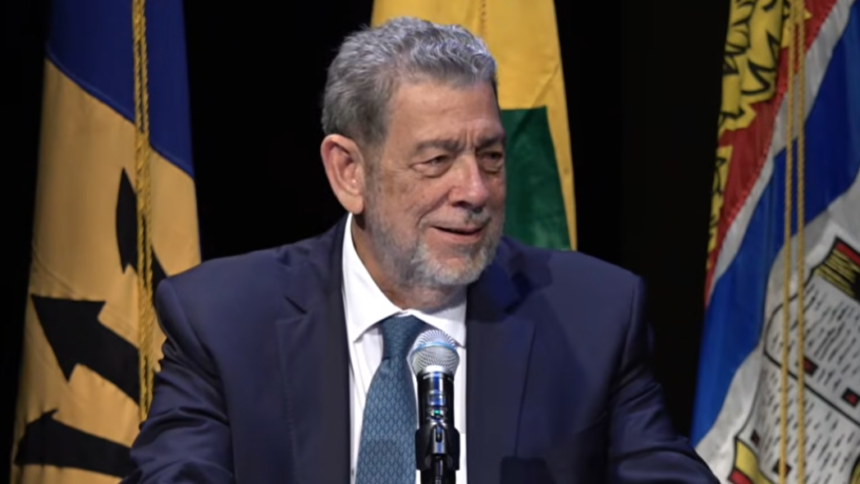
Delivering the 5th Distinguished Owen Arthur Memorial Lecture at the University of the West Indies (UWI) Cave Hill Campus, veteran Caribbean statesman Dr. Ralph Gonsalves addressed criticisms surrounding the CARICOM Secretariat and the governance framework of the regional integration movement.
Addressing public dissatisfaction over the pace of regional integration, Gonsalves described the CARICOM Secretariat as “much maligned” while operating within what he termed a “ramshackle governance and administrative apparatus”. He emphasized that the Secretariat cannot be held responsible for implementation delays, as it possesses no independent authority beyond what is explicitly conferred by the Revised Treaty of Chaguaramas and decisions taken by the Conference of Heads of Government and ministerial councils.

Gonsalves expressed deep skepticism that CARICOM will establish a supranational executive body—similar to the European Commission—capable of enforcing rules and imposing sanctions on member states. He noted that an executive CARICOM Commission focused on CSME implementation is unlikely to materialize due to a persistent psychological “islandness” and an “addiction to the doctrine of the pristine Westphalian nation state” among member states.
Because CARICOM operates strictly as a community of sovereign nations relying on intergovernmental unanimity and consensus, policy decisions remain tied to national political wills rather than centralized enforcement mechanisms.
Gonsalves highlighted recent institutional friction within the community, citing the contention surrounding the reappointment of the CARICOM Secretary-General. He noted that because the traditional political process temporarily broke down, a request was submitted to the Caribbean Court of Justice (CCJ) for a non-binding advisory opinion.
While acknowledging the court’s authority, Gonsalves warned against turning to the judiciary to resolve political disputes, cautioning that it is “a dangerous thing… to put in the hands of unelected judges political questions for resolution”. He insisted that political compromise and consensus must remain the primary mechanism for resolving internal CARICOM matters.
Despite these governance limits, Gonsalves argued that significant progress can still be achieved. Rather than focusing exclusively on an elusive single economy structure, he outlined concrete steps to optimize CARICOM’s existing framework, including:
Upgrading and enhancing the structure and function of the CARICOM Secretariat.
Instituting automaticity of financing for CARICOM, its organs, and regional institutions such as CDEMA, CARPHA, and IMPACS to ensure predictable resourcing.
Strengthening popular participation by reviving the Assembly of Caribbean Community Parliamentarians to provide a democratic institutional base.
Advancing full freedom of movement and functional cooperation in air and sea transport, energy, climate action, culture, and regional security.
Gonsalves concluded that while administrative reviews occur periodically, CARICOM will continue conducting business through intergovernmental negotiation and compromise, remaining the central political expression of Caribbean civilization.
