

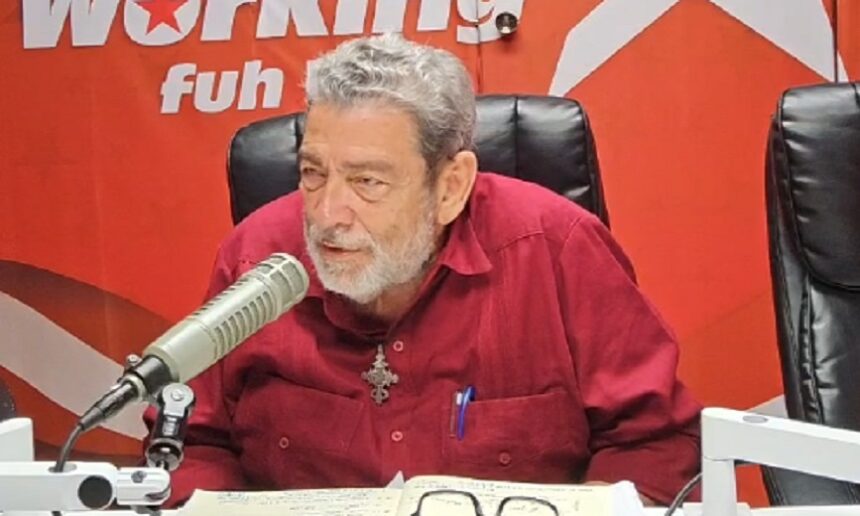
Opposition leader Ralph Gonsalves on Monday offered a detailed critique of the current government’s domestic policies, focusing heavily on the inequities of their proposed financial assistance adjustments, the unsustainability of their economic strategies, and the false dichotomy between infrastructure and social welfare.
Gonsalves argued that the government’s proposal to increase public assistance to $500 creates a fundamental inequity regarding the National Insurance Services (NIS). He pointed out that the minimum NIS pension is currently between $300 and $320, meaning that under the new proposal, individuals who never contributed to the system (public assistance recipients) would receive significantly more than those who contributed throughout their working lives.
Gonsalves emphasized that “you can’t have a situation where somebody who did not contribute to the NIS… getting more money than the person who contribute to the NIS”. He explained that when his administration raised public assistance to $350, they simultaneously provided additional support to minimum pensioners to maintain fairness.
The former pm provided a financial breakdown, noting that to “do justly,” the government would need to add approximately $12 million annually to the budget to raise the NIS pensions for the 4,000 lowest-paid pensioners to match the public assistance increase,. Without this adjustment, he warned the policy would “cause dissension among the poor”.
Gonsalves highlighted the World Pediatric Project (WPP) as a prime example of successful social equity policy instituted by his administration. He noted that the program provides “first world healthcare free of charge” to children, fully integrated into the local health system,. He contrasted this with the United States, where such care would cost “humongous” sums or require expensive insurance,. He used his own granddaughter’s recent need for surgery to illustrate that good public policies benefit the entire population, stating, “when you have good public policies you’re a beneficiary… The whole country everybody is either beneficiary or potential beneficiary”.
Gonsalves on Monday sharply criticized the current administration’s reliance on Citizenship by Investment (CBI), describing the program as “wrong in principle, wrong in practicality, unsustainable, reckless and undermines democracy”,. He likened the reliance on CBI revenue to a drug addiction, stating that when the money stops—due to pressure from the EU, UK, and US—the nation suffers “withdrawal symptoms”.
He said that the current government lacks a strategy for wealth creation and is instead focused on “managing and controlling and dispensing scarcity” and listed several areas where he believes the government is failing or breaking promises:
Employment: Despite promising to employ every young person, they are firing workers, including those in housing.
Foreign Policy: The government is creating uncertainty regarding relations with Taiwan versus China, with Gonsalves demanding a clear statement on whether they intend to break election promises to stay with Taiwan.
Back Pay: He questioned the status of the promised back pay for public servants who refused the COVID-19 vaccine.
Gonsalves rejected the “false dichotomy” attributed to Minister St Clair Leacock regarding “concrete and mortar” versus “people’s development”. He asserted that the two are “inextricably linked,” arguing that you cannot have social development without the physical infrastructure of schools, hospitals, ports, and roads.
The Opposition leader suggested the current administration’s approach consists of “just words” and “shooting the breeze,” lacking the substance required to “move the needle” on national development.
He questioned the moral standing of the current leadership, referencing the prophet Micah to ask if they are truly “doing justly” and “walking humbly,” while advising them to “grow up” and stop behaving as though they possess “magical qualities”
