

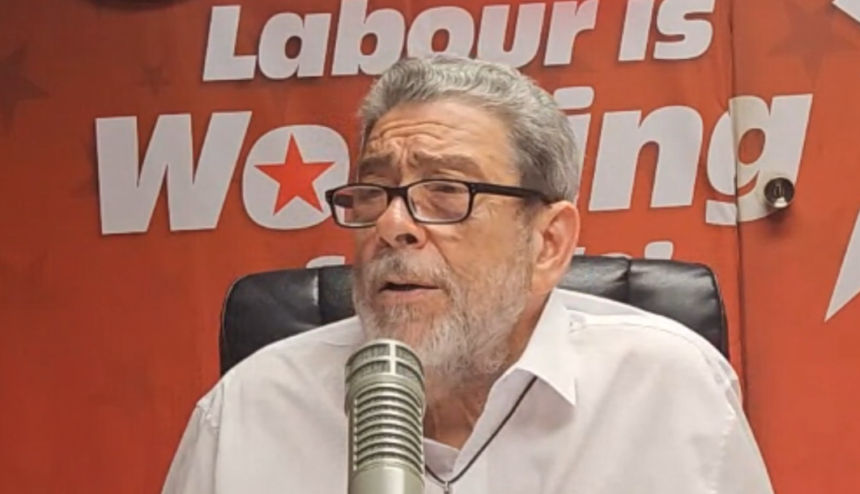
Gonsalves rejects govt ‘performance’ claims, warns ‘Ban You Belly’ hardship
Marking one year under the New Democratic Party (NDP) administration, opposition leader and former Prime Minister Dr. Ralph Gonsalves delivered a scathing assessment of the country’s economic trajectory, dismissing official claims of governmental progress as empty rhetoric while citizens grapple with unprecedented financial hardship. Addressing the nation in a comprehensive review of state affairs, Gonsalves sharply rejected the administration’s celebratory catchphrase of “give them performance,” arguing that official self-congratulation stands in stark contrast to the daily reality of Vincentians who are being forced to “ban their belly” to survive escalating living costs.
The opposition leader seized upon the phrase “ban you belly”—a traditional Caribbean idiom denoting severe belt-tightening and austerity, recently popularized in seasonal parang music by artist CP—to illustrate what he characterized as a deepening social and economic crisis. Gonsalves contended that while government officials prepare to highlight their achievements through ministerial statements and parliamentary fanfare, working-class families are confronting crippling price increases across fundamental goods and services. He noted that traditional holiday traditions, such as updating home furnishings or purchasing seasonal items, have become unaffordable luxuries for households facing severe liquidity constraints.
Central to Gonsalves’ critique was a detailed breakdown of rising energy and fuel costs, which he identified as a primary driver of household inflation and operational pressure on small businesses. He highlighted recent price adjustments at the pump, noting that gasoline has risen to $17.76 per gallon following a 47-cent increase, while standard dieseline surged by $1.65 to reach $19.22 per gallon. Low-sulfur diesel, heavily utilized by public transport minibuses and modern commercial vehicles, climbed by $1.58 to $19.31 per gallon.
Gonsalves contrasted these figures with price levels maintained under the previous administration—where gasoline stood at $13.22 and dieseline at $12.56—pointing out that diesel costs have jumped by more than 50 percent. He emphasized that minibus operators consuming up to 20 gallons daily now face additional monthly fuel expenses exceeding $2,600, compounding private debt pressures and forcing public transport operators into financial distress.
Dismissing government interventions as entirely inadequate, Gonsalves characterized minor policy adjustments—such as modest increases to juror stipends—as “puny” measures that fail to move the needle for vulnerable populations. He argued that the administration has failed to establish essential safety nets, cushion transport operators, or subsidize basic food items like rice and poultry. According to the opposition leader, the absence of targeted cost-of-living relief has left indigent and low-income citizens without a functional social buffer, creating an economic climate described in public commentary as the hardest in 21st-century memory.
Gonsalves framed the current economic strain within a broader framework of six interlocking national crises, encompassing government fiscal deficits, stagnant economic growth, social welfare rollbacks, public safety concerns marked by 45 homicides over 45 weeks, administrative incompetence, and a breakdown in community stability. He pointed to operational strains within key public services, citing financial deficiencies at the St. Vincent Postal Corporation—where subventions were increased to $1.3 million despite recurring net operational losses—and reports of stretched resources in healthcare facilities.
In response to government assertions regarding inherited public debt, Gonsalves maintained that major capital investments in national infrastructure, ports, and hospitals under the prior government were structured alongside projected economic growth, whereas current policy has led to elevated borrowing rates on regional security markets and reduced investor confidence.
Looking ahead to upcoming parliamentary proceedings, Gonsalves signaled that the parliamentary opposition intends to hold the administration strictly to account through intensive questioning on fiscal governance, state corporation management, and legislative revisions.
Reaffirming his intent to challenge performative politics in the House of Assembly, the former Prime Minister insisted that parliamentary time must be dedicated to substantive policy debate rather than ministerial self-congratulation, reiterating that true governmental performance is measured by tangible economic relief rather than political rhetoric.
