

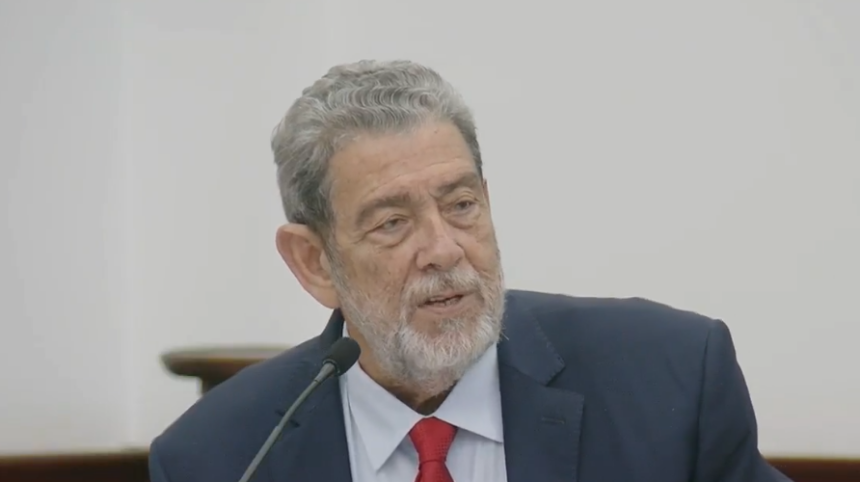
The 2026 Budget Debate is emerging as a ideological collision between the New Democratic Party (NDP) administration’ and the previous government. Opposition Leader Ralph Gonsalves during his contribution to the 2026 budget said within a mere nine weeks of taking office, the NDP government finds itself navigating the shortest political honeymoon in human history and noted, there is “little or no honey,” and the “moon is driving them crazy.”
Gonsalves said this disconnect represents a fracture in the invisible vital bond of trust between the state and its citizens, where deceptive campaign rhetoric has been met with a budget that is, at best, an unimaginative exercise in treading water and, at worst, a blueprint for national insolvency.
“The structural integrity of the Budget Speech itself serves as a “smoking gun” for an administration in crisis. The document bears the unmistakable, fragmented hallmarks of a “non-human author”—specifically, ChatGPT. Investigative analysis of the text reveals excessive use of dashes without spaces, random bolding of phrases, and repetitive, short paragraphs bunched together, the generic giveaways of an AI tool utilized because the administration’s human authors (the Prime Minister and his two principal advisors) could not reconcile their disparate styles”.
Gonsalves said this reliance on artificial intelligence to articulate national policy is a chilling indicator of a government that lacks a compelling, human-driven narrative for the Vincentian people.
The Opposition Leader said the statistical foundation of the 2026 Budget is built upon what can only be described as “disingenuous data lags.”
“By utilizing incomplete 2025 figures, the administration has attempted to paint a “troubling narrative” of wage stagnation that contradicts the actual records held by the National Insurance Services (NIS). When one examines full-year data, the economic reality of the working class tells a far different story”.
Contested Economic Indicators
| Indicator | NDP Budget Speech (Stylized) | NIS/Opposition Data (Real) |
| Construction Sector Wage Growth | 6.7% growth over a decade | 16% growth (2014–2024 actual) |
| Avg. Annual Insurable Wages | $26,118 (Based on incomplete 2025 data) | $28,480 (2024 full-year actual) |
| Poverty Rate (Inherited context) | 33% “in or near” poverty | 37% inherited from NDP; reduced under ULP |
| Indigence Rate (Inherited context) | Unspecified/Grouped | 26% inherited; significantly reduced |
Gonsalves said this data manipulation matters because it informs public policy.
“By characterizing families as “a single paycheck away from disaster” based on flawed 2025 snapshots, the government is gaslighting the public to justify a retreat from social spending. Even in the most prosperous nations, like the US or Canada, a significant portion of the population lives paycheck to paycheck; to use this universal vulnerability as a pretext for “managing scarcity” while ignoring the 16% rise in actual insurable wages is a fiscal sleight of hand”.
Gonsalves said the administration’s move toward Citizenship by Investment (CBI) is viewed not as economic innovation, but as a “national narcotic.”
“Like cocaine, CBI revenue provides a temporary high while creating a devastating dependency. The government’s attempt at “commercial diplomacy” and rebranding diplomats as “roving passport salespersons” ignores the reality that the “end is nigh” for these programs”.
Gonsalves said the strategic risks are multi-layered:
The Security Fallout: Proposing a “Residential Qualification” as short as two or three months is a red flag for the US, UK, and EU, who now view these programs as inherent security risks rather than management issues.
The Revenue Collapse: The regional bubble is already bursting. St. Kitts and Nevis reported a 43% drop in CBI receipts this year.
The Currency Union Crisis: Because the Eastern Caribbean Currency Union (ECCU) operates under a currency board arrangement, a drop in foreign exchange inflows from CBI would force the government to withdraw EC dollars from circulation to maintain the 2.70 peg. This “withdrawal symptom” would trigger massive unemployment, capital flight, and an eventual, devastating devaluation of the currency.
Gonsalves said to survive the inevitable burst of this bubble, the nation would require a massive, multi-lateral “adjustment package” involving the US, UK, World Bank, and IMF will be a surrender of sovereignty brought on by an ill-advised gamble on selling passports.
The Opposition Leader said there has been a reckless shift from securing concessional foreign debt to a reliance on high-interest local borrowing. The budget attempts to fund a litany of “unsecured projects” through a proposed $200 million in local loans, a sum the local market has little appetite for.
Unsecured Projects Targeted for Local Financing:
Road Patching and Paving: $7,000,000
Hurricane Beryl Post-Relief Fund: $5,000,000
Argyle Infrastructural Work: $4,500,000
Market Expansion: $4,000,000
Canouan Jetty Construction: $2,000,000
TVET Center (Consultancy fees only): $1,000,000
Concessional Loans (CDB/World Bank): Interest rates at 0.75% to 3% with long grace periods.
Local Bonds: Interest rates expected at 6.5% to 7% with punishingly short 5–7 year amortization periods.
Gonsalves said used the “Horses are Starving” metaphor to capture this crisis: “While the government waits for the “grass” of the bond market to grow, the “horse”, the state’s immediate cash-flow needs is starving”.
This $200 million aspiration Gonsalves said is a “Mickey Mouse” approach to finance that will leave contractors unpaid and essential services stalled in a “queue” behind other OECS nations.
Gonsalves said the contrast between the proven success of the Bank of St. Vincent and the Grenadines (BOSVG) and the proposed National Development Bank (NDB) is stark.
“Under the previous administration, the BOSVG was transformed from an impaired institution into a powerhouse with assets growing from $395 million to $2.1 billion, and non-performing loans dropping from 20% to 4.3%. Conversely, the NDB is a “biblical fantasy.”
“The government plans to capitalize this bank with a mere $500,000 while tasking it to fund housing, digital entrepreneurship, agricultural de-risking, and youth-led enterprises. To suggest that half a million dollars can fund a national development agenda is as “brazen” as Jesus feeding the multitude with a “fish and a loaf,” yet there is no miracle in sight. This represents a “major shift” where social support previously given for free to the poor, is being converted into debt-burdening loans from day one”.
Gonsalves said the 2026 Budget shows a retreat from the “Education Revolution” and vital infrastructure. The claim that the administration will give the Argyle International Airport (AIA) the “authority to spread arrivals” to end flight bunching is “ludicrous” as airline scheduling is dictated by international hubs like JFK and Heathrow, not a regional airport office.
In healthcare, he says the plan to close Milton Cato Memorial Hospital is a dangerously “bad idea.”
“Strategic wisdom dictates refurbishing the existing facility for maternity and pediatric care; abandoning it leaves the western side of the island exposed. Furthermore, the 45% cut to the “On-Site” internship program (losing 150 placements) and the 36% cut to the mathematics improvement program are direct strikes against the nation’s future productivity”.
Gonsalves said the administration is already exhibiting “high-handed” behavior, or what he calls “behaving like a gargon.”
“Ministers are reportedly interfering in the hiring and firing of cleaning staff, tasks that are the sole purview of the public service. This “political jaundice” is exacerbated by the profligate spending of $4.6 million on a fleet of 29 new vehicles during a fiscal deficit, even as social ministries suffer”.
“The transparency gap is perhaps most evident in the Prime Minister’s Office, where his son reportedly occupies a position without an official state contract, a salary allocation in the estimates, or an oath of secrecy.”
Gonsalves said the 2026 Budget is not a document of resilience; it is a document of retreat. By abandoning cheap concessional financing for the “local loan trap” and swapping free social support for underfunded debt schemes, the government has set the nation on an inevitable “path to the IMF.”
Gonsalves said unless there is a radical “wheel and come again” shift toward transparent governance and a rejection of the CBI “narcotic,” St. Vincent and the Grenadines faces an era of manufactured austerity and broken trust.