


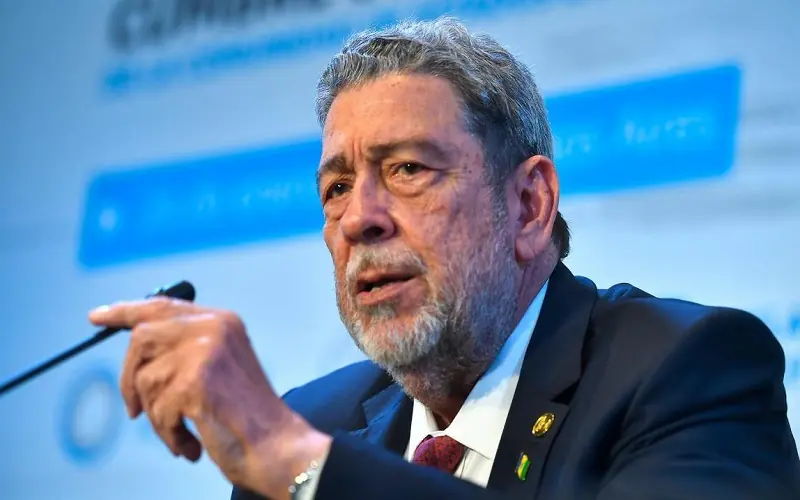
Opposition Leader Ralph Gonsalves has delivered a scathing critique of the current NDP government’s foreign policy, specifically taking aim at their self-described philosophy of “strategic realism.”
Responding to comments made by opposition figure Fitz Bramble who contrasted the NDP’s “strategic realism” with the supposed “emotionalism” of Gonsalves’ ULP administration Gonsalves argued that this new approach is merely a cover for submissiveness and a lack of diplomatic vision.
Gonsalves vigorously challenged the premise of “strategic realism,” questioning what is actually strategic or realistic about the government’s current posture. According to Gonsalves, the NDP’s version of realism translates simply to “rolling over and playing dead” when faced with actions by major foreign powers.
To illustrate this, he pointed to the government’s failure to protest the killing of St. Lucian fishermen within St. Vincent and the Grenadines’ exclusive economic zone. Gonsalves contrasted this silence with his own proactive diplomacy, noting that he directly informed US embassy officials that such conduct was completely unacceptable, firmly rejecting any foreign policy or law enforcement actions dictated by the “Monroe doctrine”.
Gonsalves further criticized the hypocrisy of this “realist” approach in the region. He accused the government of actively trying to get rid of essential Cuban medical professionals, while simultaneously agreeing to take in refugees and deportees from third countries that the United States refuses to accept. “That’s your strategic realism,” Gonsalves remarked, pointing out the absurdity of sacrificing healthcare resources to appease foreign powers.
He also condemned the government’s refusal to speak out explicitly on major international crises, such as the blockade on Cuba or international conflicts involving Israel, Iran, and the US. He noted that even leaders of NATO-aligned countries, like French President Emmanuel Macron, are capable of speaking their minds on the global stage, making the NDP’s silence look weak rather than strategic.
In response to the charge that his ULP government ran a foreign policy based on “emotionalism,” Gonsalves sarcastically listed the massive, tangible achievements his administration secured through aggressive and principled diplomacy. He challenged his critics to hold an “intelligent discussion” on how this so-called emotionalism resulted in:
Major Infrastructure: Building the international airport by working with British, American, and Canadian Exim banks to secure vital equipment, as well as constructing the modern hospital and the Rabacca bridge.
Global Leadership: Securing a seat for SVG on the UN Security Council and becoming the first English-speaking country to serve as president pro tempore of CELAC.
Regional Peace: Utilizing that CELAC leadership to bring Guyana and Venezuela together for the Argyle Declaration, fostering peace in the region—an organization the NDP previously dismissed as a “waste of time”.
Debt Relief: Negotiating massive debt relief, including the Commonwealth debt initiative with Britain in 2001 (which the British had refused to grant the previous NDP government) and $180 million in relief from Venezuela under PetroCaribe for the Otley Hall project.
Expanded Diplomatic Footprint: Establishing SVG’s first embassies in Cuba and Venezuela, and opening a full Consulate General in Toronto and New York.
Concluding his critique, Gonsalves painted the current government’s foreign policy as directionless and unprincipled. He mocked their internal divisions over maintaining ties with Taiwan versus China, and ridiculed the decision to send the Minister of National Security to Taiwan merely to ask for “12 vehicles” in the midst of a complex global crisis.
Gonsalves says true foreign policy requires proactive engagement, strong alliances, and the courage to defend a nation’s sovereignty—not the passive “strategic realism” currently on display.