

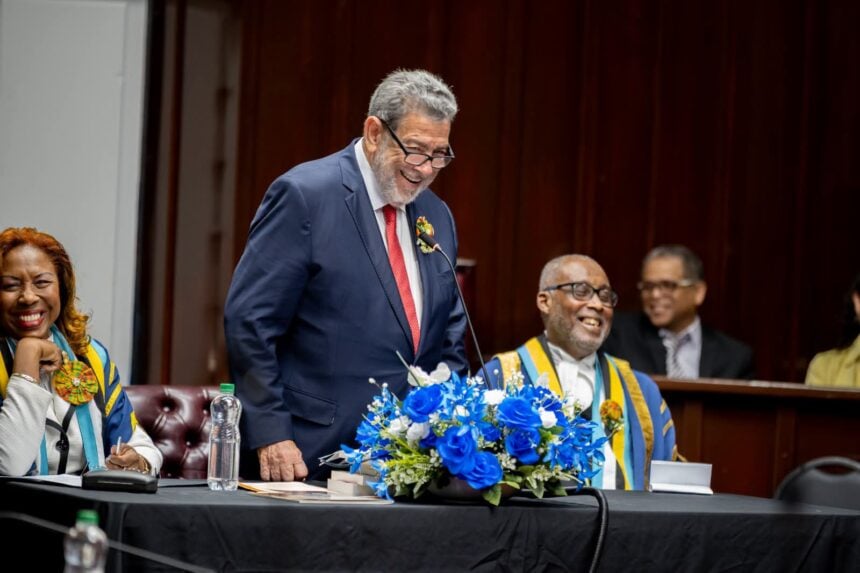
Addressing a historic special sitting of the St. Lucia House of Assembly, veteran Caribbean statesman and historian Dr. Ralph Gonsalves delivered a wide-ranging address marking the 75th anniversary of universal adult suffrage in St. Lucia.
Speaking before parliamentarians, government leaders, and dignitaries, Gonsalves framed the 1951 attainment of full voting rights not as a static historical event, but as a pivotal milestone in an ongoing “popular social democratic revolution” across the Caribbean that remains incomplete today.

Reflecting on the milestone achieved on October 12, 1951, Gonsalves recalled how universal adult suffrage finally granted every St. Lucian citizen aged 21 and over the right to vote without income, property, gender, literacy, or status encumbrances. Prior to 1951, colonial voting criteria favoured adult white males of property and wealth, alternating with periods of direct crown colony rule where no elections occurred.
Gonsalves placed St. Lucia’s political evolution within both global and regional timelines, noting that following New Zealand (1893), the United Kingdom (1918/1928), and Jamaica (1944), St. Lucia joined regional neighbours in securing unencumbered voting rights despite colonial attempts to impose restrictive literacy conditions.
Tracing the roots of this democratic breakthrough to the region-wide anti-colonial labor uprisings of 1935–1938, Gonsalves highlighted the pioneering analysis of St. Lucian Nobel Laureate Sir W. Arthur Lewis. Lewis’s seminal 1938 monograph, Labor in the West Indies, documented the rise of trade unions and the working class’s decisive entry into West Indian politics.
In St. Lucia, this struggle was spearheaded by militant coal loaders at Port Castries, agricultural workers on sugar estates, and early trade unionists. Their efforts culminated in the 1939 formation of the St. Lucia Cooperative Workers Union under George Charles and Martin Jatis, followed by the founding of the St. Lucia Labour Party (SLP) in 1949. Under Charles—who became the island’s first Chief Minister in 1960—the SLP secured electoral victories in 1951, 1954, 1957, and 1961.
Gonsalves also acknowledged the contributions of John Compton and the United Workers Party (UWP), formed in 1964, noting that despite political rivalry and “manufactured tribalism,” successive SLP and UWP administrations continued key elements of the social democratic agenda through internal self-government in 1967 and independence in 1979.
Highlighting St. Lucia’s socioeconomic transformation over the past 75 years, Gonsalves observed that the island has successfully transitioned from plantation agriculture centered on sugar to a small-farmer banana economy, and ultimately to a modern service economy dominated by tourism.
“In 1951, St. Lucia had a very low level of human development assessed across all material indices,” Gonsalves stated. “Today, according to the United Nations Development Program, St. Lucia is at a high level of human development, poised to attain a very high level… on course to be a first-world island nation of a special type”. He added that St. Lucia remains on target to achieve the central UN Sustainable Development Goals by 2035.
Turning to contemporary geopolitics, Gonsalves warned of severe external headwinds confronting Caribbean nations, including climate change, international financial inequities, artificial intelligence regulation, and great-power rivalries.
On relations with the United States, Gonsalves rejected ideological extremes:
“It is infantile, unwise, and unproductive for the social, democratic, and anti-imperialist forces in our Caribbean… to adopt a knee-jerk, perpetual, instinctive opposition to the USA. At the same time, we cannot roll over and play dead”.
He urged Caribbean states to navigate external relations through mature diplomatic engagement, leveraging multilateral platforms such as CARICOM, the Organization of Eastern Caribbean States (OECS), and the Community of Latin American and Caribbean States (CELAC).
Gonsalves issued a strong call for European nation-states to deliver reparatory justice for native genocide and the enslavement of African peoples. He referenced the UN General Assembly resolution of March 25, 2026, which overwhelmingly declared the transatlantic slave trade and chattel slavery as crimes against humanity.
Commending St. Lucia Prime Minister Philip J. Pierre for his regional leadership on reparations, Gonsalves looked ahead to further progress at the upcoming Commonwealth Heads of Government Meeting (CHOGM) in Antigua on November 1. He also commended Prime Minister Pierre’s April 21, 2026 Budget Address, titled “Consolidating Our Gains, Prospering in Uncertain Times,” as essential reading for advancing national development goals.
Closing his address, Gonsalves cautioned that the region’s margin for policy error remains slim, warning against political frivolity and social indiscipline.
“Politics is serious business for serious people; it is not a branch of the expanding entertainment industry,” Gonsalves emphasized. “A society of quality and shared prosperity cannot be built on laziness, indiscipline, and pervasive crimes of violence. A sustainable social democracy cannot be shaped by excessive pleasure, leisure, and ‘nice time’… these activities have to be paid for by productive labor”.
Reaffirming that Caribbean nations are grounded in the belief in the supremacy of God and human dignity, Gonsalves urged St. Lucians to honor their ancestors by uniting around core national priorities as they celebrate 75 years of democratic empowerment.
