


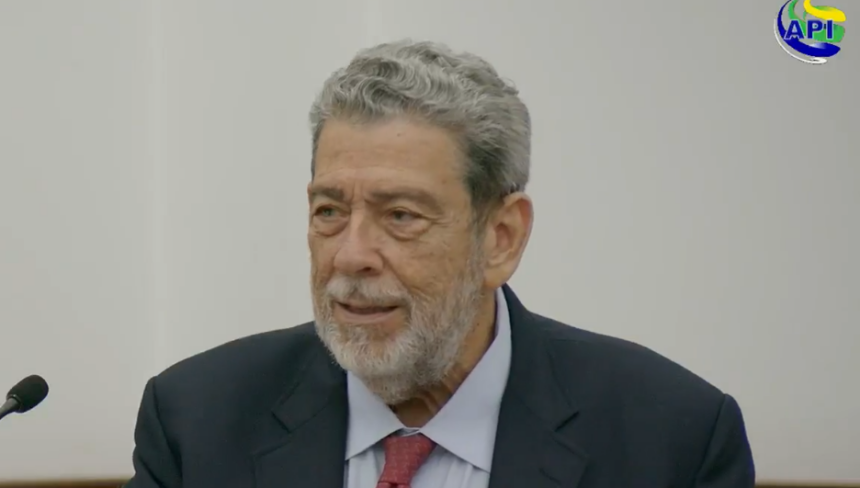
Former Prime Minister Ralph Gonsalves has strongly rebuked recent parliamentary claims that his administration engaged in the electronic surveillance of Vincentian citizens, categorizing the accusations as a “total falsehood”.
Addressing the nation via his radio broadcast, the current Leader of the Opposition responded directly to allegations made by the current Minister of National Security, Sinclair Leacock, who claimed to have found personal information about citizens crossing his desk, leading him to accuse the former government of spying.
“I have no… neither does Leacock have now nor does Friday under the law of this land to put anybody under electronic surveillance, to tap your phones, to spy on you,” Gonsalves stated emphatically.
Gonsalves detailed that St. Vincent and the Grenadines lacks the necessary legislation to authorize electronic surveillance or phone tapping to fight crime. He contrasted this with jurisdictions like Trinidad, the United Kingdom, and the United States, where law enforcement can approach a judge in chambers to secure a 24- or 48-hour surveillance warrant based on actionable evidence. Because such a legal framework does not exist locally, Gonsalves insisted he never authorized any illegal spying operations.
To clarify how information actually reaches the Minister of National Security, the former Prime Minister outlined the three legitimate avenues of state intelligence gathering:
Standard Police Investigations: Routine intelligence gathered by the police force during normal criminal investigations, which Gonsalves noted is “not spying, that’s the police doing their work”.
Special Branch Reports: Gonsalves characterized much of this local intelligence as informal gathering or “gossip of no actionable significance” obtained from public spaces like markets and rum shops.
External Intelligence Agencies: Information provided by foreign agencies, typically concerning significant national security threats, such as hostile forces attempting to hack the government’s information systems.
Rather than past surveillance, Gonsalves warned citizens to be highly concerned about the current state of technology, noting that overseas agencies are entirely capable of placing individuals including former prime ministers under surveillance.
Furthermore, Gonsalves flipped the accusation back onto the current administration. He questioned the source of the sensitive information Leacock claims to be receiving now, suggesting that if the current Minister of National Security is actively seeing “information… of a spying kind,” it raises serious questions about whether the current New Democratic Party (NDP) government is currently engaged in illegal surveillance.
Gonsalves characterized the allegations against him as a politically motivated distraction. He accused the current government of launching verbal abuse and falsehoods to mask their administrative failures and to keep their political base angry at the previous administration.