

A robust collaborative recovery effort is underway on Union Island as government officials, international volunteer teams, and local contractors join forces to rebuild homes, restore historic landmarks, and repair critical infrastructure following the devastation of Hurricane Beryl.
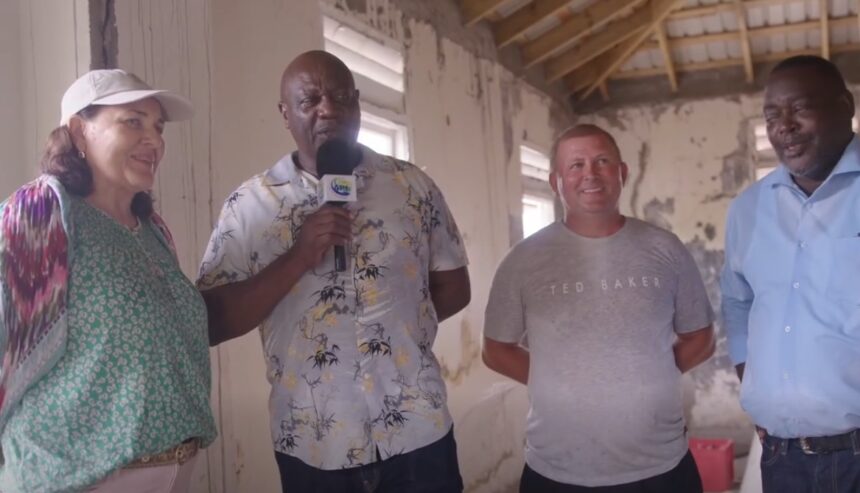
During an official visit to the island, high-ranking government representatives—including Attorney General Sarah Louise Mitchell, Minister Andrew John, and Member of Parliament for the Southern Grenadines Terrance Ollivierre, inspected several key reconstruction sites to assess the rapid progress being made.
The recovery operations are being driven by an extraordinary partnership under the Recovery and Resilience Project. This initiative brings together the local Union Island community, the Canouan community led by Cornes Maki, developer Ian Waist, local contractors, and international volunteer teams.
Notably, a specialized team from Romania, led by coordinator Danny, and a team leader from Canada have joined the rebuilding efforts.
“This is really an amazing partnership,” said Attorney General Sarah Louise Mitchell, highlighting the immense goodwill of everyone on board. “Together, we’ve all come together in the recovery and resilience project to build back better after Beryl.”
Among the prominent sites visited by the delegation was a highly historic building that previously served as a district council office, a library, and a museum.
Work is currently underway to repair and restore this structure, which was severely damaged by the hurricane. The team from Romania has already commenced rebuilding its roof, with the goal of making it stronger and more resilient than before.
Once completed, the government plans to fully transform the building back into a dedicated museum to showcase Union Island’s rich history.
“Union Island has one of the richest histories of all the islands in the Grenadines,” Mitchell noted, explaining that the restored space will eventually be used to safeguard and display this heritage.
A primary focus of the visiting officials was the progress of housing rehabilitation. The delegation inspected a newly completed roof—the very first to be finished under the project—which was successfully reconstructed in just six days.
Minister Andrew John expressed great satisfaction with the pace and quality of the construction. “This quality of work is what I really am looking forward to see,” John remarked.
A government representative visiting the completed roof also commented on the high standard of construction. “Very good quality work if you look at it. And I’m so pleased,” they noted, explaining that this was just the beginning of a broader rebuilding phase.
While celebrating this initial milestone, officials urged residents to remain patient as repairs continue. A structured list is being maintained to systematically address damaged roofs across the island.
In addition to roof repairs, the project is building destroyed homes entirely from scratch and plans to introduce prefabricated houses to accelerate the island’s resettlement.
A prime example is the construction site for Estina, a local mother who is currently living in a shelter with her three children. Workers have poured the foundation and commenced block work on a new, two-bedroom concrete wall home for her family, with completion expected within two weeks.
The delegation also observed significant improvements in essential local infrastructure.
- A critical bridge that was destroyed prior to Hurricane Beryl has been fully restored. This restoration has reconnected the island’s road network, allowing residents to travel seamlessly between communities once again.
- The island’s landfill has undergone a major overhaul under the Recovery and Resilience Project. The site has been cleaned out, and garbage has been compacted and layered with crushed blocks to raise its height, expanding the facility’s capacity by an estimated one to two years. Additionally, metal waste from ongoing road cleanups is being systematically separated and baled.
Though a heavy rain fell during the ministerial tour, the atmosphere on Union Island was overwhelmingly positive, with officials noting a palpable shift in the community’s energy.
“Already since I’m here, I’m feeling a different feel of the place,” one of the visiting officials shared. “It’s bustling. It feels as if things are be done, and I feel happy to be here today.”
With displaced residents currently renting elsewhere expected to return to the island shortly, the combined efforts of local citizens, regional neighbors, and international volunteers are successfully paving the way for a stronger, more resilient Union Island.
