
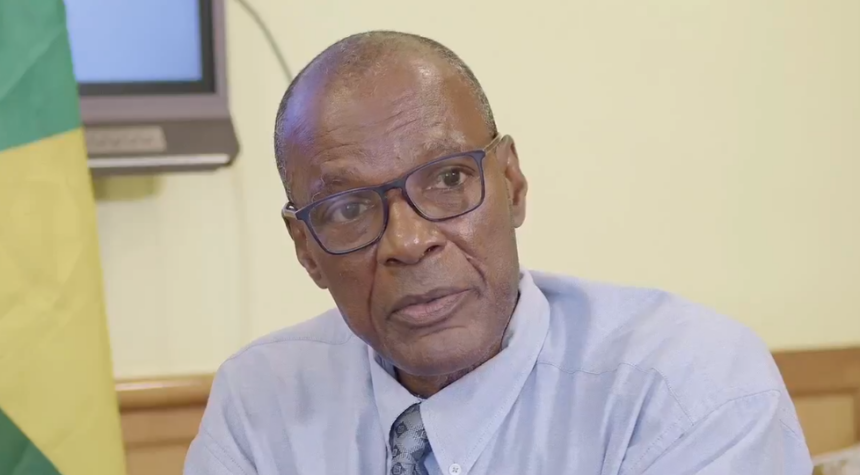
Faced with a mounting surge of public indignation over ballooning electricity bills, Energy Minister Daniel Cummings is urging consumers to look inward at their own property wiring rather than blaming the messenger.
In a decisive rebuttal to critics of the country’s modernizing utility infrastructure, the Minister characterized the transition to smart meters as an “excellent decision,” dismissing the current wave of public outcry as “hype” while asserting that high bills are almost certainly the result of internal “electricity leaks” rather than hardware error.
Minister Cummings in an interview with SVG TV, called for a move toward objective reality in the face of widespread consumer frustration. “My friends, let us be rational,” the Minister stated, seeking to decouple the accurate recording of energy from the cost of that energy. “Let us use common sense and not be carried away by hype.”
The shift to Vinlec’s smart meter program represents a fundamental upgrade in utility efficiency and accuracy. By recording consumption electronically, the system eliminates the logistical friction of sending manual meter readers onto private property.
Under the new program, the meter—acting as a precise digital ledger—remains on the property while the electricity company records usage data remotely. The Minister’s position is clear: the technology is functioning as intended; it is the infrastructure behind the meter that is failing the consumer.
To bridge the gap between technical jargon and public understanding, Minister Cummings introduced the concept of “electricity leaks”—a term he chose specifically because “people could understand that.” Using the relatable analogy of water pipes, the Minister explained that just as a cracked pipe loses water before it reaches the faucet, a home’s electrical system can lose energy before it ever powers an appliance.
“Similar to when you have leaks on your pipes with electricity lines, you get losses, you get leaks,” the Minister explained. These faults mean a property can be “consuming energy without realizing it,” with the meter accurately recording the flow even if the electricity is never used productively.
- Degradation of Insulation: Electrical wires are covered in protective “sheeting” designed to insulate them. Over time, and under various environmental circumstances, these sheets break down, allowing energy to escape the circuit.
- Dissipation into the Earth: When internal wiring is compromised, electricity can literally “go to the earth,” bleeding into the ground and creating a continuous draw on the system.
- Unnoticed Consumption: Faulty internal wiring creates a “thief” within the walls, where the meter records high consumption because the energy is technically being pulled through the connection, despite never reaching the intended lights or devices.
Recognizing that many citizens are unaware of the state of their internal wiring, Minister Cummings unveiled a proactive strategy to modernize oversight via a “beefed-up” Electrical Inspectorate Division within the Ministry of Works. This revitalized approach moves beyond simple observation, transforming the division into a strategic tool for consumer protection through three core pillars:
- Specialized Staffing: The division has been reinforced with newly trained personnel equipped to identify the specific faults causing “leaks.”
- Modernized Authority: The implementation of new legislation provides the Inspectorate with a contemporary legal framework to address 21st-century utility challenges.
- Enhanced Power: The division is now specifically empowered to enforce safety standards, ensuring that property owners comply with necessary infrastructure requirements.
The Minister was careful to remind the public that property inspections are not merely a suggestion for the cautious, but a “legal requirement” triggered the moment a consumer applies to VinL for a connection. The Inspectorate’s mandate is to determine if a property harbors faults that threaten both the owner’s wallet and their safety.
In a strong call to action, Minister Cummings encouraged property owners to be proactive rather than reactive. The Inspectorate’s role is to serve as a diagnostic partner, identifying exactly where a system is failing—whether it involves “changing out” old, degraded wires or repairing compromised sheeting. By ensuring internal property standards match the precision of the new smart meters, residents can stop the financial drain of electricity leaks and ensure their homes are both safe and efficient.