


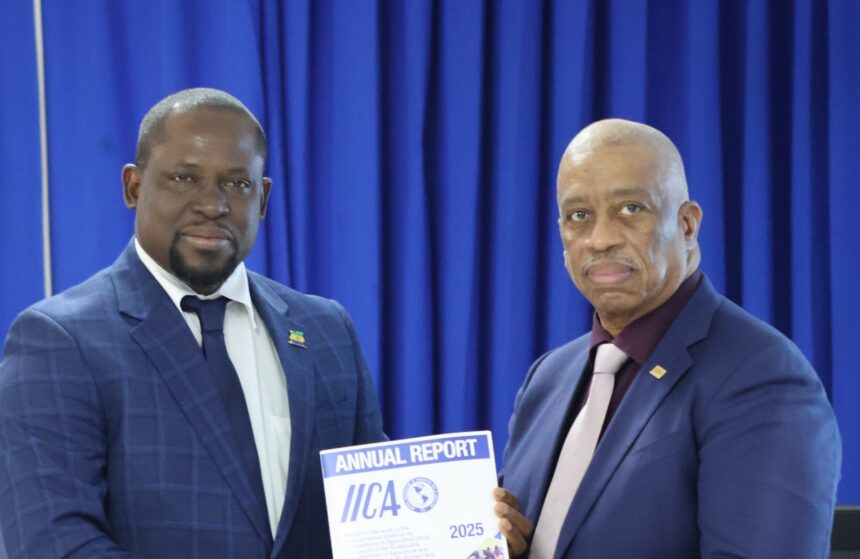
From strengthening agribusinesses and food safety systems to enhancing resilience against animal diseases, the Inter-American Institute for Cooperation on Agriculture (IICA) delegation in Saint Vincent and the Grenadines, showcased its contribution to agricultural development during its 2025 Accountability Seminar held on June 10, 2026, at Frenches House in Kingstown.
Convened under the theme “Transparency, Responsibility, Impact”, the seminar brought together more than 40 farmers, agro-processors, Ministry of Agriculture officials, development partners and representatives of agricultural organisations to review IICA’s work and results in Saint Vincent and the Grenadines during 2025 and discuss priorities for the future.
Among those attending were Minister of Fisheries, Marine Conservation and Climate Resilience, Hon. Conroy Huggins; Acting Permanent Secretary in the Ministry of Agriculture, Forestry and Rural Transformation, Colville King; Chief Agricultural Officer Renato Gumbs; and IICA Representative for the Eastern Caribbean States, Gregg Rawlins.
A key feature of the event was the presentation and formal handover of IICA’s 2025 Accountability Report to Minister Huggins and Acting Permanent Secretary King.
Presented by Michael Dalton, former Technical Specialist with the IICA Delegation in Saint Vincent and the Grenadines and newly appointed IICA Representative in Suriname, the report highlighted a range of initiatives implemented during the year, including online training programmes for micro, small and medium-sized enterprises (MSMEs), support for agricultural health, safety and food quality systems, efforts to strengthen African Swine Fever surveillance and response capacity, and other interventions aimed at advancing agricultural and rural development.
Addressing the seminar, Minister Huggins commended IICA for its commitment to transparency and accountability, saying that it “reflects a commendable commitment to transparency, collaboration and results-based development within the agriculture sector.”
The Minister noted that the seminar provided an opportunity to assess progress, address ongoing challenges and align efforts to advance agriculture and improve rural livelihoods in Saint Vincent and the Grenadines. He acknowledged that climate variability, external shocks and structural constraints continue to affect productivity and competitiveness but praised IICA for remaining responsive to national priorities through targeted interventions that strengthen resilience, enhance productivity and support sustainable agricultural systems.
Acting Permanent Secretary, Colville King, also welcomed the accountability exercise and the opportunity for stakeholders to engage in dialogue on the future of the sector.
“I want to thank IICA for continuing to account,” King said while acknowledging the Institute’s contribution to agricultural development.
Additionally, King called for greater focus on two longstanding challenges facing farmers, inclusive of market access and praedial larceny. He noted that many producers continue to struggle to access lucrative markets due to fragmentation and limited market organisation, while losses associated with praedial larceny remain a major concern for the sector.
He described both issues as priorities requiring attention in the period ahead and expressed appreciation for IICA’s leadership and support to the people and Government of Saint Vincent and the Grenadines.
Addressing the seminar, Gregg Rawlins emphasised that accountability remains a fundamental principle of the Institute’s work and a key reason for hosting the annual exercise.
“Accountability is at the core of all the actions of IICA,” he said. “We have a responsibility to account for our stewardship of those resources and the outcomes we can effect for the improvement of lives and livelihoods of our clients.”
He noted that the Institute’s interventions are ultimately aimed at improving the lives and livelihoods of farmers, agro-processors and rural communities across Saint Vincent and the Grenadines and the wider region, keeping in line with Government development priorities.
“We see IICA’s technical agenda sitting fitting directly into the Government’s growth plan,” he stated.
He explained that while agriculture remains the primary focus of IICA’s work in the country, the Institute also recognises opportunities to contribute to the blue economy, strengthen linkages between agriculture and tourism, and promote innovation through digital technologies and new models of entrepreneurship. He pointed to initiatives such as the recently concluded ADOPT Caribbean Project as examples of IICA’s efforts to support recovery, transformation and resilience within the agricultural sector.
Beyond the presentation of results, the seminar also carried special significance as it marked Dalton’s final accountability seminar in Saint Vincent and the Grenadines after nearly 17 years of service with IICA in the country.
The event became an emotional occasion as farmers, agro-processors, government officials and development partners reflected on Dalton’s contribution to strengthening the agricultural sector and supporting rural communities over the years. Tributes, well wishes and presentations were shared in recognition of his dedication, leadership and commitment to capacity building throughout his tenure.