

We applaud the Hon. Minister of Family and Gender Affairs, Laverne Gibson-Velox, for her good intention to address our adolescent sexual crisis.
But increasing the so-called age of consent and establishing new childcare facilities will not resolve the national crisis we face.
That approach is rooted in our knee-jerk, cultural disposition to punishment, and more punishment. It has not worked and it will not work.
Consent is not the issue. More than 40% of first sexual experiences in our region are non-consensual, coercive, and often violent.
Some 76-85% of so-called teen pregnancies across our region result from relations with men 20 years and older; 50-55% result from relations with young men just 20-24 years old.
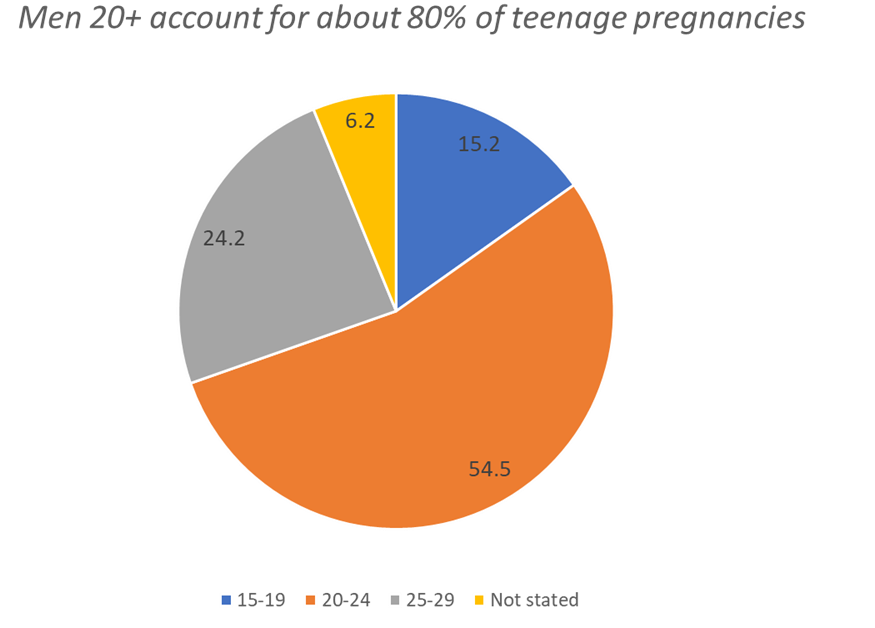
Source: ASPIRE, The Myth of ‘Teenage’ Pregnancies: Percentage of Fathers by Age
So, we do not understand how increasing the age of consent addresses this problem.
We need a mental shift from restriction and punishment for our adolescents to empowering them – giving them Access and Education.
At 45.2, Grenada has the fourth highest adolescent fertility rate (AFR) in the region.
That is ten points above the average in the Caribbean and nine times the average of 5.1 for all Caribbean colonizers – England, Spain, Portugal, France and the Netherlands.
The difference is not about culture; it is about methodology. Bermuda’s AFR is 7.4, Martinique’s is 10.7, and Aruba’s is 13.3 – all Caribbean.
In 1987, St. Vincent was the third country in the region to pass legislation that allowed 16-year-olds access to healthcare without parental consent. That was a sensible and commendable step. It provided Access; but it did very little about Education.
Health and Family Life Education (HFLE) remains a weak, largely ignored, and unexamined aspect of our school system. Of course, failure in any academic subject can be readily corrected in the next semester; but failure in HFLE can be catastrophic and irreversible.
If the minister truly wants to address the roaring crisis of reproductive health she must (i) extend the 1987 legislation to age 12 or lower, (ii) radically strengthen HFLE education in schools, and (iii) encourage parents to discuss responsible sex with their children. Only about 5-10% of Caribbean parents do so.
Adolescent Fertility Rate: Argentina, 2015-2021
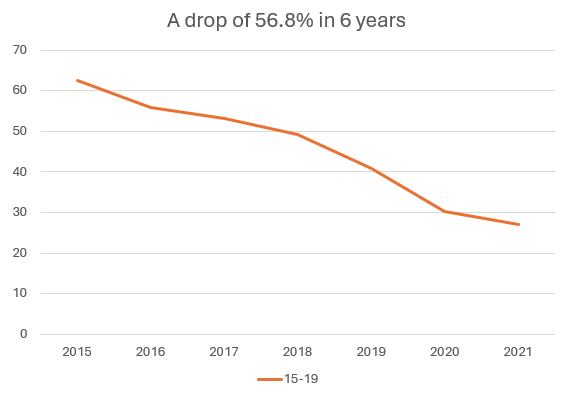
Source: CEDEs Annual 2022 Report. The Paths of the Argentine Experience, June 2023.
Argentina recently adopted a stratified approach to providing teenagers with access to health care. There, the government introduced a three-layer model. They gave teenagers 16-18 full autonomy. They allowed teens 13-15 independent access providing there was no serious risk. And for those 12 and younger, they required adult access, chosen by the child.
In just six years with this model, the adolescent fertility rate fell from 62.6 to 27, a drop of almost 57%. That is remarkable.
This is what is possible when public policy is informed by empirical evidence. This is not magic: It is social science in action.
Sincerely,
ASPIRE is a pro-motherhood, pro-choice, pro-family, non-governmental advocacy group registered in six Caribbean countries. It promotes research and dialogue with civil society and governments to advance fairness and justice in reproductive health.
