

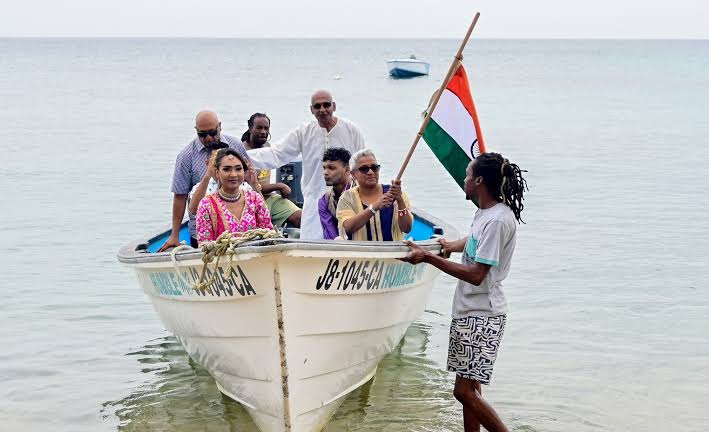
The President, members of the Executive, the Indian community of SVG and in the Diaspora, will, on Wednesday October 7th 2026, commemorate the 19th anniversary, since the recognition of INDIAN HERITAGE DAY, by an Act of Parliament on March 26th 2007.
After the abolition of slavery in 1838, there was a shortage of labour, as many of the newly freed slaves refused to work on the estates. Between the years 1861 and 1880, eight (8) ships arrived from India bringing a total of 2,474 Indians. They lived on twenty- three (23) estates in St Vincent. Of the 2,474 Indians who came to SVG, 1,141 returned to India, because they saw no more prospects for them in SVG.

Indian Heritage Day received its significance when on October 7th 1882, fifty (50) barefooted Indians from Argyle estate laid down their cutlasses and hoes, and marched all the way to Kingstown in defiance of the estate manager, Mr Mc Kenzie, and the laws of St Vincent, to take their several grievances directly to the Lieutenant Governor.
On their way to Kingstown, seven (7) miles away, they were joined by more Indians from Calder, M Pleasant, Stubbs, Diamond, Ratho Mill, Golden Vale, Harmony Hall, Carapan, Happy Vale, Belair, and Arnos Vale.
When they got to Kingstown, seven of the Indians, called “ringleaders”, were arrested and charged for “vagabondism”; that they had left the estate without permission, and had gone beyond the two- mile limit.
After two months, a petition was sent to the Colonial Office on behalf of the seven Indians, and the Secretary of State ruled that an injustice was done, and they were given the right to return to India. However, the high cost of repatriation was considered, and in lieu of the return passage to India, an offer was made to give them lands. This was turned down by the planters.
The Indians who remained in SVG continued to live on the estates, while buying pieces of land in other areas, to move their families.
The religion of the Indians who arrived in SVG was mainly Hinduism. As they were a relatively small group, they were encouraged to adapt to Christianity. Infants were baptized in Christian churches and given Anglo-Saxon names. There was competition among the Christian churches to baptize the Indians.
The Indian names were changed, so that they could be educated in the Christian schools. Later, there was inter-marriage with other races. There were also changes in the style of dress and cuisine; females no longer wore saris, and curry dishes were replaced by creole dishes, such as ground provision and fish.
The SVG Indian Heritage Foundation has endeavoured, over the past twenty (20) years of its existence, to preserve the identity of their fore-parents, to recognize and understand their heritage and culture, to acknowledge their outstanding contribution to the development of the areas in which they settled, and above all, thank those who remained in SVG, so we can be here now.
We pay tribute to their suffering, fortitude and progress as we try, as far as is humanly possible, to carry on their rich legacy, and hand down what we have learnt to our children, grandchildren and great grandchildren, with the hope that they will build on what we so enthusiastically started.
We continue to share the interesting and educational series of “Interviews with outstanding Vincentian Indians in the Diaspora” and “Conversations with our Indian Elders, which are available on YouTube and our website www.svgihf.org. So far, we have featured 27 outstanding citizens.
A Genealogy website is available to persons who are interested in tracing their roots. (Indentured Indians/Girmityas). Please visit our main website www.svgihf.org, click on the “subscribe” button, then select “premium” and follow the prompts to subscribe.
Some of the features include building, or importing and expanding family trees, accessing and sharing information about families, linking up family trees with other Indians of SVG, and printing family trees.
As we continue our mandate:
“to represent the interest of the East Indian community of SVG and those in the Diaspora, instil a greater sense of pride in our heritage and culture, create opportunities for Indo-Vincentians to learn more about, and preserve their history, create and strengthen relationships, improve all other aspects of the Indian community”, we say Happy Indian Heritage Day 2026 to everyone, and ask that you join us as we commemorate this historical day by wearing something Indian, and eating some Indian food on Wednesday October 7th 2026.