

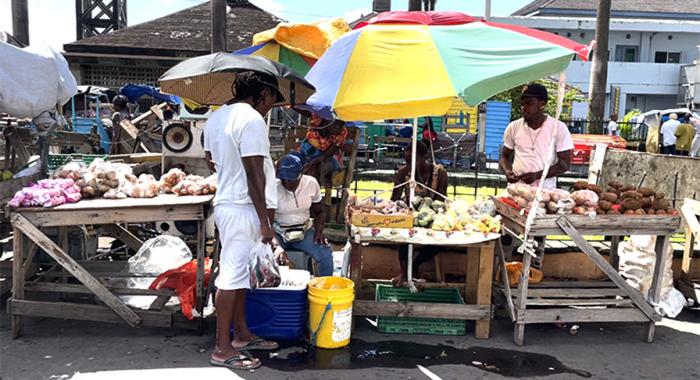
Prominent attorney and social commentator Jomo Thomas has voiced total support for the government’s decision to rescind its order removing street vendors from the capital, insisting that Kingstown’s street vending should be regulated rather than eradicated.
Speaking on his weekly program “Plain Talk with Jomo Thomas” on Boom 106.9 FM (OMG Morning Show), Thomas outlined a detailed defense of vendors, framing the issue around economic survival, historical culture, and urban planning, while offering concrete proposals to organize public spaces in Kingstown.
Thomas, who noted that he has advocated on the vending issue for over two decades, reaffirmed his long-standing position against clearing vendors from city streets. He warmly welcomed the government’s decision to reverse its removal order, declaring that he has never supported—and will never support—any initiative aimed at removing street vendors.
Refuting common complaints that vendors make city sidewalks impassable, Thomas emphasized that as someone who walks the streets of Kingstown every day, he has never been blocked or prevented from passing by street vendors. He characterized claims of complete pedestrian blockage as un-truthful, pointing out that navigating around a buyer or a vendor’s tray requires no more effort than stepping around two pedestrians conversing on the sidewalk.
Addressing the broader socioeconomic context, Thomas highlighted that St. Vincent and the Grenadines faces a poverty rate of approximately 40% (four out of every ten citizens). For many of the country’s most vulnerable individuals, street vending serves as an indispensable economic lifeline. Vendors routinely work 10 to 12 hours a day and pay about $60 per week to the Town Board for permission to trade.
Thomas sharply criticized opposition from major commercial operators and supermarket owners who object to vendors setting up near their store entrances:
No Real Competition with Big Business: Thomas dismissed claims that vendors pose unfair competition to established merchants, noting that a vendor carrying $2,000 worth of stock cannot reasonably be viewed as competition to a million-dollar supermarket.
Natural Attraction to Foot Traffic: Vendors naturally set up in high-traffic areas outside major commercial hubs like Greaves or Peppercorn because sifting through high foot-traffic volume is essential for sales.
High Economic Multiplier: Earnings generated by lower-income vendors circulate rapidly within the local economy compared to money retained by middle- or upper-class individuals, creating a powerful economic multiplier effect.
Historical Impact: He pointed to historical figures like Miss Barrow, who spent decades selling peanuts and sugarcakes under city galleries (“building alone”) to build a home and send her children to school, arguing that efforts to dismantle such opportunities reflect a stance of “privilege”.
Rather than evicting vendors, Thomas advocated for practical urban planning solutions to harmonize street trade with city traffic:
Middle Street Pedestrian Zone: Convert Middle Street (stretching from Jax’s / the police station area up to Heritage Square) into a dedicated, pedestrian-only selling zone closed to daily vehicular traffic.
Early Commercial Offloading Hours: Mandate that commercial delivery trucks unload their inventory early in the morning—between 4:30 a.m. and 5:00 a.m.—so streets remain clear when morning traffic builds up at 7:00 a.m., ending the practice of trucks blocking streets mid-day.
Structured Sidewalk Allocations: Emulate Carnival-style markings by establishing designated sidewalk blocks (e.g., limiting specific store perimeter blocks to 10 vendors) to ensure orderly setups while keeping pedestrian thoroughfares functional.
While defending produce, fruit, vegetable, and clothing vendors, Thomas drew a clear distinction regarding public sanitation and food safety. He explicitly excluded raw fish sales from acceptable street vending, classifying individuals walking the streets with buckets or pans of fish as an unhygienic health hazard.
“That’s not vending to me. That’s a health hazard,” Thomas asserted, emphasizing that street fish vendors should be removed and relocated to proper market facilities.
Thomas also critiqued the infrastructure of Kingstown’s multi-story central market building, describing it as a “monstrosity” that lacks a natural “magnet” or foot-traffic flow to draw shoppers inside. He contrasted it with the historic open-air market, which was rain-covered yet open on all sides, allowing seamless pedestrian movement.
He warned against false concepts of modernization that erase local history and culture, citing historical research by Dr. Fraser, Dr. Scott, as well as commentary by filmmaker Alton Ackley.
Pointing to international examples—such as open-air street trade on Canal Street and Fifth Avenue in New York City, as well as in Jamaica, St. Lucia, Ghana, and England—Thomas argued that authentic street markets represent rich cultural vitality that local residents and visiting tourists alike appreciate.
Thomas said that Kingstown does not suffer from excessive vending, but rather from a lack of thoughtful regulation. By organizing vendor zones and establishing clear operational rules, the government can maintain urban order while protecting the livelihoods of working Vincentians.
