

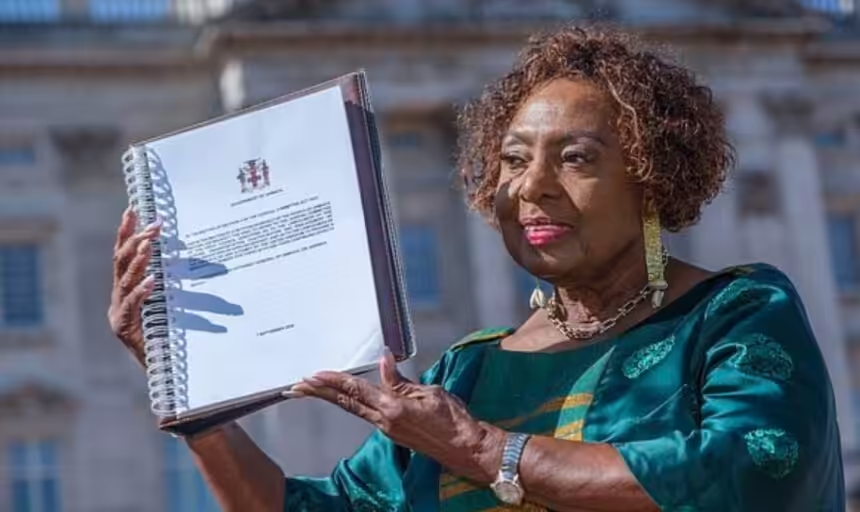
King Charles III did not personally meet with a Jamaican government delegation or receive their petition requesting £7.6 billion ($10 billion) in slavery reparations during their visit to London.
The decision by Buckingham Palace stems from a combination of scheduling constraints, constitutional protocols, and established legal procedures governing petitions to the Crown.
Buckingham Palace explained that King Charles is currently residing at Balmoral Castle in Scotland for his traditional annual summer break, during which Buckingham Palace in London remains open to the public.
According to a palace spokesman, the Jamaican delegation submitted its request for an in-person meeting at the palace during the week of August 24, 2026, for a meeting that same week. The palace clarified that fulfilling an in-person meeting on such short notice was not a practical possibility.
Beyond scheduling, palace officials emphasized that delivering petitions directly to the monarch in person is not the correct legal or constitutional process.
Under Section 4 of the Judicial Committee Act 1833, the monarch’s role in referring legal petitions to the Privy Council’s Judicial Committee is strictly formal. The King exercises no personal discretion in deciding whether to refer a petition, plays no role in the substantive consideration of its legal merits, and acts solely on the advice of his ministers and relevant government authorities.
To adhere to official constitutional channels:
- Filing the Petition: Petitions must be delivered in hard copy directly to the registrar of the Judicial Committee of the Privy Council.
- Official Representation: Any formal meeting regarding such petitions is conducted through the King’s official representative in Jamaica, the Governor-General, with whom Buckingham Palace has been working to ensure the filing is properly lodged.
- Bilateral Meetings: Official discussions with the visiting delegation are handled by the UK Foreign, Commonwealth and Development Office (FCDO) rather than the monarch directly
The Jamaican delegation, led by Culture Minister Olivia Grange, traveled to London to lodge the petition seeking formal legal rulings on three core questions regarding historical enslavement:
- Whether the enslavement of Africans in Jamaica was legal under English law.
- Whether it broke international law.
- Whether Britain now has a legal duty to provide financial and judicial redress.
The petition highlights that when Britain outlawed slavery in 1834, it paid £20 million in compensation to former slave owners rather than to the enslaved population—a massive financial burden amounting to 40 percent of the UK Treasury’s annual income at the time, which was funded by a loan only fully paid off in 2015.
While British governments maintain that they will not pay slavery reparations, palace representatives noted that King Charles has repeatedly expressed a personal commitment to promoting understanding around the legacy of slavery and addressing historical wrongs.
Constitutional law experts, including Craig Prescott of Royal Holloway, University of London, noted that utilizing the 1833 constitutional procedure is a strategic legal move by Jamaica. However, Prescott observed that if the Privy Council or British government rejects the petition, it could underscore the political gulf between London and Kingston, further accelerating Prime Minister Andrew Holness’s plans to sever ties with the British monarchy and transition Jamaica into a republic
