

A police officer can report for duty, respond to calls, make difficult decisions, deal with tragedy and still tell everyone, “I am good.” That does not always mean that everything is good.
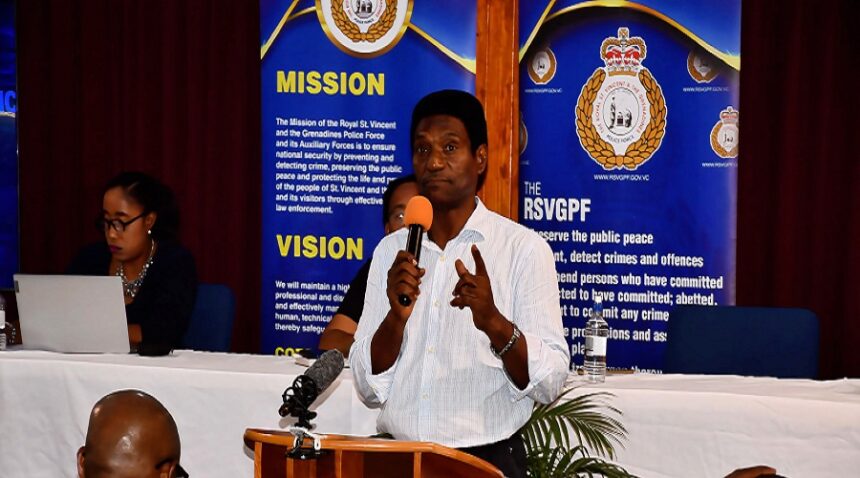
That reality was at the centre of “Protecting Our Protectors: Understanding Suicide and Mental Health in Law Enforcement,” a symposium hosted by the Royal St. Vincent and the Grenadines Police Force on Thursday, September 24, 2026, at the St. Vincent and the Grenadines Mission of Seventh-day Adventists Headquarters Auditorium, Old Montrose.

The symposium formed part of the Force’s observance of Suicide Prevention Awareness Month and brought together psychologists, counselling professionals, law-enforcement personnel, senior officers and other partners for a focused discussion on the mental and emotional pressures associated with policing. For the RSVGPF, the significance of the initiative extends beyond one afternoon. Police officers routinely encounter violence, death, serious accidents, domestic conflict, grieving relatives, frightened victims and people experiencing some of the most difficult moments of their lives. They are nevertheless expected to remain composed, exercise sound judgement, manage conflict and return to duty ready for whatever comes next.
The symposium created an official space for the organisation to acknowledge that those experiences can carry a human cost and that protecting the wellbeing of police personnel is directly connected to protecting the strength and effectiveness of the organisation itself.
“We cannot afford to treat this casually”
In brief remarks, Acting Commissioner of Police Mr. Trevor Bailey made clear that the mental and emotional wellbeing of police officers is not an issue the organisation can afford to treat casually.
He noted that policing demands composure, discipline and judgement under pressure, while exposing officers to circumstances that may remain with them long after a shift has ended.
The Commissioner cautioned against assuming that an officer who says, “I am good,” necessarily has nothing more to say. He encouraged greater attention when persons begin to withdraw, when behaviour changes, when performance shifts or when there are other indications that something may be wrong. His message on stigma was equally clear. “There should be no shame attached to asking for help.”
Commissioner Bailey said mental health affects the people within the organisation, decision-making, operational effectiveness and ultimately the quality of service delivered to the public.
He also stressed that a healthy police organisation cannot be built solely around vehicles, equipment, training and operations. It must also be built around healthy people.
“If we expect our officers to protect the public, then the organisation must also take seriously its responsibility to protect the wellbeing of its officers.”
The Commissioner described the symposium as part of a wider conversation about strengthening the RSVGPF from within and encouraged the organisation to continue learning from research, professional expertise and approaches that can improve the support available to personnel.
Assistant Commissioner of Police (Ag.) Mr. Brenton Smith, responsible for Crime and Human Resource Management, also addressed the symposium, noting the importance of taking mental health seriously within an organisation whose members are regularly exposed to difficult and emotionally demanding situations.
He spoke to the need for greater understanding around the pressures officers carry and the importance of creating an environment where persons feel able to seek help when they need it.
His remarks also reinforced the wider message of the symposium: that mental wellbeing should not be treated as a private weakness or an issue to be hidden, but as something the organisation must be prepared to acknowledge openly and address responsibly.
He encouraged officers to look out for one another and to recognise that strength does not mean ignoring the effect that stress, trauma or personal challenges can have over time.
The symposium featured four presentations, each examining a different part of the mental-health conversation within law enforcement.
Dr. Jozelle Miller, Clinical Health Psychologist, addressed “The Accumulated Weight of the Job: Trauma, Grief, Hypervigilance and Recovery in Law Enforcement.”
The topic drew attention to an important reality of policing. The challenge is not always one extraordinary incident. Sometimes it is the accumulation of many difficult experiences over months or years. Understanding that cumulative effect is important to recognising distress earlier, supporting recovery and reducing the tendency to dismiss emotional strain simply because difficult experiences are considered part of the job.
Dr. Kevan Glasgow, Psychologist, presented on “The Silent Load: Stress, Masculinity, Help-Seeking and Mental Health in Law Enforcement.”
The subject was particularly relevant to a profession in which strength, composure and self-reliance are highly valued. For law enforcement, encouraging strength cannot mean creating an environment where people believe they must remain silent when they are struggling. Reducing stigma around help-seeking does not lower professional standards. It can help officers remain healthy enough to meet them.
Pastor Edward Smith, an ordained pastor and Counselling Psychologist, presented “Strength, Faith and Seeking Help: Supporting Mental and Emotional Wellbeing in Law Enforcement.” His topic added another dimension to the discussion by examining faith, emotional wellbeing and seeking professional or personal support as responses that can work together rather than being treated as opposing choices.
Corporal Elroy Quammie, a member of the RSVGPF attached to the National Prosecution Service, Office of the Director of Public Prosecutions, addressed “Carrying Other People’s Trauma: Witness Care, Emotional Exposure and the Hidden Burden on Law Enforcement Personnel.” His topic highlighted an area that can easily be overlooked.
Police officers and other criminal-justice professionals do not simply handle files and investigations. They repeatedly listen to experiences of violence, abuse, fear, grief and loss. Understanding how that exposure can affect the professionals providing assistance is another part of building healthier and more sustainable systems of support.
The presentations were followed by a moderated round-table discussion and audience questions, led by Station Sergeant Stephen Billy, giving participants an opportunity to examine the issues collectively and consider how they apply to the realities of policing in Saint Vincent and the Grenadines.
The significance of Protecting Our Protectors is not that one symposium can solve every mental-health challenge associated with policing. It cannot. Its importance lies in what it represents.
It places mental health and officer wellbeing on an official organisational platform. It allows police personnel to hear directly from professionals. It challenges stigma. It encourages officers to pay closer attention to themselves and to one another. Most importantly, it acknowledges that caring for the people who police the country is part of caring for the organisation itself. Changing culture takes time.
It requires education, leadership, appropriate support systems and repeated conversations that make it easier for someone to say, “I need help,” and easier for another person to recognise that those words deserve a serious response. The symposium therefore represents a step in a wider process, not the end of one.
The RSVGPF expresses sincere appreciation to the organisations, businesses and individuals whose support contributed to the success of the symposium and the wider September activities.
Special appreciation is extended to the St. Vincent and the Grenadines Mission of Seventh-day Adventists for its support and for facilitating the use of the Mission Headquarters Auditorium.
The Force also acknowledges Right Stuff, Mr. Rohan D. Freitas, Forestry Services, and Police Headquarters, including the Administration Department through Assistant Commissioner of Police Hesran Ballantyne, for the assistance extended to the initiative.
The RSVGPF further recognises the support of its High Command and senior ranks, whose involvement helped reinforce the importance being placed on the wellbeing of personnel throughout the organisation.
Appreciation is also extended to the Ministry of Health and personnel of the Health Promotion Unit for their partnership and support during the wider programme of activities associated with the month.
The Force is equally grateful to the presenters, organisers, support personnel and all those who contributed their time, professional expertise and resources to make the symposium possible.
The September activities were expected to culminate with the Suicide Prevention and Prostate Cancer Awareness Wellness Walk on Saturday, September 26, 2026.
However, the activity was postponed as a result of operational demands requiring the attention and deployment of police personnel and other members of the national-security community. The RSVGPF thanks all partner agencies, officers and members of the public who had expressed an interest in participating.
Commissioner Bailey closed his remarks with a message that captures the wider purpose of the initiative:
“What begins here today should not end when we leave this auditorium. The conversation must continue, and so must the work.”
For the Royal St. Vincent and the Grenadines Police Force, Protecting Our Protectors is a recognition that behind every rank, every uniform and every responsibility is a person. And strengthening the organisation must include strengthening the people who serve within it.