

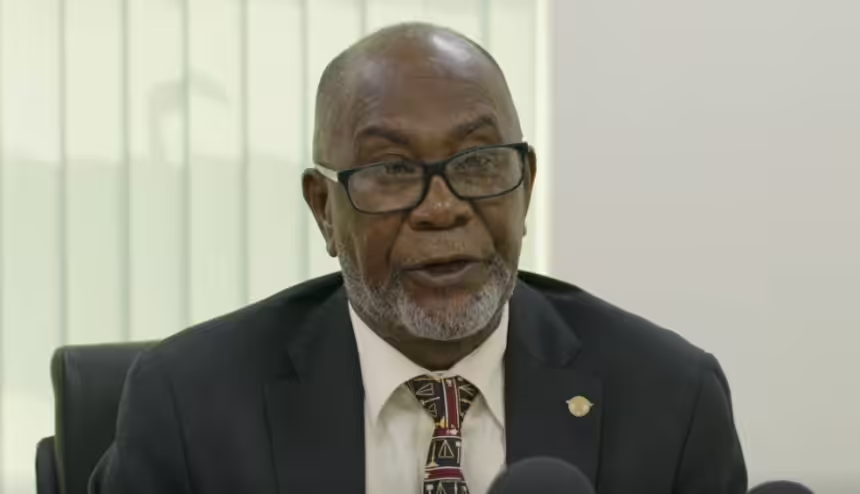
In an unusually candid public address, Minister of National Security St Clair Leacock has delivered a sobering assessment of the state of public finances and government infrastructure in St. Vincent and the Grenadines, declaring that “the government broke” and calling for unprecedented transparency with the Vincentian public.
Speaking during a live radio broadcast on Nice Radio, Leacock broke his silence to lay bare the severe financial constraints and physical deterioration affecting key government facilities across the country, including police stations, public offices, and state residences.

Addressing the program’s hosts and listeners, Leacock reflected on his transition from opposition platform speaker to cabinet minister, identifying the central dilemma currently facing governance as the ability to speak truthfully to the populace when conditions are grim.
Leacock made reference to a caller on the program who lamented that after supporting the ruling party for 25 years, his house was rotting down around him while he waited for state assistance. Leacock pointed to this example as emblematic of the heavy expectations placed on government amidst severe resource limitations.
“If you were to ask me forever, what is the most difficult experience I have of being a government minister, I don’t think you can even have a guess as to what the answer I will give you,” Leacock stated.
He emphasized that free and honest communication forms the cornerstone of democratic accountability:
“One of the most important aspects of a democracy that I think people want is the ability of their government or their politicians to be able to speak to the people free, frank, open and honestly… That is an aspect of accountability and transparency.”
However, Leacock confessed that his primary challenge as a sitting minister is determining “how far and how open you can be in speaking to your people about what is the state of affairs,” warning that when openness becomes difficult, it signals an unpleasant reality.
Dismissing formal economic jargon, Leacock insisted that the administration must abandon abstract terms when explaining fiscal realities to citizens. He argued that technical metrics often obscure the true condition of the national treasury.
“We use high-falutin language when we talking to people—your debt-to-GDP ratio is this and that and that and that,” Leacock remarked. “For all intentions and purpose, the government has to tell people plain talk just like the ordinary man on the street: the government broke.”
Leacock noted that public utilities and basic services at state properties remain active largely due to official leniency rather than prompt settlement of accounts. “The only reason why government buildings probably don’t get the light bill cut off is because they name government, or the water bills cut off is probably because we name government,” he said.
Drawing on his professional background in accounting, finance, and economics, Leacock detailed his participation in high-level fiscal meetings, including discussions with the International Monetary Fund (IMF) and the World Bank. He described witnessing senior financial officers struggle to manage an extensive list of government creditors:
Creditor Prioritization: Financial officers are forced to rationalize a lengthy list of unpaid debts, deciding “who get or who don’t get” and determining how long creditors must wait for payment.
Loss of Commercial Trust: As a consequence of delayed disbursements, private contractors and vendors are increasingly reluctant to conduct business with the state, as government commitments are no longer viewed as “an article of faith.”
To illustrate the compounding nature of public debt, Leacock offered a folk analogy of a truck driver trapped in a cycle of credit:
“It’s the typical case where a truck driver takes money, and instead of paying the debt, he trusts next rum. Then he gets paid, and instead of paying off the bill, he pays a piece, but he is still going by the workshop—until everybody meets up one day and says, ‘Boy, you owe you two.'”
To illustrate the severity of current liquidity challenges, Leacock recalled an example from his tenure in opposition regarding international grant funding and matching debt requirements.
He recounted a past proposal involving a $48 million grant from the Saudi Arabian Fund. In order to access the $48 million in development funds, the government was required to raise $3 million in local counterpart financing. Because the funds were unavailable in state coffers, the government was forced to borrow the $3 million, incurring additional national debt to secure the grant.
Leacock warned that the current fiscal crisis has rendered even matching contributions unattainable:
| Funding Scenario | Grant Amount | Required Counterpart Funds | Financial Action Required | Current Feasibility |
|---|---|---|---|---|
| Historical Saudi Fund | $48 Million | $3 Million | Borrowed matching capital to access grant | Achieved through added debt |
| Current Hypothetical | $50 Million | $5 Million | Must raise local capital from state treasury | Unlikely—government cannot find the $5M |
“It will not surprise me if something like that happened today again, where to get say $50 million they tell you put in $5 million for yourself, that the current government could find itself in the same situation—that they can’t find the five,” Leacock cautioned.
As Minister of National Security, Leacock pointed to a systematic pattern of physical neglect across state infrastructure, revealing that the ministry has been forced to seek private corporate donations for basic maintenance.
Key Facilities Affected
- Old Montrose Police Station: Describing the facility’s entrance as a “shameful thing,” Leacock noted that the station’s sign had become completely unreadable. He revealed asking the Commissioner of Police to solicit corporate assistance:
- Requesting one local business to donate new signage for the station.
- Asking another company to provide power washing and donate paint for the entrance and barracks.
- (Calliaqua) Police Station: Suffering from structural degradation and severe termite infestation (“eaten down”).
- Layou Police Station: Facing acute public health hazards, with raw sewage and excreta overflowing from the septic system directly into the main public street.
- Spring Village Police Station: Exhibiting the same recurring pattern of structural deterioration seen across rural stations.
- Kingstown Post Office: Featuring unsightly exterior walls blackened by moss and water stains running down the drainpipes. Leacock observed that while workers repainted the interior post box area, the unmaintained, moss-stained exterior created a jarring contrast, making the building look even worse despite good intentions.
- Official Residences: Highlighting Government House (where the Governor General is not residing) and the Prime Minister’s residence, both left in disrepair. Leacock clarified that such neglect reflects acute financial incapacitation rather than negligence, stating that officials simply lack the funds to maintain the properties.
“When you find yourself as a minister speaking to the chief executive officer of a business in that kind of way, it’s telling you that things are bad,” Leacock reflected, comparing the ministry’s predicament to an ordinary citizen organizing a barbecue, a sponsored walk, or seeking remittances from relatives abroad to cover basic expenses.
Leacock situated St. Vincent’s fiscal distress within the broader Eastern Caribbean region, noting that member states of the Organisation of Eastern Caribbean States (OECS)—including St. Lucia, Grenada, Dominica, and Antigua—face identical struggles to secure counterpart, emergency, or maintenance funds.
He noted that international pressures from the United States and European authorities have increasingly restricted traditional non-tax revenue avenues, such as Citizenship by Investment (CBI) programs.
While noting that nations like Argentina are contemplating CBI programs and other Caribbean jurisdictions have historically generated $3 billion to $5 billion through such initiatives, Leacock observed that regional leaders rarely engage in direct, transparent dialogues with their populations regarding severe road conditions and infrastructure backlogs.
Turning briefly to national security, Leacock addressed public concerns regarding crime, assuring listeners that law enforcement agencies are actively implementing measures to combat criminal activity.
Leacock addressed public perception surrounding homicide statistics, referencing a recent incident in which four lives were lost in a single event. He contextualized the incident against broader regional trends:
“Last week across the Caribbean and across the spectrum here, you had far worse than the four homicides that we had—because where we had one event that took four, some of them had six or eight separate incidents. But the one that took four comes over as being worse than having six, seven, eight, or nine separate incidents.”
He defended ongoing investments in law enforcement infrastructure, urging critics to consider how much worse the security situation would be without proactive police deployments.
Leacock called on the administration to embrace absolute honesty with the electorate, invoking the legal oath to deliver “the gospel truth and nothing but the truth.”
He stressed that having sought office with full knowledge of the country’s historic difficulties, the government now holds an obligation to explain both the extent of the crisis and the specific measures required to overcome it.
“You had a sense that things went bad and you still asked for the job. Now you have the job. You have to go out there and tell them it is bad and tell them how you get out,” Leacock stated.
Leacock urged Vincentians to face fiscal realities with resilience (“ban your belly”) and maintain social solidarity, reminding citizens to “be our brother’s keepers” as the nation confronts its financial challenges.
