

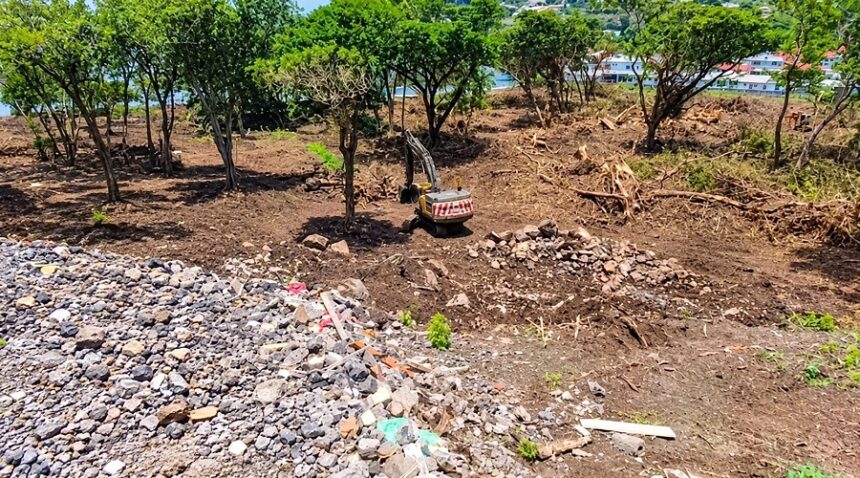
Over the past 25 years, not a single mangrove stands in St. Vincent and the Grenadines has received legal protection under national law, leaving ecologically vital ecosystems at Canash on mainland St. Vincent and the Ashton Lagoon on Union Island completely exposed to destruction on private property.
The regulatory gap was disclosed in the House of Assembly by the Minister of Transport, Infrastructure, and Physical Planning in response to parliamentary inquiries regarding the recent cutting down of mangroves at Canash.
The inquiry followed the recent destruction of mangroves at Canash on mainland St. Vincent. According to parliamentary statements, an application in principle for a new commercial apartment complex at Canash was submitted by Rybeck Properties Limited on December 16, 2025. The Physical Planning and Development Board formally refused the application on March 26, 2026, citing concerns over the destruction of mangrove trees.
Despite the refusal, mangrove clearing subsequently took place on the site without any new planning applications being submitted. The Minister explained that the Physical Planning and Development Board is legally constrained in stopping tree removal on private property in the absence of explicit statutory protections for mangroves.
The cleared areas at Canash consist of two privately owned parcels, while a third adjacent parcel owned by the Sailing Association remains intact.
A parliamentary review of environmental legislation revealed that neither the Canash mangrove nor the ecologically sensitive Ashton Lagoon mangrove on Union Island enjoys legal protection:
Private Land Voluntary Protection: The only protected mangrove in the entire country is a private stand in Brighton owned by Dr. Gerald Thompson, who voluntarily entered into a perpetual conservation agreement with the Forestry Department.
Unenacted Regulations: Although the Forest Reserve and Conservation Act was passed in 1992 to allow the government to declare protected forests and mangroves, the essential enabling regulations required to enforce the Act were never enacted over the subsequent three decades.
Omission from Protected Schedules: Canash is omitted from the schedule of declared forest reserves under the 1992 Act, which currently lists only the Kings Hill Forest Reserve, Cumberland Forest Reserve, and the Tobago Cays Marine Park.
Inadequate Marine and Fisheries Laws: While the waters off Canash Beach are designated as a conservation area under the Fisheries Act, the law only restricts the use of spear guns in the water and provides no legal protection for coastal vegetation or shoreline mangroves. Furthermore, the proposed South Coast Marine Park was never formally declared by the National Parks, Rivers and Beaches Authority.
Parliament was also informed that an informational sign erected at Canash by the National Parks authority—funded by the German Development Bank (KFW)—incorrectly claims that the area contains red mangroves and suggests it is a protected reserve.
The Minister clarified that the sign lacks the official Forestry Department logo and contains false information. The species present at Canash is buttonwood, which provides habitat for coastal seabirds and crabs, whereas red mangroves in St. Vincent and the Grenadines exist exclusively at Ashton Lagoon on Union Island, which remains similarly unprotected.
