
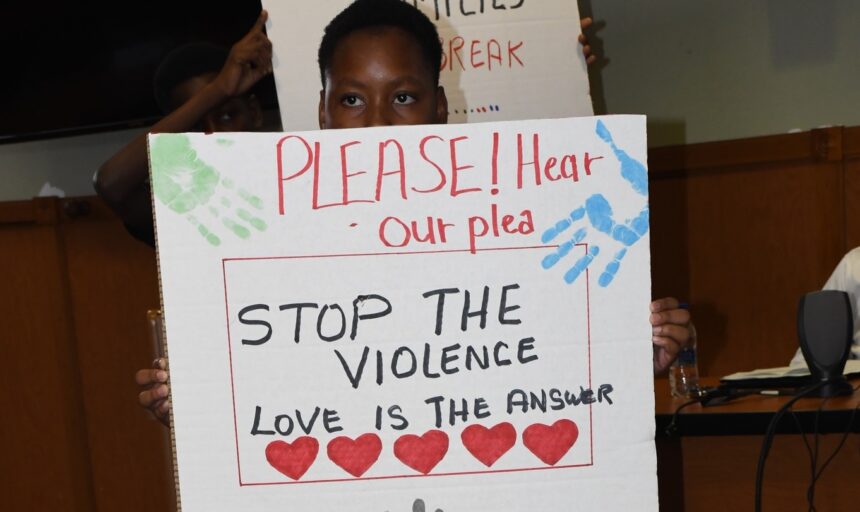
NATIONAL CONSULTATION CALLS FOR UNITED ACTION ON SCHOOL VIOLENCE
The question facing St. Vincent and the Grenadines is no longer whether violence is appearing in schools, but how the nation chooses to respond. On Tuesday morning, policymakers, educators, police leadership, and community stakeholders gathered at the National Insurance Services (NIS) Conference Room for a national consultation on school violence, held under the theme “Safer Schools, Safer Communities.”
The consultation, hosted by the Ministry of National Security, Disaster Management and Immigration in collaboration with the Ministry of Education, Vocational Training and Innovation, Digital Transformation and Information and the Royal St. Vincent and the Grenadines Police Force (RSVGPF), examined emerging patterns of violence among students and explored coordinated strategies aimed at strengthening safety within schools and communities.
The engagement also formed part of a broader effort by the Royal St. Vincent and the Grenadines Police Force, under the leadership of Commissioner of Police Mr. Enville Williams, to strengthen partnerships with national stakeholders in addressing emerging threats affecting young people and maintaining safe learning environments across the country.
Assistant Commissioner of Police Mr. Trevor Bailey underscored the seriousness of the issue, cautioning that certain behaviours emerging in and around schools must not be dismissed as routine indiscipline. He noted that when intimidation, retaliation, and organized peer pressure begin to surface, the situation demands careful national attention.
“We are dealing with a developing security concern,” ACP Bailey stated, adding that responsible institutions must assess patterns early and intervene before they become entrenched.
At the same time, he emphasized the importance of balance and fairness when addressing young people involved in misconduct.
“We cannot afford to make the mistake of branding every troubled child as a criminal,” he said, while also warning that minimizing early warning signs could carry serious consequences.
Deputy Commissioner of Police Mr. Frankie Joseph outlined the Royal St. Vincent and the Grenadines Police Force’s approach to addressing school violence, emphasizing prevention and partnership as central pillars. According to the Deputy Commissioner, addressing the issue requires a comprehensive strategy built on prevention, early intervention, protection, and enforcement.
“Prevention must always be our strongest weapon,” DCP Joseph stated as he highlighted youth-focused initiatives such as Police Youth Clubs, mentorship programmes, and conflict resolution training as critical tools in guiding young people toward positive behaviour.
He also emphasized the importance of early detection and coordinated responses among teachers, parents, social services, and law enforcement.
“Violence does not occur without warning signs,” he noted.
While prevention remains the preferred approach, DCP Joseph made it clear that criminal conduct will be addressed firmly when necessary.
“Criminal behaviour, including assaults, weapon possession, and gang activity, will be addressed in accordance with the law,” he said.
Minister of Education, Vocational Training and Innovation, Digital Transformation and Information, Hon. Phillip Jackson, stressed that the issue of school violence demands national ownership.
Declaring, “Vincy, we have a problem,” the Minister urged citizens not only to recognize the challenge but to accept collective responsibility for addressing it.
“This is not the Minister of Education’s problem, or the Commissioner of Police’s problem. It is our problem,” he said, emphasizing that families, communities, and institutions must work together to guide young people and reinforce positive values.
The feature address was delivered by Deputy Prime Minister and Minister of National Security, Disaster Management and Immigration, Major the Hon. St. Clair Leacock, who described youth violence as one of the most pressing challenges confronting the nation and emphasized that safeguarding young people must remain a national priority.
“Our youths represent the future of St. Vincent and the Grenadines. We lose them, we lose our future,” he stated.
Major Leacock commended the Royal St. Vincent and the Grenadines Police Force for its proactive engagement on the issue and stressed that prevention remains the most effective response to crime and violence among young people.
“Prevention clearly is better than cure,” he said, highlighting the importance of strengthening institutions such as cadet programmes, youth clubs, scouts, and mentorship initiatives that provide structure and positive direction for young people.
At the same time, the Minister made it clear that enforcement will remain an essential component of the national response, declaring that criminal behaviour will not be tolerated.
“Criminal behaviour will not be tolerated,” he said, noting that the Government remains committed to providing the necessary resources to maintain law and order while supporting initiatives that build discipline, character, and responsibility among young people.
Throughout the consultation, speakers emphasized that schools alone cannot resolve the challenges associated with youth violence. Lasting solutions, they noted, will require sustained collaboration among government agencies, educators, parents, community organizations, and law enforcement.
The consultation forms part of a continuing national effort to safeguard schools, support students, and reinforce the values of discipline, respect, and responsibility among young people across St. Vincent and the Grenadines.
The Royal St. Vincent and the Grenadines Police Force reaffirmed its commitment to working closely with schools, communities, and partner agencies to ensure that educational spaces remain safe environments where young people can learn, develop, and thrive.