

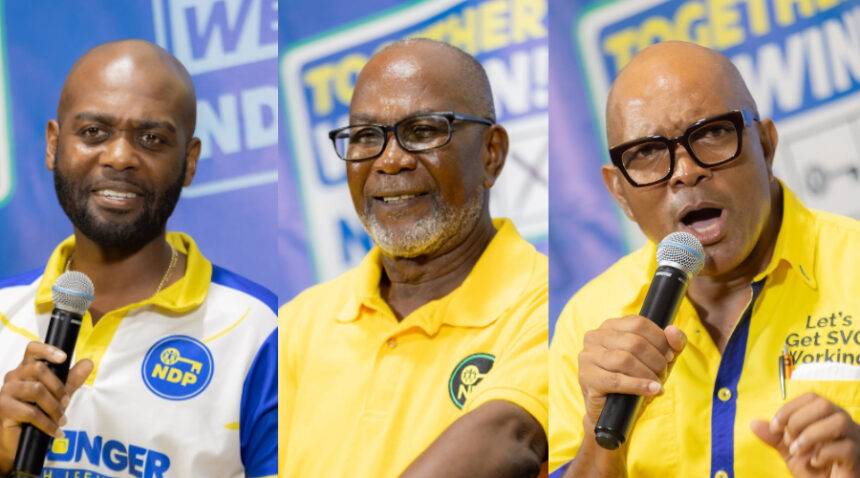
A potential leadership vacuum at the highest levels of the New Democratic Party (NDP) has sparked intense speculation regarding who would step in as the next Prime Minister should Dr. Godwin Friday and Fitz Bramble be disqualified from office.
Discussions on Hot 97.1 SVG highlighted three primary front-runners: Major St Clair Leacock, Dr. Kishore Shallow, and Nigel “Nature” Stephenson.
The political landscape has been unsettled by ongoing questions regarding the citizenship status of current NDP leader Dr. Friday and East Kingstown MP Fitz Bramble.
If the court rules against them, sources suggest they would be disqualified from their seats without triggering a bi-election. In such a scenario, the responsibility of choosing a new leader and by extension, the Prime Minister would fall to the remaining 12 to 14 NDP members of parliament.
Political analysts and party insiders have narrowed the field of potential successors to three distinct figures:
- Major Leacock: Often viewed as the “natural successor,” Leacock represents the party’s established guard. While his experience is a significant asset, some commentators express concern that his long tenure in the opposition may have fostered a degree of bitterness that could affect his leadership.
- Dr. Kishore Shallow: Representing the “young upstart” faction, Shallow is described as ambitious, energetic, and aspirational. Supporters draw parallels between his potential rise and that of youthful world leaders like Barack Obama or Justin Trudeau, though critics point to his relative inexperience as a potential drawback.
- Nigel “Nature” Stephenson : Perhaps the most surprising name in the mix, the “Nature Boy” has emerged as a significant dark horse. Despite a public perception that may not immediately scream “Prime Minister,” Stevenson is reportedly extremely popular within the party’s rank-and-file and is considered a favorite among internal voting members.
The selection process is expected to be a calculated exercise in internal politics rather than a reflection of national popularity. Because the decision rests solely with the parliamentary members, a candidate does not necessarily need to be the “best fit” for the country or even well-liked by the public to secure the position.
“This is a shootout,” one commentator noted, explaining that a candidate only needs to rally five or six fellow members to seize the premiership. This dynamic opens the door for a “wild card” candidate or someone the nation might otherwise consider “unsuitable” or “inexperienced” to take the helm.
While Leacock, Shallow, and Stephenson are the primary names being circulated, other figures like Israel Bruce and Philip Jackson have been mentioned. However, Jackson faces significant hurdles due to perceived unpopularity and “horror stories” circulating within political circles. Meanwhile, veteran politician Mr. Cummings is currently perceived as having little interest in the leadership role at this stage.
As the legal proceedings regarding citizenship continue, the NDP finds itself at a crossroads. The eventual choice will likely depend on whether the party prioritizes veteran stability, youthful charisma, or internal party loyalty to navigate a transition of power that could reshape the country’s future.
