
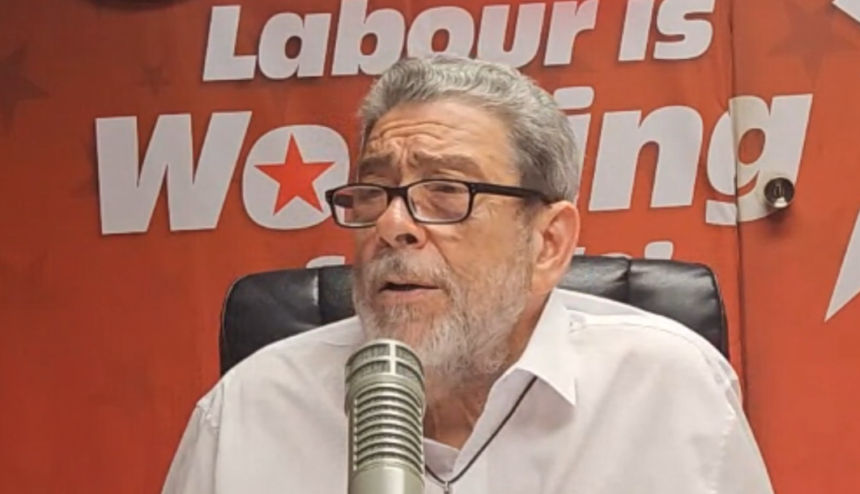
Former Prime Minister and Opposition Leader Dr. Ralph Gonsalves have accused the Democratic Party (NDP) administration of plunging St. Vincent and the Grenadines into severe socio-economic decline and transforming the country into a “nation overwhelmingly of sufferers” within its first year in office.
Speaking on Star FM on Wednesday, Gonsalves charged that while government officials engage in celebratory rhetoric and lengthy ministerial statements—which he characterized by adapting Winston Churchill’s famous line as “never in the history of mankind has so much been said about nothing”—ordinary citizens across every social stratum are enduring severe financial distress, rising living costs, and a near-total collapse of public support systems.
Highlighting the human toll of the economic downturn, Gonsalves stated that while a small upper echelon with substantial savings or established commercial enterprises maintains a level of comfort, even those business owners are growing increasingly alarmed as operating expenses rise while revenues drop. The brunt of the pressure, according to Gonsalves, is falling squarely on the middle class, working people, farmers, fisherfolk, and small business operators. He pointed to middle-class households struggling to keep pace with basic obligations, including mortgages, electricity bills, food costs, and educational expenses for school and university students, compounded by domestic fuel price hikes such as a $1.65 per gallon increase on diesel.
Gonsalves highlighted micro-level indicators of economic stagnation, noting that shopkeepers who previously sold six to seven cases of beer over a single weekend now take up to five weeks to clear the same inventory, while small shop owners have been forced to abandon physical premises to sell items along the roadside. For the poorest, indigent, and marginalized Vincentians, Gonsalves characterized daily life under current policy settings as a “journey into hell on earth.”
Deconstructing the financial figures presented by the government during parliamentary question time, Gonsalves directly challenged the administration’s celebration over a reduced central government deficit. Finance Minister Dr. Godwin Friday had reported an overall fiscal deficit of $26.4 million for the ten-month period ending October, representing a $107.6 million improvement over the $304 million deficit recorded during the same period in the prior year under the Unity Labour Party (ULP) administration.
However, Gonsalves asserted during parliamentary exchanges that this deficit reduction was not achieved through economic growth or fiscal prudence, but rather through a drastic $180 million reduction in capital expenditure. Public capital spending fell from $340.1 million under the ULP to $160.6 million under the NDP. Gonsalves argued that this sharp contraction in public works projects has starved the national economy, forcing construction firms to lay off workers, leaving heavy equipment and transport operators idle, and suppressing broader economic circulation.
Gonsalves further observed that recurrent revenues and grants fell by nearly two to three percent compared to the previous year, noting that the fiscal picture would appear even more precarious had it not been buoyed by one-off asset sales, such as the $53 million realization from the Chattam property.
He also cited persistent pressures on domestic financing, pointing out that government overdraft balances have routinely exceeded $240 million—far above standard statutory limits—due to underlying shortfalls in budgeted revenue collection. Gonsalves argued that by spooking domestic financial markets with inaccurate economic diagnoses and unworkable policy measures, the government has inadvertently raised local borrowing costs and constrained liquidity across the commercial sector.
Contrasting the current economic climate with his administration’s previous developmental trajectory—which relied on United Nations Development Programme (UNDP) metrics targeting high human development and first-world status by 2040—Gonsalves diagnosed the nation as trapped in six interlocking crises spanning fiscal affairs, economic production, social welfare, public safety and crime, governance, and national leadership.
He maintained that masking economic distress with accounting maneuvers in Parliament will not alleviate the daily burdens faced by citizens, pledging to continue exposing the reality behind official financial figures and advocating for policies that restore capital investment, stimulate production, and support vulnerable Vincentians.